6MQY | pdb_00006mqy

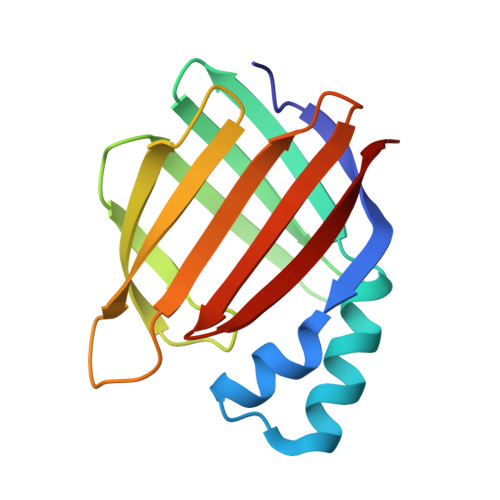
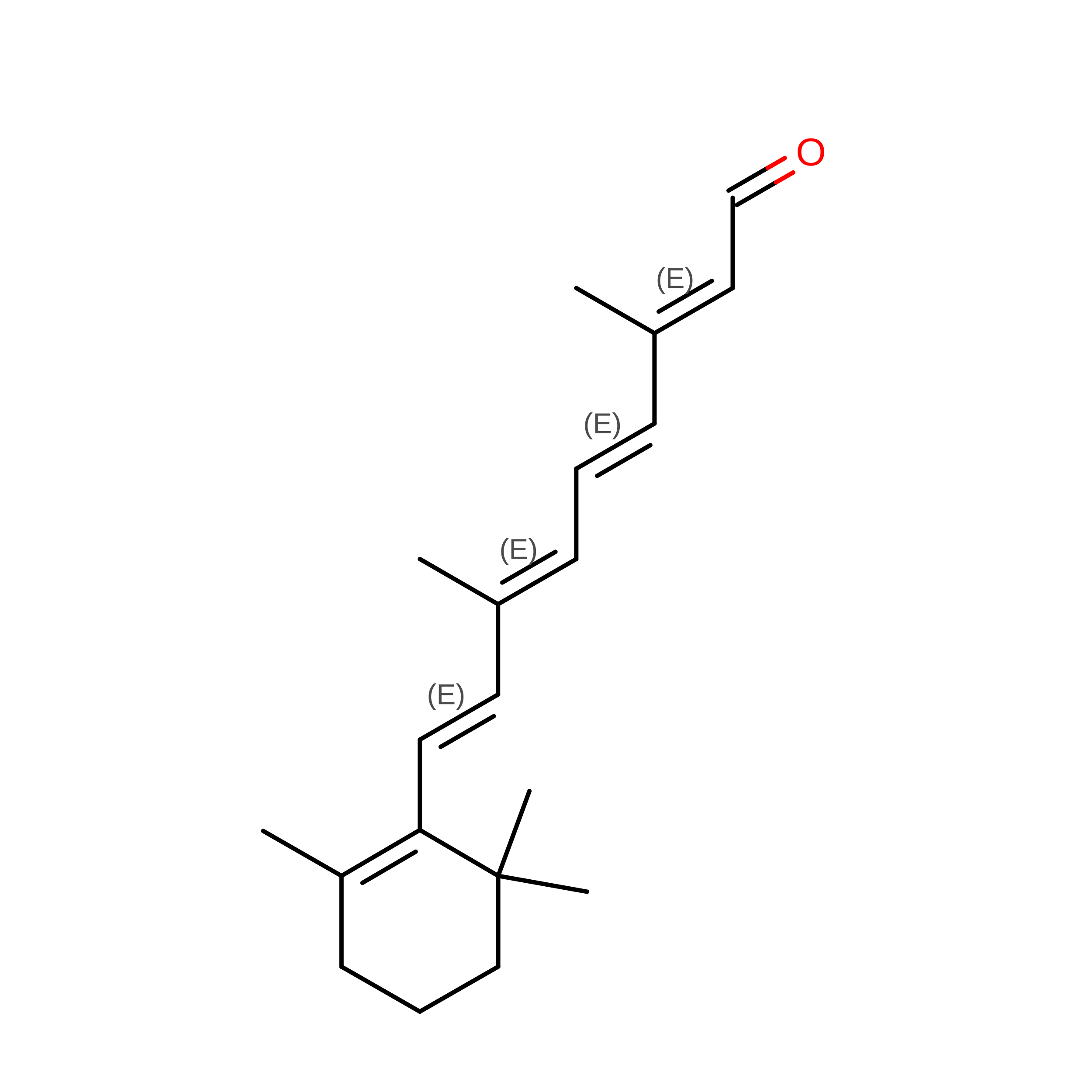
Crystal Structure of the 13-cis Product of All-trans Retinal-Bound R111K:Y134F:T54V:R132Q:P39Y:R59Y:L121E Mutant of Human Cellular Retinoic Acid Binding Protein II Irradiated with 400 nm Laser (30 seconds) at 1.9 Angstrom


Experimental Data Snapshot

  • Method: X-RAY DIFFRACTION
  • Resolution: 1.90 Å
  • R-Value Free: 
    0.217 (Depositor), 0.217 (DCC) 
  • R-Value Work: 
    0.189 (Depositor), 0.191 (DCC) 
  • R-Value Observed: 
    0.191 (Depositor) 

Starting Model: experimental
View more details

wwPDB Validation 3D Report Full Report

Validation slider image for 6MQY

Ligand Structure Quality Assessment 


This is version 1.4 of the entry. See complete history

Literature

Mimicking Microbial Rhodopsin Isomerization in a Single Crystal.

Ghanbarpour, A.Nairat, M.Nosrati, M.Santos, E.M.Vasileiou, C.Dantus, M.Borhan, B.Geiger, J.H.

(2019) J Am Chem Soc 141: 1735-1741

  • DOI: https://doi.org/10.1021/jacs.8b12493
  • Primary Citation Related Structures: 
    6MOP, 6MOQ, 6MOR, 6MOV, 6MOX, 6MPK, 6MQI, 6MQJ, 6MQW, 6MQX, 6MQY, 6MQZ, 6MR0

  • PubMed Abstract: 

    Bacteriorhodopsin represents the simplest, and possibly most abundant, phototropic system requiring only a retinal-bound transmembrane protein to convert photons of light to an energy-generating proton gradient. The creation and interrogation of a microbial rhodopsin mimic, based on an orthogonal protein system, would illuminate the design elements required to generate new photoactive proteins with novel function. We describe a microbial rhodopsin mimic, created using a small soluble protein as a template, that specifically photoisomerizes all- trans to 13- cis retinal followed by thermal relaxation to the all- trans isomer, mimicking the bacteriorhodopsin photocycle, in a single crystal. The key element for selective isomerization is a tuned steric interaction between the chromophore and protein, similar to that seen in the microbial rhodopsins. It is further demonstrated that a single mutation converts the system to a protein photoswitch without chromophore photoisomerization or conformational change.


  • Organizational Affiliation
    • Michigan State University , Department of Chemistry , East Lansing , Michigan 48824 , United States.

Macromolecule Content 

  • Total Structure Weight: 16.16 kDa 
  • Atom Count: 1,188 
  • Modeled Residue Count: 137 
  • Deposited Residue Count: 137 
  • Unique protein chains: 1

Macromolecules

Find similar proteins by:|  3D Structure
Entity ID: 1
MoleculeChains  Sequence LengthOrganismDetailsImage
Cellular retinoic acid-binding protein 2137Homo sapiensMutation(s): 7 
Gene Names: CRABP2
UniProt & NIH Common Fund Data Resources
Find proteins for P29373 (Homo sapiens)
Explore P29373 
Go to UniProtKB:  P29373
PHAROS:  P29373
GTEx:  ENSG00000143320 
Entity Groups
Sequence Clusters30% Identity50% Identity70% Identity90% Identity95% Identity100% Identity
UniProt GroupP29373
Sequence Annotations
Expand
Reference Sequence

Experimental Data & Validation

Experimental Data

  • Method: X-RAY DIFFRACTION
  • Resolution: 1.90 Å
  • R-Value Free:  0.217 (Depositor), 0.217 (DCC) 
  • R-Value Work:  0.189 (Depositor), 0.191 (DCC) 
  • R-Value Observed: 0.191 (Depositor) 
Space Group: P 31 2 1
Unit Cell:
Length ( Å )Angle ( ˚ )
a = 58.343α = 90
b = 58.343β = 90
c = 99.865γ = 120
Software Package:
Software NamePurpose
PHENIXrefinement
HKL-2000data reduction
HKL-2000data scaling
PHASERphasing

Structure Validation

View Full Validation Report


Ligand Structure Quality Assessment 


Entry History 

& Funding Information

Deposition Data


Funding OrganizationLocationGrant Number
National Institutes of Health/National Human Genome Research Institute (NIH/NHGRI)United States--

Revision History  (Full details and data files)

  • Version 1.0: 2019-01-09
    Type: Initial release
  • Version 1.1: 2019-02-13
    Changes: Data collection, Database references
  • Version 1.2: 2019-12-18
    Changes: Author supporting evidence
  • Version 1.3: 2023-10-11
    Changes: Advisory, Data collection, Database references, Refinement description
  • Version 1.4: 2024-10-23
    Changes: Structure summary