6MCD | pdb_00006mcd

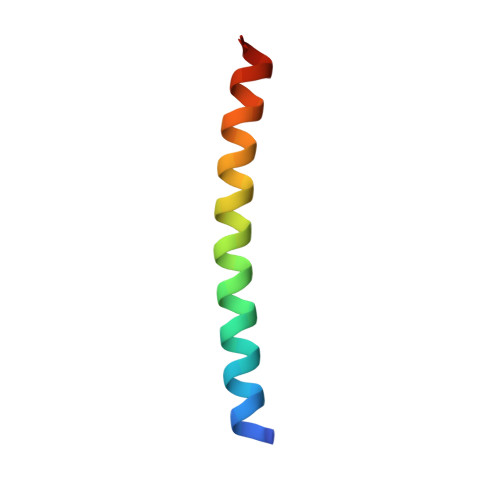
Crystal Structure of tris-thiolate Pb(II) complex with adjacent water in a de novo Three Stranded Coiled Coil Peptide


Experimental Data Snapshot

  • Method: X-RAY DIFFRACTION
  • Resolution: 1.50 Å
  • R-Value Free: 
    0.206 (Depositor), 0.221 (DCC) 
  • R-Value Work: 
    0.206 (Depositor), 0.198 (DCC) 
  • R-Value Observed: 
    0.206 (Depositor) 

Starting Model: experimental
View more details

wwPDB Validation 3D Report Full Report

Validation slider image for 6MCD

This is version 1.4 of the entry. See complete history

Literature

Heteromeric three-stranded coiled coils designed using a Pb(II)(Cys)3template mediated strategy.

Tolbert, A.E.Ervin, C.S.Ruckthong, L.Paul, T.J.Jayasinghe-Arachchige, V.M.Neupane, K.P.Stuckey, J.A.Prabhakar, R.Pecoraro, V.L.

(2020) Nat Chem 12: 405-411

  • DOI: https://doi.org/10.1038/s41557-020-0423-6
  • Primary Citation Related Structures: 
    6MCD

  • PubMed Abstract: 

    Three-stranded coiled coils are peptide structures constructed from amphipathic heptad repeats. Here we show that it is possible to form pure heterotrimeric three-stranded coiled coils by combining three distinct characteristics: (1) a cysteine sulfur layer for metal coordination, (2) a thiophilic, trigonal pyramidal metalloid (Pb(II)) that binds to these sulfurs and (3) an adjacent layer of reduced steric bulk generating a cavity where water can hydrogen bond to the cysteine sulfur atoms. Cysteine substitution in an a site yields Pb(II)A 2 B heterotrimers, while d sites provide pure Pb(II)C 2 D or Pb(II)CD 2 scaffolds. Altering the metal from Pb(II) to Hg(II) or shifting the relative position of the sterically less demanding layer removes heterotrimer specificity. Because only two of the eight or ten hydrophobic layers are perturbed, catalytic sites can be introduced at other regions of the scaffold. A Zn(II)(histidine) 3 (H 2 O) centre can be incorporated at a remote location without perturbing the heterotrimer selectivity, suggesting a unique strategy to prepare dissymmetric catalytic sites within self-assembling de novo-designed proteins.


  • Organizational Affiliation
    • Department of Chemistry, University of Michigan, Ann Arbor, MI, USA.

Macromolecule Content 

  • Total Structure Weight: 4.37 kDa 
  • Atom Count: 338 
  • Modeled Residue Count: 37 
  • Deposited Residue Count: 38 
  • Unique protein chains: 1

Macromolecules

Find similar proteins by:|  3D Structure
Entity ID: 1
MoleculeChains  Sequence LengthOrganismDetailsImage
Pb(II)(GRAND Coil Ser L12CL16A)-38synthetic constructMutation(s): 0 

Experimental Data & Validation

Experimental Data

  • Method: X-RAY DIFFRACTION
  • Resolution: 1.50 Å
  • R-Value Free:  0.206 (Depositor), 0.221 (DCC) 
  • R-Value Work:  0.206 (Depositor), 0.198 (DCC) 
  • R-Value Observed: 0.206 (Depositor) 
Space Group: H 3 2
Unit Cell:
Length ( Å )Angle ( ˚ )
a = 38.304α = 90
b = 38.304β = 90
c = 141.141γ = 120
Software Package:
Software NamePurpose
REFMACrefinement
HKL-2000data reduction
HKL-2000data scaling
MOLREPphasing
PDB_EXTRACTdata extraction

Structure Validation

View Full Validation Report


Entry History 

& Funding Information

Deposition Data


Funding OrganizationLocationGrant Number
National Institutes of Health/National Institute of Environmental Health Sciences (NIH/NIEHS)United StatesR01 ES012236

Revision History  (Full details and data files)

  • Version 1.0: 2020-03-04
    Type: Initial release
  • Version 1.1: 2020-03-18
    Changes: Database references
  • Version 1.2: 2020-04-15
    Changes: Database references
  • Version 1.3: 2023-10-11
    Changes: Data collection, Database references, Derived calculations, Refinement description
  • Version 1.4: 2024-11-20
    Changes: Structure summary