6M5M | pdb_00006m5m

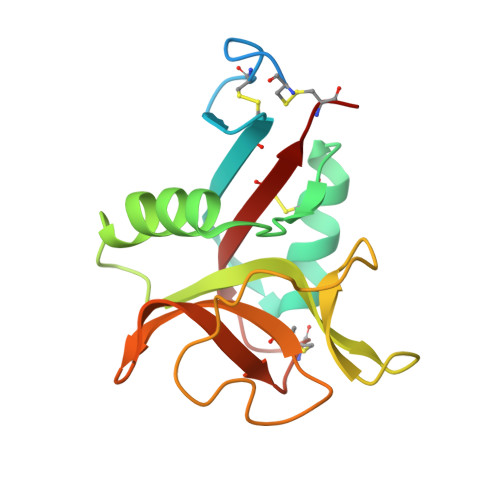
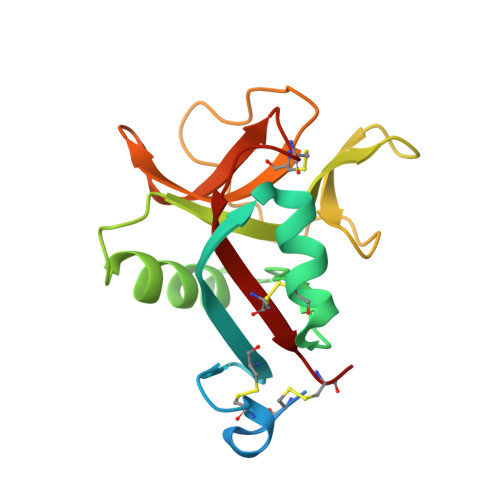
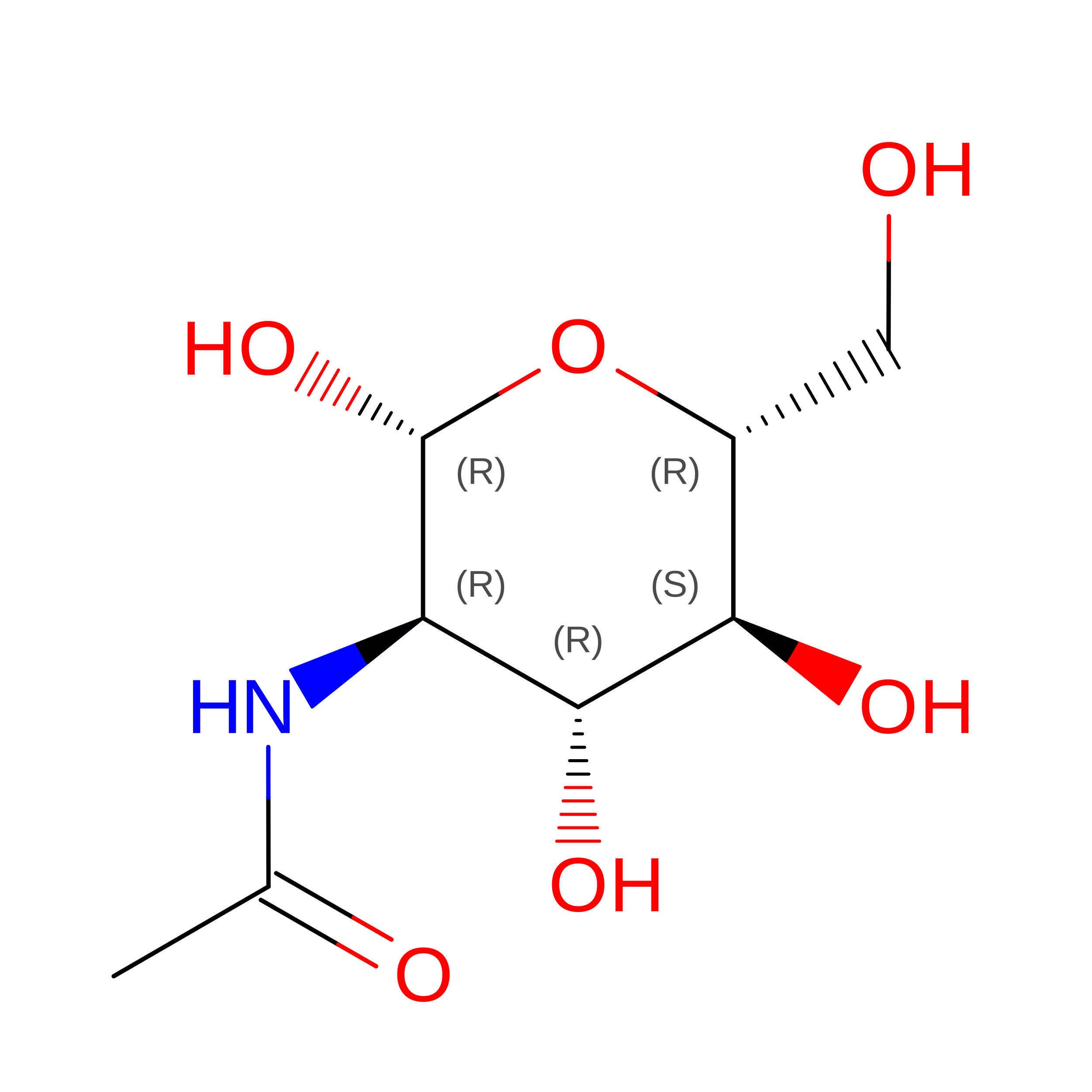
SPL-1 - GlcNAc complex


Experimental Data Snapshot

  • Method: X-RAY DIFFRACTION
  • Resolution: 1.70 Å
  • R-Value Free: 
    0.216 (Depositor), 0.216 (DCC) 
  • R-Value Work: 
    0.203 (Depositor), 0.208 (DCC) 
  • R-Value Observed: 
    0.204 (Depositor) 

Starting Model: experimental
View more details

wwPDB Validation 3D Report Full Report

Validation slider image for 6M5M

Ligand Structure Quality Assessment 


This is version 1.4 of the entry. See complete history

Literature

Novel carbohydrate-recognition mode of the invertebrate C-type lectin SPL-1 from Saxidomus purpuratus revealed by the GlcNAc-complex crystal in the presence of Ca2.

Unno, H.Higuchi, S.Goda, S.Hatakeyama, T.

(2020) Acta Crystallogr F Struct Biol Commun 76: 271-277

  • DOI: https://doi.org/10.1107/S2053230X20007256
  • Primary Citation Related Structures: 
    6M5M

  • PubMed Abstract: 

    The C-type lectins SPL-1 and SPL-2 from the bivalve Saxidomus purpuratus are composed of A and B chains and of two B chains, respectively. They bind specific carbohydrates containing acetamido groups, such as N-acetylglucosamine (GlcNAc) and N-acetylgalactosamine (GalNAc), in a Ca 2+ -independent manner. Unlike ordinary C-type lectins, which require Ca 2+ ions for carbohydrate recognition, these lectins recognize specific carbohydrates mainly through interactions with the acetamido group without Ca 2+ ions, even though Ca 2+ enhances the binding affinity of these lectins, especially SPL-1. In the present study, the crystal structure of the SPL-1-GlcNAc complex in the presence of Ca 2+ revealed that the binding of SPL-1 to GlcNAc is stabilized by hydrogen bonds to the water molecule(s) coordinating Ca 2+ , whereas in ordinary C-type lectins Ca 2+ directly forms coordinate bonds to the hydroxy groups of carbohydrates. These differences may also allow SPL-1 and SPL-2 to recognize both GlcNAc and GalNAc, which have different orientations of the 4-hydroxy group.


  • Organizational Affiliation
    • Biomolecular Chemistry Laboratory, Graduate School of Engineering, Nagasaki University, 1-14 Bunkyo-machi, Nagasaki 852-8521, Japan.

Macromolecule Content 

  • Total Structure Weight: 36.48 kDa 
  • Atom Count: 2,366 
  • Modeled Residue Count: 273 
  • Deposited Residue Count: 317 
  • Unique protein chains: 2

Macromolecules

Find similar proteins by:|  3D Structure
Entity ID: 1
MoleculeChains  Sequence LengthOrganismDetailsImage
N-acetylglucosamine-specific lectin158Saxidomus purpurataMutation(s): 0 
UniProt
Find proteins for A0A2Z6G7U6 (Saxidomus purpurata)
Explore A0A2Z6G7U6 
Go to UniProtKB:  A0A2Z6G7U6
Entity Groups
Sequence Clusters30% Identity50% Identity70% Identity90% Identity95% Identity100% Identity
UniProt GroupA0A2Z6G7U6
Sequence Annotations
Expand
Reference Sequence
Find similar proteins by:|  3D Structure
Entity ID: 2
MoleculeChains  Sequence LengthOrganismDetailsImage
N-acetylglucosamine-specific lectin159Saxidomus purpurataMutation(s): 0 
UniProt
Find proteins for A0A2Z6G7U3 (Saxidomus purpurata)
Explore A0A2Z6G7U3 
Go to UniProtKB:  A0A2Z6G7U3
Entity Groups
Sequence Clusters30% Identity50% Identity70% Identity90% Identity95% Identity100% Identity
UniProt GroupA0A2Z6G7U3
Sequence Annotations
Expand
Reference Sequence

Experimental Data & Validation

Experimental Data

  • Method: X-RAY DIFFRACTION
  • Resolution: 1.70 Å
  • R-Value Free:  0.216 (Depositor), 0.216 (DCC) 
  • R-Value Work:  0.203 (Depositor), 0.208 (DCC) 
  • R-Value Observed: 0.204 (Depositor) 
Space Group: P 65
Unit Cell:
Length ( Å )Angle ( ˚ )
a = 44.46α = 90
b = 44.46β = 90
c = 303.613γ = 120
Software Package:
Software NamePurpose
Aimlessdata scaling
REFMACrefinement
PDB_EXTRACTdata extraction
XDSdata reduction
PHASERphasing

Structure Validation

View Full Validation Report


Ligand Structure Quality Assessment 


Entry History 

Deposition Data

Revision History  (Full details and data files)

  • Version 1.0: 2020-06-10
    Type: Initial release
  • Version 1.1: 2020-07-08
    Changes: Database references
  • Version 1.2: 2020-07-29
    Type: Remediation
    Reason: Carbohydrate remediation
    Changes: Data collection, Derived calculations, Structure summary
  • Version 1.3: 2023-11-29
    Changes: Data collection, Database references, Refinement description, Structure summary
  • Version 1.4: 2024-10-30
    Changes: Structure summary