6LNZ | pdb_00006lnz

NMR solution structure of VEGF G-quadruplex bound a non-planar cyclometalated-carbene platinum(II) complex

  • Classification: DNA
  • Organism(s): Homo sapiens
  • Mutation(s): No 

  • Deposited: 2020-01-02 Released: 2021-01-13 
  • Deposition Author(s): Liu, W., Zhu, B.Z., Mao, Z.W.
  • Funding Organization(s): National Natural Science Foundation of China (NSFC)

Experimental Data Snapshot

  • Method: SOLUTION NMR
  • Conformers Calculated: 100 
  • Conformers Submitted: 15 
  • Selection Criteria: structures with the lowest energy 

wwPDB Validation 3D Report Full Report

Validation slider image for 6LNZ

This is version 1.2 of the entry. See complete history

Literature

Selectivity and Targeting of G-Quadruplex Binders Activated by Adaptive Binding and Controlled by Chemical Kinetics.

Zhu, B.C.He, J.Liu, W.Xia, X.Y.Liu, L.Y.Liang, B.B.Yao, H.G.Liu, B.Ji, L.N.Mao, Z.W.

(2021) Angew Chem Int Ed Engl 60: 15340-15343

  • DOI: https://doi.org/10.1002/anie.202104624
  • Primary Citation Related Structures: 
    6LNZ

  • PubMed Abstract: 

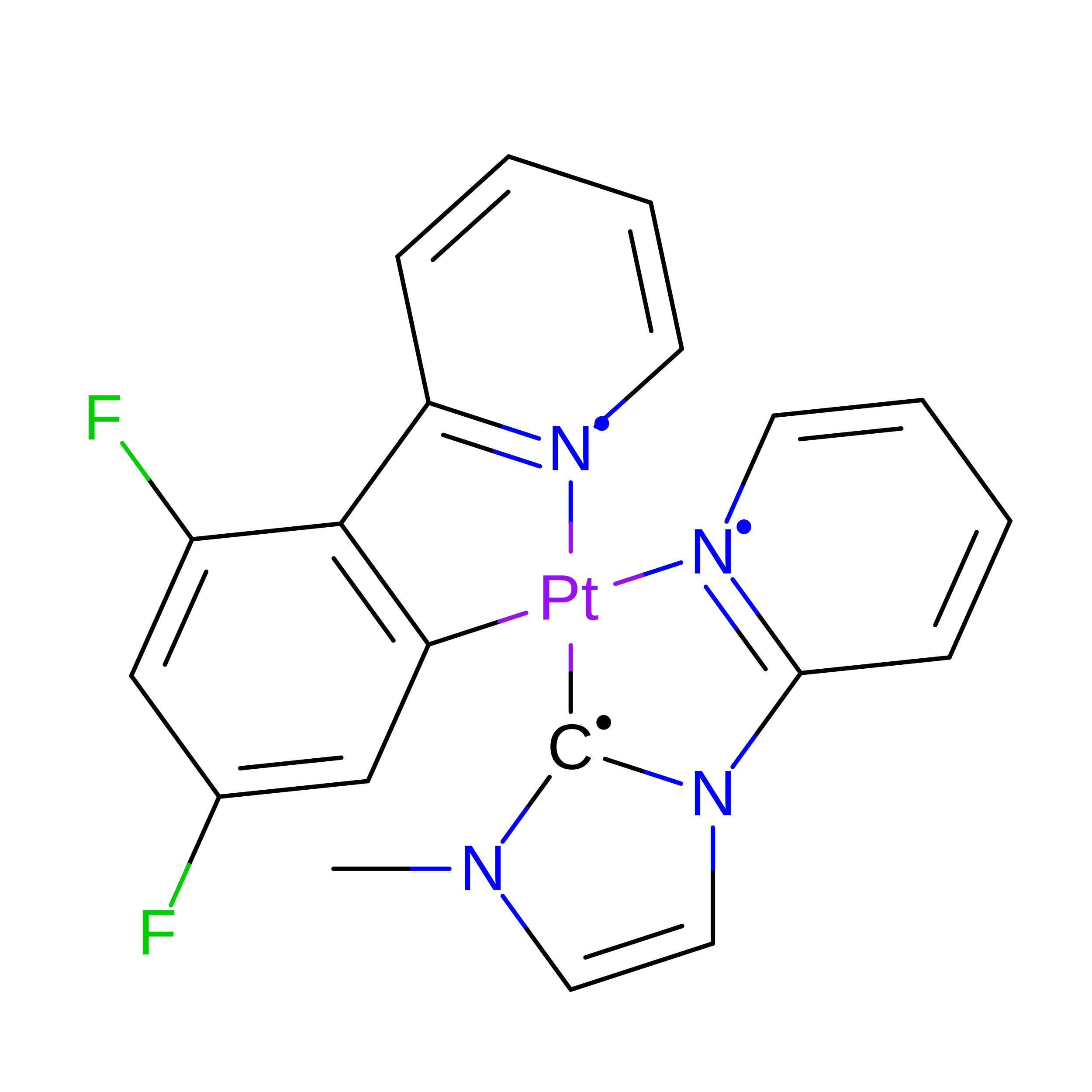
    G-quadruplexes (G4s) are prevalent in oncogenes and are potential antitumor drug targets. However, binding selectivity of compounds to G4s still faces challenges. Herein, we report a platinum(II) complex (Pt1), whose affinity to G4-DNA is activated by adaptive binding and selectivity controlled by binding kinetics. The resolved structure of Pt1/VEGF-G4 (a promoter G4) shows that Pt1 matches 3'-G-tetrad of VEGF-G4 through Cl - -dissociation and loop rearrangement of VEGF-G4. Binding rate constants are determined by coordination bond breakage/formation, correlating fully with affinities. The selective rate-determining binding step, Cl - -dissociation upon G4-binding, is 2-3 orders of magnitude higher than dsDNA. Pt1 potently targets G4 in living cells, effectively represses VEGF expression, and inhibits vascular growth in zebrafish. We show adaptive G4-binding activation and controlled by kinetics, providing a complementary design principle for compounds targeting G4 or similar biomolecules.


  • Organizational Affiliation
    • MOE Key Laboratory of Bioinorganic and Synthetic Chemistry, School of Chemistry, State Key Laboratory of Oncology in South China, Sun Yat-Sen University, No. 135, Xingang Xi Road, 510275, Guangzhou, China.

Macromolecule Content 

  • Total Structure Weight: 7.47 kDa 
  • Atom Count: 487 
  • Modeled Residue Count: 22 
  • Deposited Residue Count: 22 
  • Unique nucleic acid chains: 1

Macromolecules

Find similar nucleic acids by:  Sequence
Entity ID: 1
MoleculeChains LengthOrganismImage
DNA (5'-D(*CP*GP*GP*GP*GP*CP*GP*GP*GP*CP*CP*TP*TP*GP*GP*GP*CP*GP*GP*GP*GP*T)-3')22Homo sapiens
Sequence Annotations
Expand
Reference Sequence

Small Molecules

Ligands 1 Unique
IDChains Name / Formula / InChI Key2D Diagram3D Interactions
EL9
(Subject of Investigation/LOI)

Query on EL9


Download:Ideal Coordinates CCD File
B [auth A]cyclometalated-carbene platinum(II) complex
C20 H15 F2 N4 Pt
MSOPGFNQFJYXDN-UHFFFAOYSA-N

Experimental Data & Validation

Experimental Data

  • Method: SOLUTION NMR
  • Conformers Calculated: 100 
  • Conformers Submitted: 15 
  • Selection Criteria: structures with the lowest energy 

Structure Validation

View Full Validation Report


Entry History 

& Funding Information

Deposition Data


Funding OrganizationLocationGrant Number
National Natural Science Foundation of China (NSFC)China21837006

Revision History  (Full details and data files)

  • Version 1.0: 2021-01-13
    Type: Initial release
  • Version 1.1: 2021-08-04
    Changes: Database references
  • Version 1.2: 2024-05-01
    Changes: Data collection, Database references