Download Mendeley
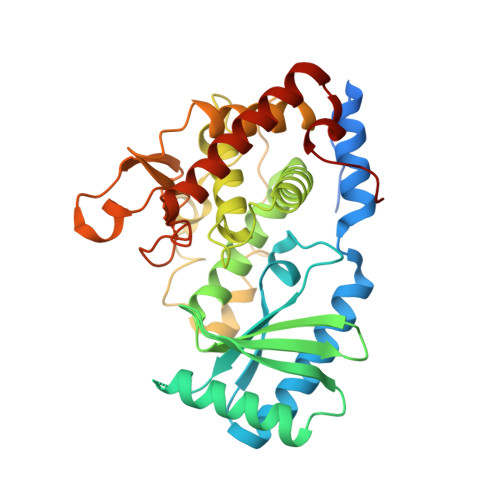
Structures of mammalian GLD-2 proteins reveal molecular basis of their functional diversity in mRNA and microRNA processing.
Ma, X.Y., Zhang, H., Feng, J.X., Hu, J.L., Yu, B., Luo, L., Cao, Y.L., Liao, S., Wang, J., Gao, S.(2020) Nucleic Acids Res 48: 8782-8795
- PubMed: 32633758 Search on PubMedSearch on PubMed Central
- DOI: https://doi.org/10.1093/nar/gkaa578
- Primary Citation Related Structures:
6LBJ, 6LBK - PubMed Abstract:
The stability and processing of cellular RNA transcripts are efficiently controlled via non-templated addition of single or multiple nucleotides, which is catalyzed by various nucleotidyltransferases including poly(A) polymerases (PAPs). Germline development defective 2 (GLD-2) is among the first reported cytoplasmic non-canonical PAPs that promotes the translation of germline-specific mRNAs by extending their short poly(A) tails in metazoan, such as Caenorhabditis elegans and Xenopus. On the other hand, the function of mammalian GLD-2 seems more diverse, which includes monoadenylation of certain microRNAs. To understand the structural basis that underlies the difference between mammalian and non-mammalian GLD-2 proteins, we determine crystal structures of two rodent GLD-2s. Different from C. elegans GLD-2, mammalian GLD-2 is an intrinsically robust PAP with an extensively positively charged surface. Rodent and C. elegans GLD-2s have a topological difference in the β-sheet region of the central domain. Whereas C. elegans GLD-2 prefers adenosine-rich RNA substrates, mammalian GLD-2 can work on RNA oligos with various sequences. Coincident with its activity on microRNAs, mammalian GLD-2 structurally resembles the mRNA and miRNA processor terminal uridylyltransferase 7 (TUT7). Our study reveals how GLD-2 structurally evolves to a more versatile nucleotidyltransferase, and provides important clues in understanding its biological function in mammals.
- State Key Laboratory of Oncology in South China, Collaborative Innovation Center for Cancer Medicine, Sun Yat-sen University Cancer Center, Guangzhou, Guangdong 510060, China.
Organizational Affiliation: