6KYW | pdb_00006kyw

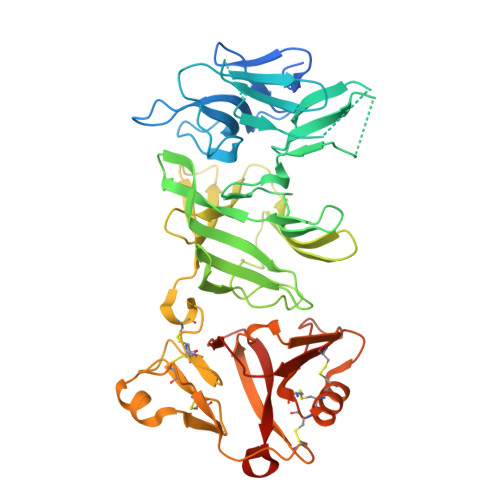
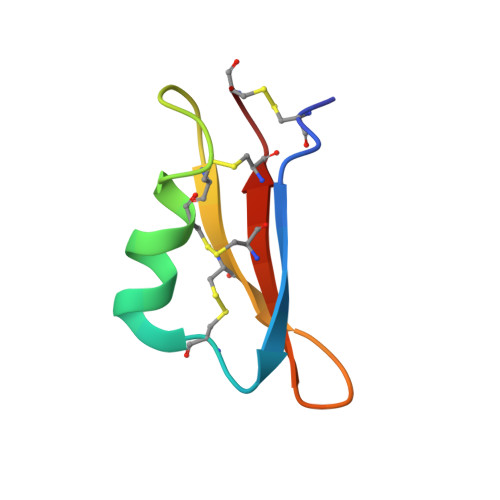
S8-mSRK-S8-SP11 complex


Experimental Data Snapshot

  • Method: X-RAY DIFFRACTION
  • Resolution: 2.60 Å
  • R-Value Free: 
    0.251 (Depositor), 0.254 (DCC) 
  • R-Value Work: 
    0.220 (Depositor), 0.222 (DCC) 
  • R-Value Observed: 
    0.221 (Depositor) 

wwPDB Validation 3D Report Full Report

Validation slider image for 6KYW

Ligand Structure Quality Assessment 


This is version 1.3 of the entry. See complete history

Literature

Mechanism of self/nonself-discrimination in Brassica self-incompatibility.

Murase, K.Moriwaki, Y.Mori, T.Liu, X.Masaka, C.Takada, Y.Maesaki, R.Mishima, M.Fujii, S.Hirano, Y.Kawabe, Z.Nagata, K.Terada, T.Suzuki, G.Watanabe, M.Shimizu, K.Hakoshima, T.Takayama, S.

(2020) Nat Commun 11: 4916-4916

  • DOI: https://doi.org/10.1038/s41467-020-18698-w
  • Primary Citation Related Structures: 
    6KYW

  • PubMed Abstract: 

    Self-incompatibility (SI) is a breeding system that promotes cross-fertilization. In Brassica, pollen rejection is induced by a haplotype-specific interaction between pistil determinant SRK (S receptor kinase) and pollen determinant SP11 (S-locus Protein 11, also named SCR) from the S-locus. Although the structure of the B. rapa S 9 -SRK ectodomain (eSRK) and S 9 -SP11 complex has been determined, it remains unclear how SRK discriminates self- and nonself-SP11. Here, we uncover the detailed mechanism of self/nonself-discrimination in Brassica SI by determining the S 8 -eSRK-S 8 -SP11 crystal structure and performing molecular dynamics (MD) simulations. Comprehensive binding analysis of eSRK and SP11 structures reveals that the binding free energies are most stable for cognate eSRK-SP11 combinations. Residue-based contribution analysis suggests that the modes of eSRK-SP11 interactions differ between intra- and inter-subgroup (a group of phylogenetically neighboring haplotypes) combinations. Our data establish a model of self/nonself-discrimination in Brassica SI.


  • Organizational Affiliation
    • Department of Applied Biological Chemistry, Graduate School of Agricultural and Life Sciences, The University of Tokyo, Tokyo, 113-8657, Japan.

Macromolecule Content 

  • Total Structure Weight: 112.62 kDa 
  • Atom Count: 7,006 
  • Modeled Residue Count: 867 
  • Deposited Residue Count: 978 
  • Unique protein chains: 2

Macromolecules

Find similar proteins by:|  3D Structure
Entity ID: 1
MoleculeChains  Sequence LengthOrganismDetailsImage
Receptor protein kinase SRK8
A, B
443Brassica rapaMutation(s): 12 
EC: 2.7.11.1
UniProt
Find proteins for Q39276 (Brassica campestris)
Explore Q39276 
Go to UniProtKB:  Q39276
Entity Groups
Sequence Clusters30% Identity50% Identity70% Identity90% Identity95% Identity100% Identity
UniProt GroupQ39276
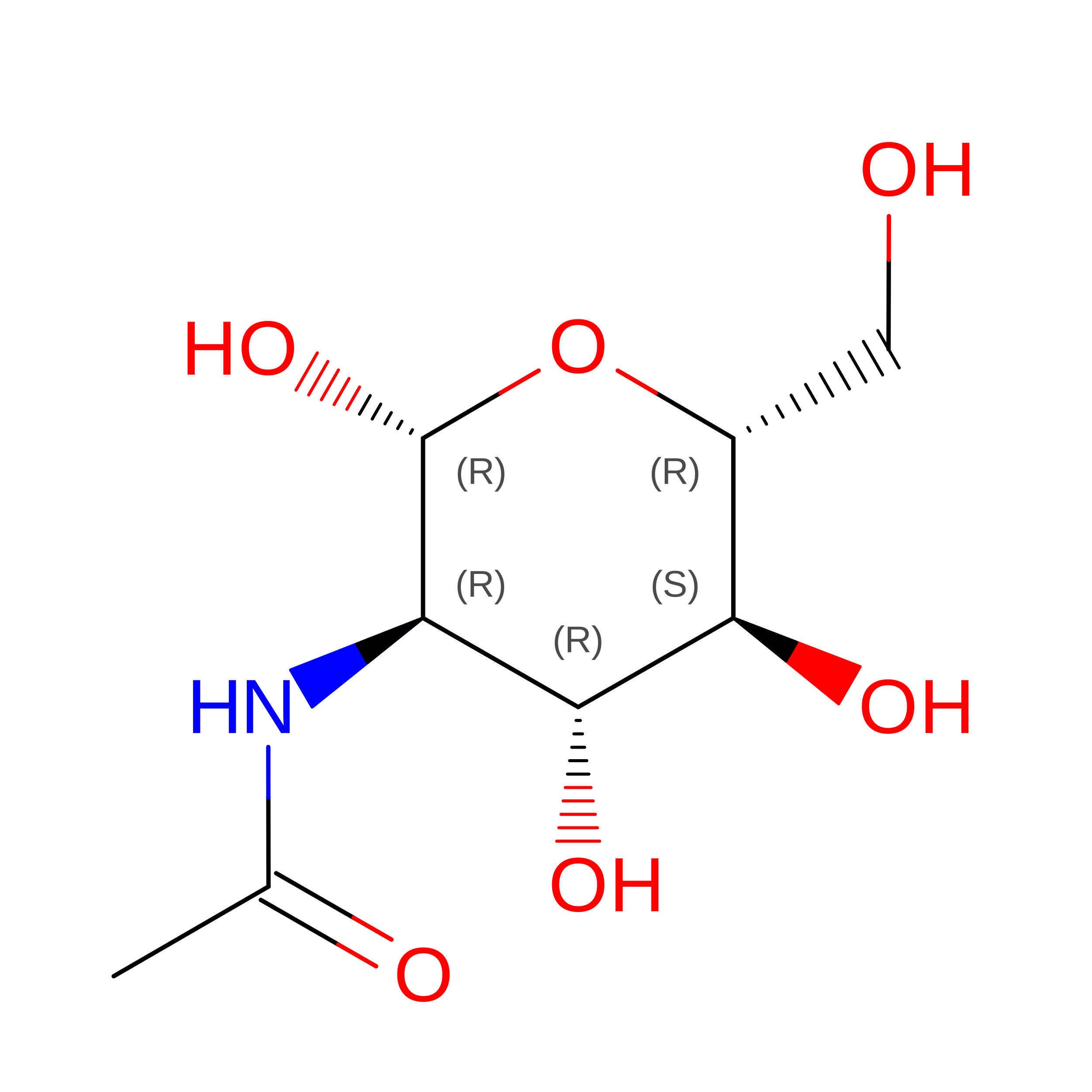
Glycosylation
Glycosylation Sites: 2
Sequence Annotations
Expand
Reference Sequence
Find similar proteins by:|  3D Structure
Entity ID: 2
MoleculeChains  Sequence LengthOrganismDetailsImage
S locus protein 11
C, D
46Brassica rapaMutation(s): 0 
UniProt
Find proteins for Q9SE17 (Brassica campestris)
Explore Q9SE17 
Go to UniProtKB:  Q9SE17
Entity Groups
Sequence Clusters30% Identity50% Identity70% Identity90% Identity95% Identity100% Identity
UniProt GroupQ9SE17
Sequence Annotations
Expand
Reference Sequence

Experimental Data & Validation

Experimental Data

  • Method: X-RAY DIFFRACTION
  • Resolution: 2.60 Å
  • R-Value Free:  0.251 (Depositor), 0.254 (DCC) 
  • R-Value Work:  0.220 (Depositor), 0.222 (DCC) 
  • R-Value Observed: 0.221 (Depositor) 
Space Group: P 41 21 2
Unit Cell:
Length ( Å )Angle ( ˚ )
a = 143.562α = 90
b = 143.562β = 90
c = 194.401γ = 90
Software Package:
Software NamePurpose
PHENIXrefinement
HKL-2000data reduction
HKL-2000data scaling
AutoSolphasing

Structure Validation

View Full Validation Report


Ligand Structure Quality Assessment 


Entry History 

& Funding Information

Deposition Data


Funding OrganizationLocationGrant Number
Japan Society for the Promotion of ScienceJapan16H06380
Japan Society for the Promotion of ScienceJapan15K18683

Revision History  (Full details and data files)

  • Version 1.0: 2020-09-16
    Type: Initial release
  • Version 1.1: 2020-10-14
    Changes: Database references
  • Version 1.2: 2020-10-21
    Changes: Database references
  • Version 1.3: 2024-11-20
    Changes: Data collection, Database references, Structure summary