6KFJ | pdb_00006kfj

NMR solution structure of the 1:1 complex of wtTel26 G-quadruplex and a tripodal cationic fluorescent probe NBTE

  • Classification: DNA
  • Organism(s): Homo sapiens
  • Mutation(s): No 

  • Deposited: 2019-07-07 Released: 2020-07-01 
  • Deposition Author(s): Liu, W., Liu, L.Y., Mao, Z.W.
  • Funding Organization(s): National Science Foundation (China)

Experimental Data Snapshot

  • Method: SOLUTION NMR
  • Conformers Calculated: 100 
  • Conformers Submitted: 15 
  • Selection Criteria: structures with the lowest energy 

wwPDB Validation 3D Report Full Report

Validation slider image for 6KFJ

This is version 1.3 of the entry. See complete history. 

Literature

Quantitative Detection of G-Quadruplex DNA in Live Cells Based on Photon Counts and Complex Structure Discrimination.

Liu, L.Y., Liu, W., Wang, K.N., Zhu, B.C., Xia, X.Y., Ji, L.N., Mao, Z.W.

(2020) Angew Chem Int Ed Engl 59: 9719-9726

  • DOI: https://doi.org/10.1002/anie.202002422
  • Primary Citation Related Structures: 
    6KFI, 6KFJ

  • PubMed Abstract: 

    G-quadruplex DNA show structural polymorphism, leading to challenges in the use of selective recognition probes for the accurate detection of G-quadruplexes in vivo. Herein, we present a tripodal cationic fluorescent probe, NBTE, which showed distinguishable fluorescence lifetime responses between G-quadruplexes and other DNA topologies, and fluorescence quantum yield (Φ f ) enhancement upon G-quadruplex binding. We determined two NBTE-G-quadruplex complex structures with high Φ f values by NMR spectroscopy. The structures indicated NBTE interacted with G-quadruplexes using three arms through π-π stacking, differing from that with duplex DNA using two arms, which rationalized the higher Φ f values and lifetime response of NBTE upon G-quadruplex binding. Based on photon counts of FLIM, we detected the percentage of G-quadruplex DNA in live cells with NBTE and found G-quadruplex DNA content in cancer cells is 4-fold that in normal cells, suggesting the potential applications of this probe in cancer cell detection.


  • Organizational Affiliation: 
    • MOE Key Laboratory of Bioinorganic and Synthetic Chemistry, School of Chemistry, Sun Yat-Sen University, Guangzhou, 510275, P. R. China.

Macromolecule Content 

  • Total Structure Weight: 8.76 kDa 
  • Atom Count: 588 
  • Modeled Residue Count: 26 
  • Deposited Residue Count: 26 
  • Unique nucleic acid chains: 1

Macromolecules

Find similar nucleic acids by:  (by identity cutoff) 
Entity ID: 1
MoleculeChains LengthOrganismImage
G-quadruplex DNA wtTel2626Homo sapiens
Sequence Annotations
Expand
Reference Sequence

Small Molecules

Ligands 1 Unique
IDChains Name / Formula / InChI Key2D Diagram3D Interactions
D6F

Query on D6F


Download:Ideal Coordinates CCD File
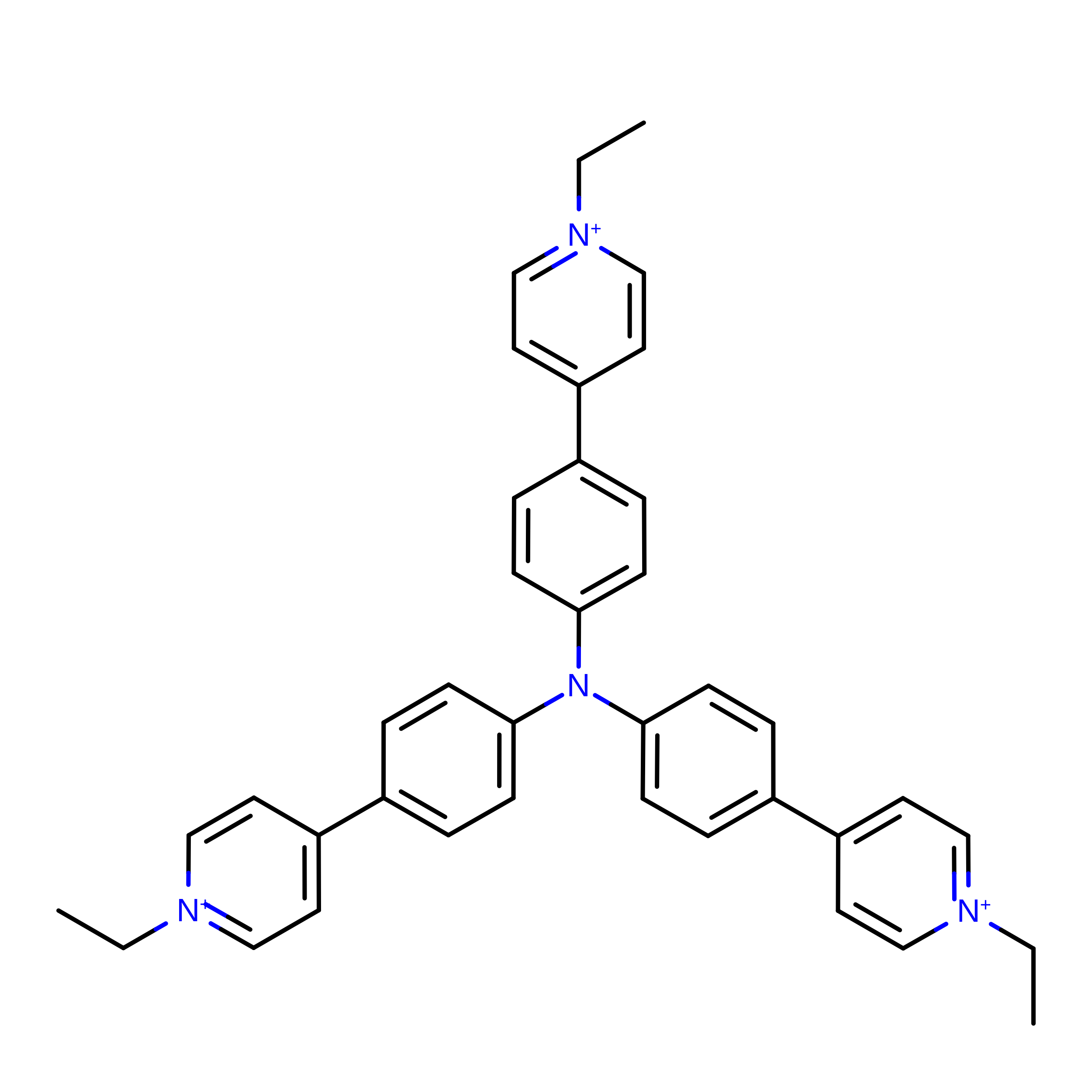
B [auth A]4,4',4''-(nitrilotris(benzene-4,1-diyl))tris(1-ethylpyridin-1-ium) iodide
C39 H39 N4
GYPMVNLFLRHFFL-UHFFFAOYSA-N

Experimental Data & Validation

Experimental Data

  • Method: SOLUTION NMR
  • Conformers Calculated: 100 
  • Conformers Submitted: 15 
  • Selection Criteria: structures with the lowest energy 

Structure Validation

View Full Validation Report


Entry History 

& Funding Information

Deposition Data


Funding OrganizationLocationGrant Number
National Science Foundation (China)China21837006

Revision History  (Full details and data files)

  • Version 1.0: 2020-07-01
    Type: Initial release
  • Version 1.1: 2020-09-23
    Changes: Database references
  • Version 1.2: 2023-06-14
    Changes: Database references, Other
  • Version 1.3: 2024-05-15
    Changes: Data collection, Database references