6J14 | pdb_00006j14

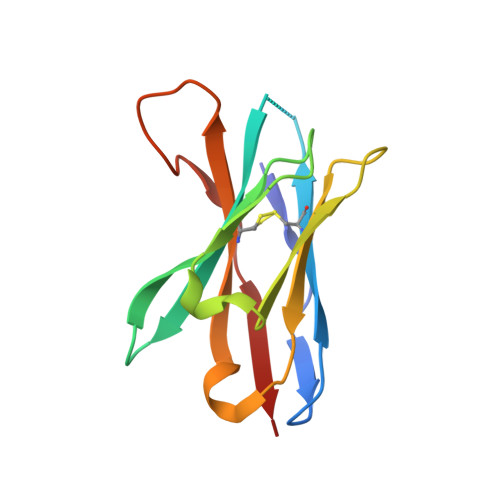
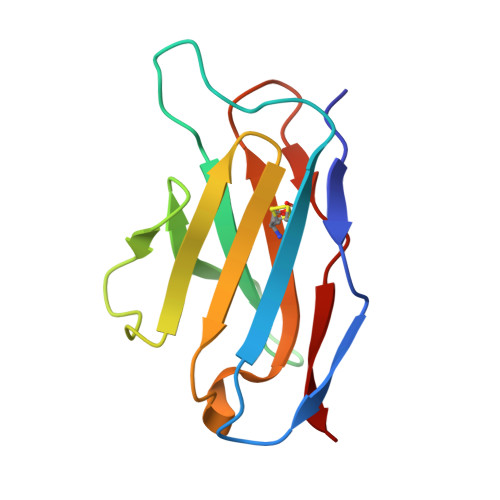
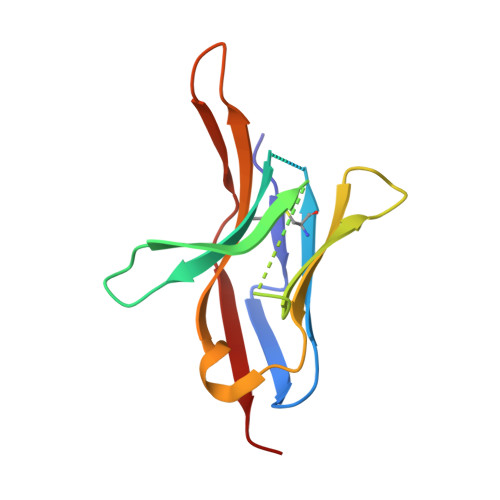
Complex structure of GY-14 and PD-1


Experimental Data Snapshot

  • Method: X-RAY DIFFRACTION
  • Resolution: 1.40 Å
  • R-Value Free: 
    0.215 (Depositor), 0.216 (DCC) 
  • R-Value Work: 
    0.188 (Depositor), 0.189 (DCC) 
  • R-Value Observed: 
    0.189 (Depositor) 

Starting Models: experimental
View more details

wwPDB Validation 3D Report Full Report

Validation slider image for 6J14

This is version 1.2 of the entry. See complete history

Literature

The FG Loop of PD-1 Serves as a "Hotspot" for Therapeutic Monoclonal Antibodies in Tumor Immune Checkpoint Therapy.

Chen, D.Tan, S.Zhang, H.Wang, H.He, W.Shi, R.Tong, Z.Zhu, J.Cheng, H.Gao, S.Chai, Y.Qi, J.Xiao, M.Yan, J.Gao, G.F.

(2019) iScience 14: 113-124

  • DOI: https://doi.org/10.1016/j.isci.2019.03.017

  • PubMed Abstract: 

    Programmed cell death 1 (PD-1)/PD-1 ligand-1 (PD-L1)-blocking monoclonal antibodies (mAbs) have taken center stage for tumor immune checkpoint therapy. Identification of the "hotspots" on PD-1 for mAbs will help to develop next-generation oral deliverable agents with long-lasting efficacy. Here, we identified two PD-1-targeting mAbs, GY-5 and GY-14, with PD-1/PD-L1-blocking efficacy. Complex structural information revealed that both mAbs mainly bind to the FG loop of PD-1, which also contributes multiple interactions with PD-L1. The FG loop adopts substantially varied conformations upon binding to different mAbs, providing a novel targetable region for the development of PD-1-specific biologics and small chemical molecules. Glycosylation modifications of PD-1 could be observed in three of the four potential N-linked glycosylation sites. However, the binding of GY-5 and GY-14 to PD-1 was not affected by glycosylation. These findings broaden our understanding of the mechanism of anti-PD-1 mAbs and provide insight into the development of agents targeting PD-1.


  • Organizational Affiliation
    • CAS Key Laboratory of Pathogenic Microbiology and Immunology, Institute of Microbiology, Chinese Academy of Sciences, Beijing 100101, China.

Macromolecule Content 

  • Total Structure Weight: 38.46 kDa 
  • Atom Count: 2,958 
  • Modeled Residue Count: 325 
  • Deposited Residue Count: 347 
  • Unique protein chains: 3

Macromolecules

Find similar proteins by:|  3D Structure
Entity ID: 1
MoleculeChains  Sequence LengthOrganismDetailsImage
GY-14 heavy chain V fragment120Mus musculusMutation(s): 0 
Find similar proteins by:|  3D Structure
Entity ID: 2
MoleculeChains  Sequence LengthOrganismDetailsImage
GY-14 light chain V fragment112Mus musculusMutation(s): 0 
Find similar proteins by:|  3D Structure
Entity ID: 3
MoleculeChains  Sequence LengthOrganismDetailsImage
Programmed cell death protein 1C [auth G]115Homo sapiensMutation(s): 0 
Gene Names: PDCD1PD1
UniProt & NIH Common Fund Data Resources
Find proteins for Q15116 (Homo sapiens)
Explore Q15116 
Go to UniProtKB:  Q15116
PHAROS:  Q15116
GTEx:  ENSG00000188389 
Entity Groups
Sequence Clusters30% Identity50% Identity70% Identity90% Identity95% Identity100% Identity
UniProt GroupQ15116
Sequence Annotations
Expand
Reference Sequence

Experimental Data & Validation

Experimental Data

  • Method: X-RAY DIFFRACTION
  • Resolution: 1.40 Å
  • R-Value Free:  0.215 (Depositor), 0.216 (DCC) 
  • R-Value Work:  0.188 (Depositor), 0.189 (DCC) 
  • R-Value Observed: 0.189 (Depositor) 
Space Group: P 1 21 1
Unit Cell:
Length ( Å )Angle ( ˚ )
a = 43.422α = 90
b = 75.679β = 104.31
c = 55.873γ = 90
Software Package:
Software NamePurpose
PHENIXrefinement
HKL-3000data reduction
HKL-3000data scaling
PHASERphasing

Structure Validation

View Full Validation Report


Entry History 

Deposition Data

Revision History  (Full details and data files)

  • Version 1.0: 2019-11-06
    Type: Initial release
  • Version 1.1: 2023-11-22
    Changes: Data collection, Database references, Refinement description
  • Version 1.2: 2024-10-23
    Changes: Structure summary