6ISP | pdb_00006isp

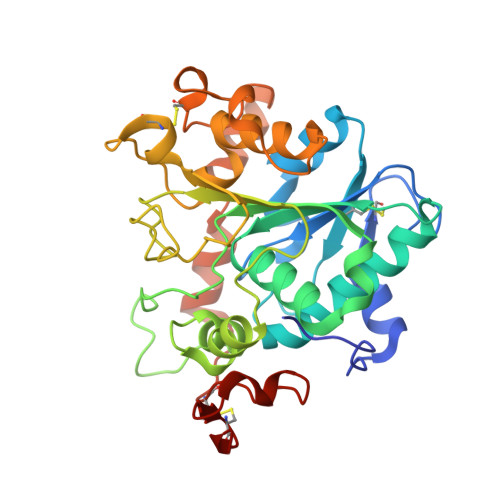
structure of Candida antarctica Lipase B mutant


Experimental Data Snapshot

  • Method: X-RAY DIFFRACTION
  • Resolution: 1.88 Å
  • R-Value Free: 
    0.238 (Depositor), 0.232 (DCC) 
  • R-Value Work: 
    0.213 (Depositor) 
  • R-Value Observed: 
    0.215 (Depositor) 

Starting Model: experimental
View more details

wwPDB Validation 3D Report Full Report

Validation slider image for 6ISP

Ligand Structure Quality Assessment 


This is version 1.3 of the entry. See complete history

Literature

Artificial cysteine-lipases with high activity and altered catalytic mechanism created by laboratory evolution.

Cen, Y.Singh, W.Arkin, M.Moody, T.S.Huang, M.Zhou, J.Wu, Q.Reetz, M.T.

(2019) Nat Commun 10: 3198-3198

  • DOI: https://doi.org/10.1038/s41467-019-11155-3
  • Primary Citation Related Structures: 
    6ISP, 6ISQ, 6ISR

  • PubMed Abstract: 

    Engineering artificial enzymes with high activity and catalytic mechanism different from naturally occurring enzymes is a challenge in protein design. For example, many attempts have been made to obtain active hydrolases by introducing a Ser → Cys exchange at the respective catalytic triads, but this generally induced a breakdown of activity. We now report that this long-standing dogma no longer pertains, provided additional mutations are introduced by directed evolution. By employing Candida antarctica lipase B (CALB) as the model enzyme with the Ser-His-Asp catalytic triad, a highly active cysteine-lipase having a Cys-His-Asp catalytic triad and additional mutations W104V/A281Y/A282Y/V149G can be evolved, showing a 40-fold higher catalytic efficiency than wild-type CALB in the hydrolysis of 4-nitrophenyl benzoate, and tolerating bulky substrates. Crystal structures, kinetics, MD simulations and QM/MM calculations reveal dynamic features and explain all results, including the preference of a two-step mechanism involving the zwitterionic pair Cys105 - /His224 + rather than a concerted process.


  • Organizational Affiliation
    • Department of Chemistry, Zhejiang University, 310027, Hangzhou, China.

Macromolecule Content 

  • Total Structure Weight: 143.27 kDa 
  • Atom Count: 10,930 
  • Modeled Residue Count: 1,270 
  • Deposited Residue Count: 1,284 
  • Unique protein chains: 1

Macromolecules

Find similar proteins by:|  3D Structure
Entity ID: 1
MoleculeChains  Sequence LengthOrganismDetailsImage
Lipase BA [auth D],
B [auth A],
C,
D [auth B]
321Moesziomyces antarcticusMutation(s): 6 
EC: 3.1.1.3
Membrane Entity: Yes 
UniProt
Find proteins for P41365 (Pseudozyma antarctica)
Explore P41365 
Go to UniProtKB:  P41365
Entity Groups
Sequence Clusters30% Identity50% Identity70% Identity90% Identity95% Identity100% Identity
UniProt GroupP41365
Sequence Annotations
Expand
Reference Sequence

Small Molecules

Ligands 2 Unique
IDChains Name / Formula / InChI Key2D Diagram3D Interactions
CPQ

Query on CPQ


Download:Ideal Coordinates CCD File
E [auth D]
F [auth D]
H [auth A]
I [auth A]
J [auth A]
E [auth D],
F [auth D],
H [auth A],
I [auth A],
J [auth A],
K [auth A],
L [auth C],
M [auth C],
N [auth C],
P [auth B],
Q [auth B]
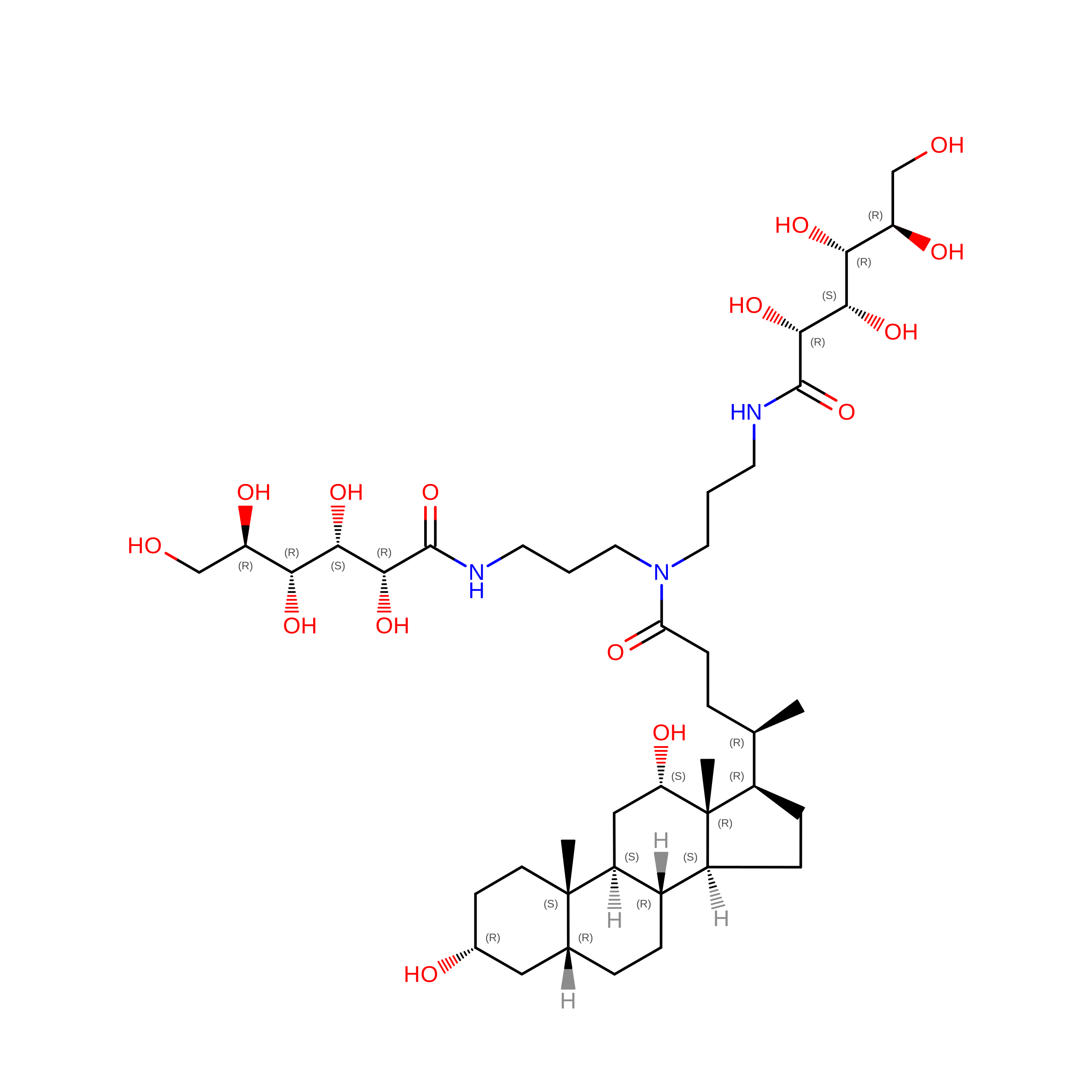
N,N-BIS(3-D-GLUCONAMIDOPROPYL)DEOXYCHOLAMIDE
C42 H75 N3 O15
OJSUWTDDXLCUFR-HGZMBBKESA-N
CA

Query on CA


Download:Ideal Coordinates CCD File
G [auth A],
O [auth B]
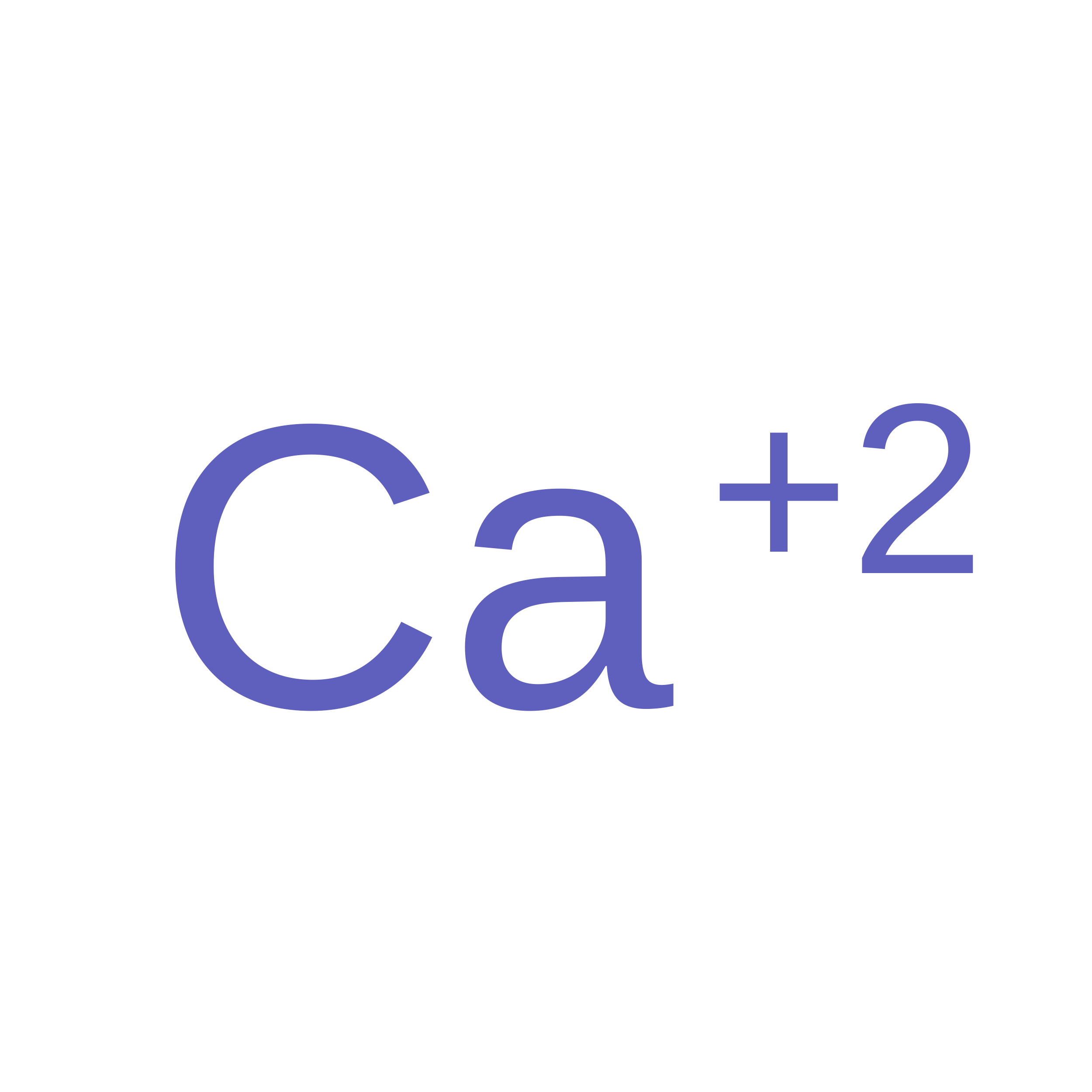
CALCIUM ION
Ca
BHPQYMZQTOCNFJ-UHFFFAOYSA-N

Experimental Data & Validation

Experimental Data

  • Method: X-RAY DIFFRACTION
  • Resolution: 1.88 Å
  • R-Value Free:  0.238 (Depositor), 0.232 (DCC) 
  • R-Value Work:  0.213 (Depositor) 
  • R-Value Observed: 0.215 (Depositor) 
Space Group: P 1 21 1
Unit Cell:
Length ( Å )Angle ( ˚ )
a = 46.98α = 90
b = 155.97β = 90
c = 92.53γ = 90
Software Package:
Software NamePurpose
PHENIXrefinement
XDSdata reduction
Aimlessdata scaling
PHENIXphasing

Structure Validation

View Full Validation Report


Ligand Structure Quality Assessment 


Entry History 

Deposition Data

Revision History  (Full details and data files)

  • Version 1.0: 2019-07-24
    Type: Initial release
  • Version 1.1: 2019-08-07
    Changes: Data collection, Database references
  • Version 1.2: 2023-11-22
    Changes: Data collection, Database references, Derived calculations, Refinement description
  • Version 1.3: 2024-10-16
    Changes: Structure summary