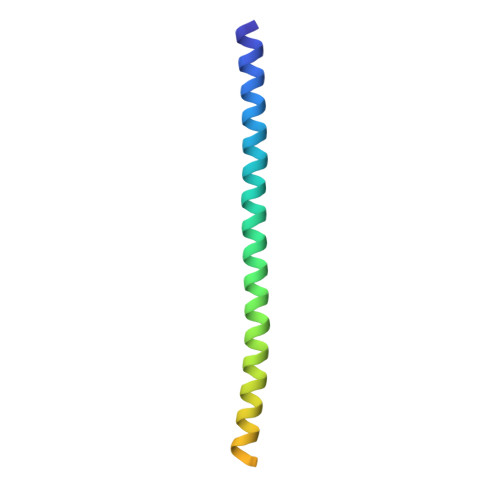
6IQE | pdb_00006iqe

Human prohibitin 2


Experimental Data Snapshot

  • Method: X-RAY DIFFRACTION
  • Resolution: 1.70 Å
  • R-Value Free: 
    0.239 (Depositor), 0.246 (DCC) 
  • R-Value Work: 
    0.216 (Depositor), 0.224 (DCC) 
  • R-Value Observed: 
    0.217 (Depositor) 

Starting Model: experimental
View more details

wwPDB Validation 3D Report Full Report

Validation slider image for 6IQE

This is version 1.1 of the entry. See complete history

Literature

Structural Basis of Mitochondrial Scaffolds by Prohibitin Complexes: Insight into a Role of the Coiled-Coil Region.

Yoshinaka, T.Kosako, H.Yoshizumi, T.Furukawa, R.Hirano, Y.Kuge, O.Tamada, T.Koshiba, T.

(2019) iScience 19: 1065-1078

  • DOI: https://doi.org/10.1016/j.isci.2019.08.056
  • Primary Citation Related Structures: 
    6IQE

  • PubMed Abstract: 

    The coiled-coil motif mediates subunit oligomerization and scaffolding and underlies several fundamental biologic processes. Prohibitins (PHBs), mitochondrial inner membrane proteins involved in mitochondrial homeostasis and signal transduction, are predicted to have a coiled-coil motif, but their structural features are poorly understood. Here we solved the crystal structure of the heptad repeat (HR) region of PHB2 at 1.7-Å resolution, showing that it assembles into a dimeric, antiparallel coiled-coil with a unique negatively charged area essential for the PHB interactome in mitochondria. Disruption of the HR coiled-coil abolishes well-ordered PHB complexes and the mitochondrial tubular networks accompanying PHB-dependent signaling. Using a proximity-dependent biotin identification (BioID) technique in live cells, we mapped a number of mitochondrial intermembrane space proteins whose association with PHB2 relies on the HR coiled-coil region. Elucidation of the PHB complex structure in mitochondria provides insight into essential PHB interactomes required for mitochondrial dynamics as well as signal transduction.


  • Organizational Affiliation
    • Department of Biology, Faculty of Science, Kyushu University, Fukuoka 819-0395, Japan.

Macromolecule Content 

  • Total Structure Weight: 9.82 kDa 
  • Atom Count: 553 
  • Modeled Residue Count: 59 
  • Deposited Residue Count: 87 
  • Unique protein chains: 1

Macromolecules

Find similar proteins by:|  3D Structure
Entity ID: 1
MoleculeChains  Sequence LengthOrganismDetailsImage
Prohibitin-287Homo sapiensMutation(s): 0 
Gene Names: PHB2BAPREA
UniProt & NIH Common Fund Data Resources
Find proteins for Q99623 (Homo sapiens)
Explore Q99623 
Go to UniProtKB:  Q99623
PHAROS:  Q99623
GTEx:  ENSG00000215021 
Entity Groups
Sequence Clusters30% Identity50% Identity70% Identity90% Identity95% Identity100% Identity
UniProt GroupQ99623
Sequence Annotations
Expand
Reference Sequence

Experimental Data & Validation

Experimental Data

  • Method: X-RAY DIFFRACTION
  • Resolution: 1.70 Å
  • R-Value Free:  0.239 (Depositor), 0.246 (DCC) 
  • R-Value Work:  0.216 (Depositor), 0.224 (DCC) 
  • R-Value Observed: 0.217 (Depositor) 
Space Group: P 41 2 2
Unit Cell:
Length ( Å )Angle ( ˚ )
a = 65.142α = 90
b = 65.142β = 90
c = 62.288γ = 90
Software Package:
Software NamePurpose
PHENIXrefinement
XDSdata reduction
Aimlessdata scaling
PHASERphasing

Structure Validation

View Full Validation Report


Entry History 

Deposition Data

Revision History  (Full details and data files)

  • Version 1.0: 2019-09-25
    Type: Initial release
  • Version 1.1: 2023-11-22
    Changes: Data collection, Database references, Refinement description