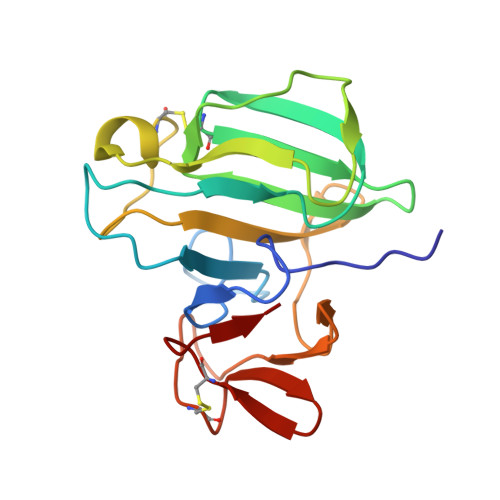
6IK4 | pdb_00006ik4

A Novel M23 Metalloprotease Pseudoalterin from Deep-sea


Experimental Data Snapshot

  • Method: X-RAY DIFFRACTION
  • Resolution: 1.90 Å
  • R-Value Free: 
    0.172 (Depositor), 0.173 (DCC) 
  • R-Value Work: 
    0.149 (Depositor), 0.155 (DCC) 
  • R-Value Observed: 
    0.150 (Depositor) 

Starting Model: experimental
View more details

wwPDB Validation 3D Report Full Report

Validation slider image for 6IK4

This is version 1.3 of the entry. See complete history. 

Literature

A predator-prey interaction between a marine Pseudoalteromonas sp. and Gram-positive bacteria.

Tang, B.L., Yang, J., Chen, X.L., Wang, P., Zhao, H.L., Su, H.N., Li, C.Y., Yu, Y., Zhong, S., Wang, L., Lidbury, I., Ding, H., Wang, M., McMinn, A., Zhang, X.Y., Chen, Y., Zhang, Y.Z.

(2020) Nat Commun 11: 285-285

  • DOI: https://doi.org/10.1038/s41467-019-14133-x
  • Primary Citation Related Structures: 
    6IK4

  • PubMed Abstract: 

    Predator-prey interactions play important roles in the cycling of marine organic matter. Here we show that a Gram-negative bacterium isolated from marine sediments (Pseudoalteromonas sp. strain CF6-2) can kill Gram-positive bacteria of diverse peptidoglycan (PG) chemotypes by secreting the metalloprotease pseudoalterin. Secretion of the enzyme requires a Type II secretion system. Pseudoalterin binds to the glycan strands of Gram positive bacterial PG and degrades the PG peptide chains, leading to cell death. The released nutrients, including PG-derived D-amino acids, can then be utilized by strain CF6-2 for growth. Pseudoalterin synthesis is induced by PG degradation products such as glycine and glycine-rich oligopeptides. Genes encoding putative pseudoalterin-like proteins are found in many other marine bacteria. This study reveals a new microbial interaction in the ocean.


  • Organizational Affiliation: 
    • State Key Laboratory of Microbial Technology, Marine Biotechnology Research Center, Shandong University, Qingdao, 266237, China.

Macromolecule Content 

  • Total Structure Weight: 19.55 kDa 
  • Atom Count: 1,557 
  • Modeled Residue Count: 173 
  • Deposited Residue Count: 173 
  • Unique protein chains: 1

Macromolecules

Find similar proteins by:|  3D Structure
Entity ID: 1
MoleculeChains  Sequence LengthOrganismDetailsImage
Elastinolytic metalloprotease173Pseudoalteromonas sp. CF6-2Mutation(s): 0 
UniProt
Find proteins for E7D102 (Pseudoalteromonas sp. CF6-2)
Explore E7D102 
Go to UniProtKB:  E7D102
Entity Groups
Sequence Clusters30% Identity50% Identity70% Identity90% Identity95% Identity100% Identity
UniProt GroupE7D102
Sequence Annotations
Expand
Reference Sequence

Experimental Data & Validation

Experimental Data

  • Method: X-RAY DIFFRACTION
  • Resolution: 1.90 Å
  • R-Value Free:  0.172 (Depositor), 0.173 (DCC) 
  • R-Value Work:  0.149 (Depositor), 0.155 (DCC) 
  • R-Value Observed: 0.150 (Depositor) 
Space Group: C 2 2 21
Unit Cell:
Length ( Å )Angle ( ˚ )
a = 62.841α = 90
b = 82.443β = 90
c = 73.419γ = 90
Software Package:
Software NamePurpose
PHENIXrefinement
HKL-2000data reduction
HKL-2000data scaling
PHASERphasing

Structure Validation

View Full Validation Report


Entry History 

& Funding Information

Deposition Data


Funding OrganizationLocationGrant Number
National Natural Science Foundation of ChinaChina31670063
National Natural Science Foundation of ChinaChinaU1706207

Revision History  (Full details and data files)

  • Version 1.0: 2019-10-16
    Type: Initial release
  • Version 1.1: 2020-04-29
    Changes: Database references
  • Version 1.2: 2023-11-22
    Changes: Data collection, Database references, Refinement description
  • Version 1.3: 2024-10-09
    Changes: Structure summary