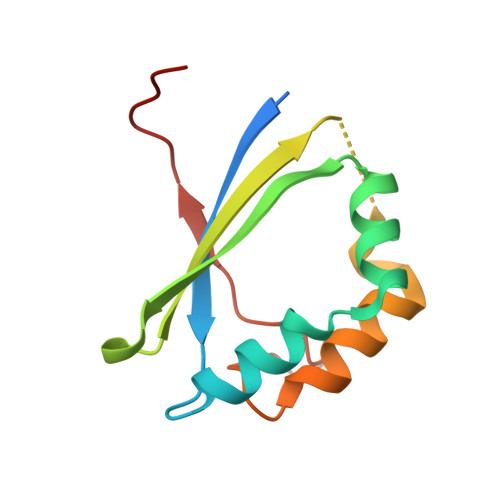
6HHN | pdb_00006hhn

Crystal structure of L-rhamnose mutarotase FA22100 from Formosa agariphila


Experimental Data Snapshot

  • Method: X-RAY DIFFRACTION
  • Resolution: 1.47 Å
  • R-Value Free: 
    0.172 (Depositor), 0.178 (DCC) 
  • R-Value Work: 
    0.148 (Depositor), 0.156 (DCC) 
  • R-Value Observed: 
    0.149 (Depositor) 

Starting Model: experimental
View more details

wwPDB Validation 3D Report Full Report

Validation slider image for 6HHN

This is version 1.3 of the entry. See complete history. 

Literature

A marine bacterial enzymatic cascade degrades the algal polysaccharide ulvan.

Reisky, L., Prechoux, A., Zuhlke, M.K., Baumgen, M., Robb, C.S., Gerlach, N., Roret, T., Stanetty, C., Larocque, R., Michel, G., Song, T., Markert, S., Unfried, F., Mihovilovic, M.D., Trautwein-Schult, A., Becher, D., Schweder, T., Bornscheuer, U.T., Hehemann, J.H.

(2019) Nat Chem Biol 15: 803-812

  • DOI: https://doi.org/10.1038/s41589-019-0311-9
  • Primary Citation Related Structures: 
    6HHM, 6HHN, 6HPD, 6HR5

  • PubMed Abstract: 

    Marine seaweeds increasingly grow into extensive algal blooms, which are detrimental to coastal ecosystems, tourism and aquaculture. However, algal biomass is also emerging as a sustainable raw material for the bioeconomy. The potential exploitation of algae is hindered by our limited knowledge of the microbial pathways-and hence the distinct biochemical functions of the enzymes involved-that convert algal polysaccharides into oligo- and monosaccharides. Understanding these processes would be essential, however, for applications such as the fermentation of algal biomass into bioethanol or other value-added compounds. Here, we describe the metabolic pathway that enables the marine flavobacterium Formosa agariphila to degrade ulvan, the main cell wall polysaccharide of bloom-forming Ulva species. The pathway involves 12 biochemically characterized carbohydrate-active enzymes, including two polysaccharide lyases, three sulfatases and seven glycoside hydrolases that sequentially break down ulvan into fermentable monosaccharides. This way, the enzymes turn a previously unexploited renewable into a valuable and ecologically sustainable bioresource.


  • Organizational Affiliation: 
    • Department of Biotechnology & Enzyme Catalysis, Institute of Biochemistry, University Greifswald, Greifswald, Germany.

Macromolecule Content 

  • Total Structure Weight: 13.42 kDa 
  • Atom Count: 975 
  • Modeled Residue Count: 99 
  • Deposited Residue Count: 115 
  • Unique protein chains: 1

Macromolecules

Find similar proteins by:|  3D Structure
Entity ID: 1
MoleculeChains  Sequence LengthOrganismDetailsImage
L-rhamnose mutarotase115Formosa agariphilaMutation(s): 0 
Gene Names: BN863_22100
EC: 5.1.3.32
UniProt
Find proteins for T2KM13 (Formosa agariphila (strain DSM 15362 / KCTC 12365 / LMG 23005 / KMM 3901 / M-2Alg 35-1))
Explore T2KM13 
Go to UniProtKB:  T2KM13
Entity Groups
Sequence Clusters30% Identity50% Identity70% Identity90% Identity95% Identity100% Identity
UniProt GroupT2KM13
Sequence Annotations
Expand
Reference Sequence

Experimental Data & Validation

Experimental Data

  • Method: X-RAY DIFFRACTION
  • Resolution: 1.47 Å
  • R-Value Free:  0.172 (Depositor), 0.178 (DCC) 
  • R-Value Work:  0.148 (Depositor), 0.156 (DCC) 
  • R-Value Observed: 0.149 (Depositor) 
Space Group: P 43 21 2
Unit Cell:
Length ( Å )Angle ( ˚ )
a = 70.913α = 90
b = 70.913β = 90
c = 54.407γ = 90
Software Package:
Software NamePurpose
XDSdata reduction
Aimlessdata scaling
Cootmodel building
MOLREPphasing
PHENIXrefinement

Structure Validation

View Full Validation Report


Entry History 

& Funding Information

Deposition Data


Funding OrganizationLocationGrant Number
French National Research AgencyFranceNo. ANR-14-CE19- 0020-01
French National Research AgencyFranceNo. ANR-10-BTBR-04

Revision History  (Full details and data files)

  • Version 1.0: 2019-06-26
    Type: Initial release
  • Version 1.1: 2019-07-24
    Changes: Data collection, Database references
  • Version 1.2: 2019-07-31
    Changes: Data collection, Database references
  • Version 1.3: 2024-01-17
    Changes: Data collection, Database references, Refinement description