Download Mendeley
Lysyl-tRNA synthetase as a drug target in malaria and cryptosporidiosis.
Baragana, B., Forte, B., Choi, R., Nakazawa Hewitt, S., Bueren-Calabuig, J.A., Pisco, J.P., Peet, C., Dranow, D.M., Robinson, D.A., Jansen, C., Norcross, N.R., Vinayak, S., Anderson, M., Brooks, C.F., Cooper, C.A., Damerow, S., Delves, M., Dowers, K., Duffy, J., Edwards, T.E., Hallyburton, I., Horst, B.G., Hulverson, M.A., Ferguson, L., Jimenez-Diaz, M.B., Jumani, R.S., Lorimer, D.D., Love, M.S., Maher, S., Matthews, H., McNamara, C.W., Miller, P., O'Neill, S., Ojo, K.K., Osuna-Cabello, M., Pinto, E., Post, J., Riley, J., Rottmann, M., Sanz, L.M., Scullion, P., Sharma, A., Shepherd, S.M., Shishikura, Y., Simeons, F.R.C., Stebbins, E.E., Stojanovski, L., Straschil, U., Tamaki, F.K., Tamjar, J., Torrie, L.S., Vantaux, A., Witkowski, B., Wittlin, S., Yogavel, M., Zuccotto, F., Angulo-Barturen, I., Sinden, R., Baum, J., Gamo, F.J., Maser, P., Kyle, D.E., Winzeler, E.A., Myler, P.J., Wyatt, P.G., Floyd, D., Matthews, D., Sharma, A., Striepen, B., Huston, C.D., Gray, D.W., Fairlamb, A.H., Pisliakov, A.V., Walpole, C., Read, K.D., Van Voorhis, W.C., Gilbert, I.H.(2019) Proc Natl Acad Sci U S A 116: 7015-7020
- PubMed: 30894487 Search on PubMedSearch on PubMed Central
- DOI: https://doi.org/10.1073/pnas.1814685116
- Primary Citation Related Structures:
5ELN, 5ELO, 6AGT, 6HCU, 6HCV, 6HCW - PubMed Abstract:
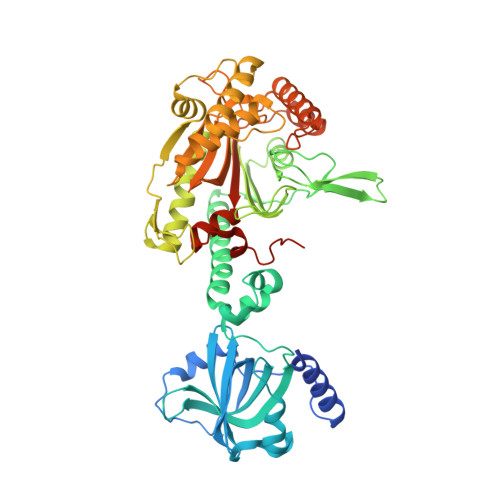
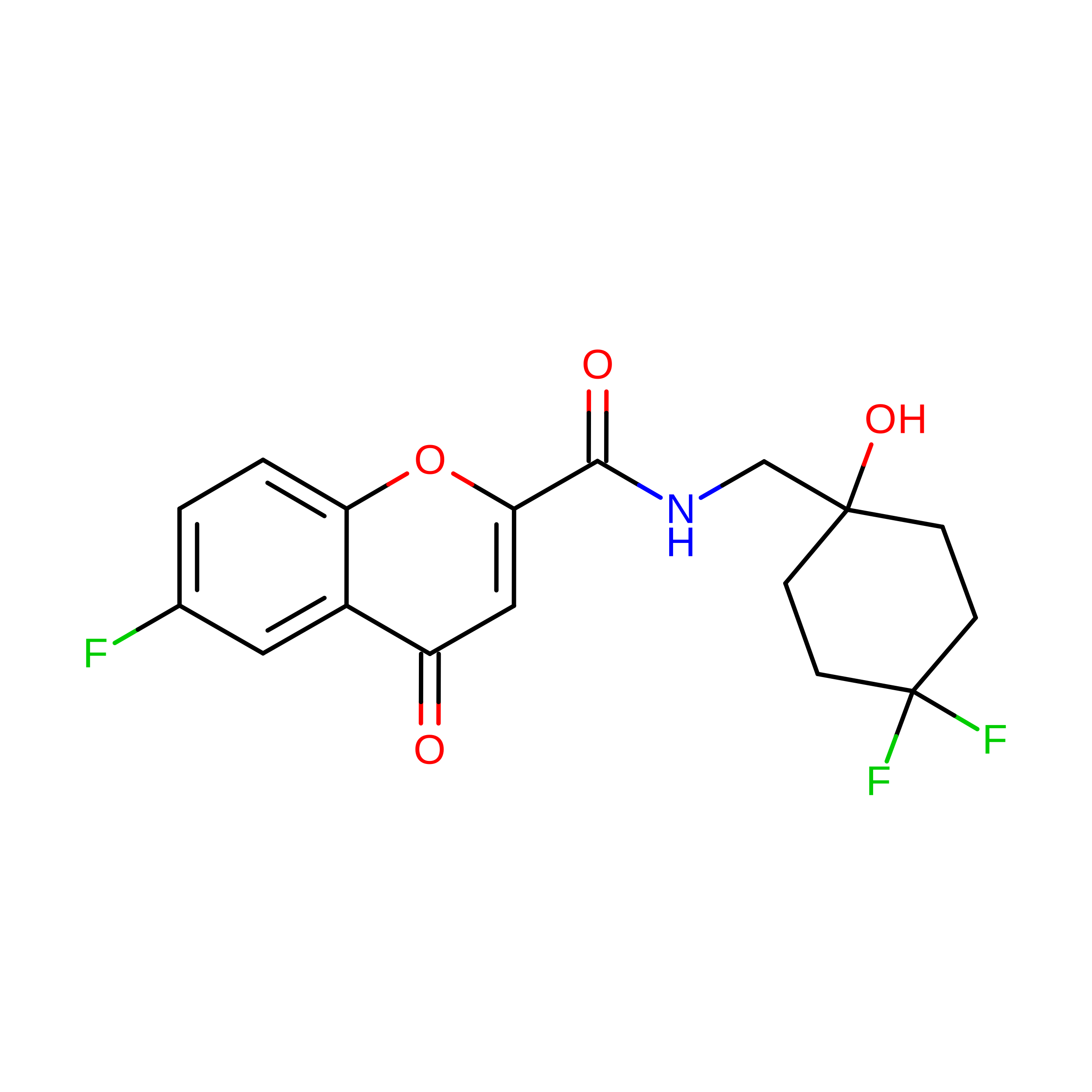
Malaria and cryptosporidiosis, caused by apicomplexan parasites, remain major drivers of global child mortality. New drugs for the treatment of malaria and cryptosporidiosis, in particular, are of high priority; however, there are few chemically validated targets. The natural product cladosporin is active against blood- and liver-stage Plasmodium falciparum and Cryptosporidium parvum in cell-culture studies. Target deconvolution in P. falciparum has shown that cladosporin inhibits lysyl-tRNA synthetase ( Pf KRS1). Here, we report the identification of a series of selective inhibitors of apicomplexan KRSs. Following a biochemical screen, a small-molecule hit was identified and then optimized by using a structure-based approach, supported by structures of both Pf KRS1 and C. parvum KRS ( Cp KRS). In vivo proof of concept was established in an SCID mouse model of malaria, after oral administration (ED 90 = 1.5 mg/kg, once a day for 4 d). Furthermore, we successfully identified an opportunity for pathogen hopping based on the structural homology between Pf KRS1 and Cp KRS. This series of compounds inhibit Cp KRS and C. parvum and Cryptosporidium hominis in culture, and our lead compound shows oral efficacy in two cryptosporidiosis mouse models. X-ray crystallography and molecular dynamics simulations have provided a model to rationalize the selectivity of our compounds for Pf KRS1 and Cp KRS vs. (human) Hs KRS. Our work validates apicomplexan KRSs as promising targets for the development of drugs for malaria and cryptosporidiosis.
- Wellcome Centre for Anti-Infectives Research, Drug Discovery Unit, Division of Biological Chemistry and Drug Discovery, University of Dundee, DD1 5EH Dundee, United Kingdom.
Organizational Affiliation: