6GVS | pdb_00006gvs

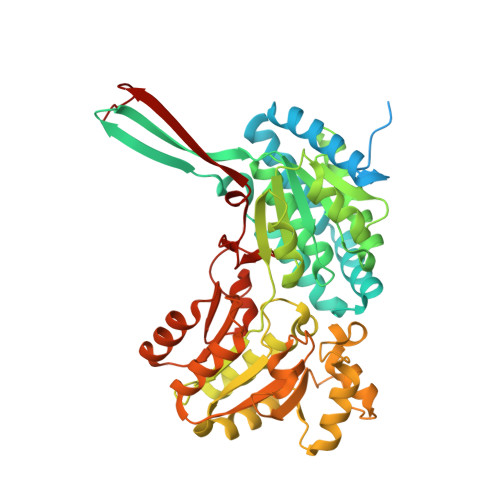
Engineered glycolyl-CoA reductase comprising 8 mutations with bound NADP+


Experimental Data Snapshot

  • Method: X-RAY DIFFRACTION
  • Resolution: 2.58 Å
  • R-Value Free: 
    0.210 (Depositor), 0.210 (DCC) 
  • R-Value Work: 
    0.192 (Depositor), 0.192 (DCC) 
  • R-Value Observed: 
    0.192 (Depositor) 

Starting Model: experimental
View more details

wwPDB Validation 3D Report Full Report

Validation slider image for 6GVS

Ligand Structure Quality Assessment 


This is version 1.3 of the entry. See complete history

Literature

Design and in vitro realization of carbon-conserving photorespiration.

Trudeau, D.L.Edlich-Muth, C.Zarzycki, J.Scheffen, M.Goldsmith, M.Khersonsky, O.Avizemer, Z.Fleishman, S.J.Cotton, C.A.R.Erb, T.J.Tawfik, D.S.Bar-Even, A.

(2018) Proc Natl Acad Sci U S A 115: E11455-E11464

  • DOI: https://doi.org/10.1073/pnas.1812605115
  • Primary Citation Related Structures: 
    6GVS

  • PubMed Abstract: 

    Photorespiration recycles ribulose-1,5-bisphosphate carboxylase/oxygenase (Rubisco) oxygenation product, 2-phosphoglycolate, back into the Calvin Cycle. Natural photorespiration, however, limits agricultural productivity by dissipating energy and releasing CO 2 Several photorespiration bypasses have been previously suggested but were limited to existing enzymes and pathways that release CO 2 Here, we harness the power of enzyme and metabolic engineering to establish synthetic routes that bypass photorespiration without CO 2 release. By defining specific reaction rules, we systematically identified promising routes that assimilate 2-phosphoglycolate into the Calvin Cycle without carbon loss. We further developed a kinetic-stoichiometric model that indicates that the identified synthetic shunts could potentially enhance carbon fixation rate across the physiological range of irradiation and CO 2 , even if most of their enzymes operate at a tenth of Rubisco's maximal carboxylation activity. Glycolate reduction to glycolaldehyde is essential for several of the synthetic shunts but is not known to occur naturally. We, therefore, used computational design and directed evolution to establish this activity in two sequential reactions. An acetyl-CoA synthetase was engineered for higher stability and glycolyl-CoA synthesis. A propionyl-CoA reductase was engineered for higher selectivity for glycolyl-CoA and for use of NADPH over NAD + , thereby favoring reduction over oxidation. The engineered glycolate reduction module was then combined with downstream condensation and assimilation of glycolaldehyde to ribulose 1,5-bisphosphate, thus providing proof of principle for a carbon-conserving photorespiration pathway.


  • Organizational Affiliation
    • Department of Biomolecular Sciences, Weizmann Institute of Science, 7610001 Rehovot, Israel.

Macromolecule Content 

  • Total Structure Weight: 560.58 kDa 
  • Atom Count: 33,944 
  • Modeled Residue Count: 4,406 
  • Deposited Residue Count: 5,220 
  • Unique protein chains: 1

Macromolecules

Find similar proteins by:|  3D Structure
Entity ID: 1
MoleculeChains  Sequence LengthOrganismDetailsImage
Aldehyde dehydrogenase
A, B, C, D, E
A, B, C, D, E, F, G, H, I, J
522Rhodopseudomonas palustris BisB18Mutation(s): 8 
Gene Names: RPC_1174
UniProt
Find proteins for Q21A49 (Rhodopseudomonas palustris (strain BisB18))
Explore Q21A49 
Go to UniProtKB:  Q21A49
Entity Groups
Sequence Clusters30% Identity50% Identity70% Identity90% Identity95% Identity100% Identity
UniProt GroupQ21A49
Sequence Annotations
Expand
Reference Sequence

Small Molecules

Ligands 2 Unique
IDChains Name / Formula / InChI Key2D Diagram3D Interactions
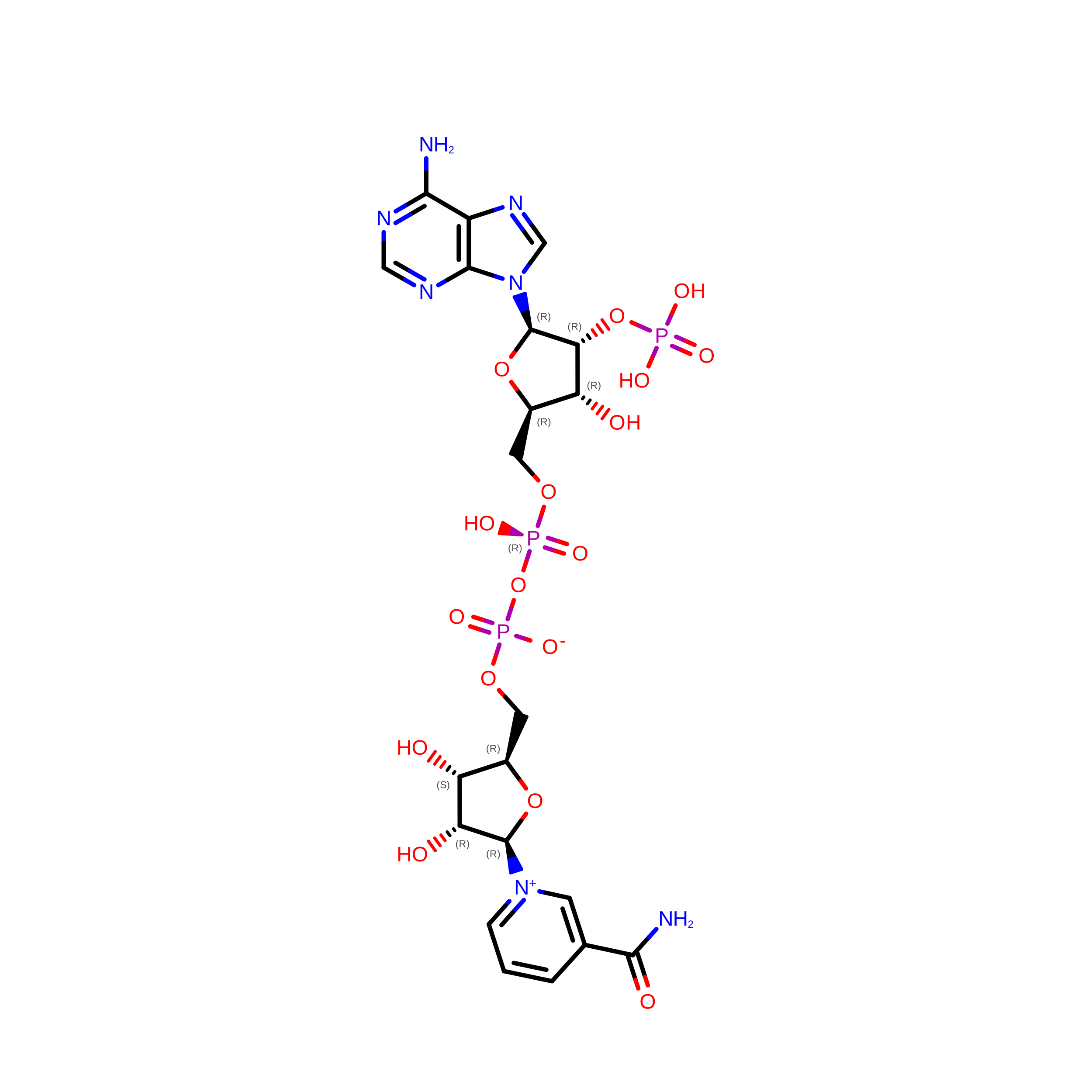
NAP

Query on NAP


Download:Ideal Coordinates CCD File
AA [auth I]
CA [auth J]
K [auth A]
M [auth B]
O [auth C]
AA [auth I],
CA [auth J],
K [auth A],
M [auth B],
O [auth C],
Q [auth D],
S [auth E],
U [auth F],
W [auth G],
Y [auth H]
NADP NICOTINAMIDE-ADENINE-DINUCLEOTIDE PHOSPHATE
C21 H28 N7 O17 P3
XJLXINKUBYWONI-NNYOXOHSSA-N
K

Query on K


Download:Ideal Coordinates CCD File
BA [auth I]
DA [auth J]
L [auth A]
N [auth B]
P [auth C]
BA [auth I],
DA [auth J],
L [auth A],
N [auth B],
P [auth C],
R [auth D],
T [auth E],
V [auth F],
X [auth G],
Z [auth H]
POTASSIUM ION
K
NPYPAHLBTDXSSS-UHFFFAOYSA-N

Experimental Data & Validation

Experimental Data

  • Method: X-RAY DIFFRACTION
  • Resolution: 2.58 Å
  • R-Value Free:  0.210 (Depositor), 0.210 (DCC) 
  • R-Value Work:  0.192 (Depositor), 0.192 (DCC) 
  • R-Value Observed: 0.192 (Depositor) 
Space Group: C 1 2 1
Unit Cell:
Length ( Å )Angle ( ˚ )
a = 362.202α = 90
b = 123.183β = 109.25
c = 165.096γ = 90
Software Package:
Software NamePurpose
PHENIXrefinement
XDSdata reduction
SCALAdata scaling
PHENIXphasing

Structure Validation

View Full Validation Report


Ligand Structure Quality Assessment 


Entry History 

& Funding Information

Deposition Data


Funding OrganizationLocationGrant Number
European Research CouncilGermanyFET-OPEN 686330

Revision History  (Full details and data files)

  • Version 1.0: 2018-11-28
    Type: Initial release
  • Version 1.1: 2018-12-05
    Changes: Data collection, Database references
  • Version 1.2: 2018-12-19
    Changes: Data collection, Database references
  • Version 1.3: 2024-01-17
    Changes: Data collection, Database references, Refinement description