6GMF | pdb_00006gmf

Structure of Cytochrome P450 CYP109Q5 from Chondromyces apiculatus


Experimental Data Snapshot

  • Method: X-RAY DIFFRACTION
  • Resolution: 1.55 Å
  • R-Value Free: 
    0.220 (Depositor), 0.224 (DCC) 
  • R-Value Work: 
    0.185 (Depositor), 0.194 (DCC) 
  • R-Value Observed: 
    0.187 (Depositor) 

Starting Model: experimental
View more details

wwPDB Validation 3D Report Full Report

Validation slider image for 6GMF

Ligand Structure Quality Assessment 


This is version 1.1 of the entry. See complete history

Literature

Characterization and structure-guided engineering of the novel versatile terpene monooxygenase CYP109Q5 from Chondromyces apiculatus DSM436.

Klenk, J.M.Dubiel, P.Sharma, M.Grogan, G.Hauer, B.

(2019) Microb Biotechnol 12: 377-391

  • DOI: https://doi.org/10.1111/1751-7915.13354
  • Primary Citation Related Structures: 
    6GMF

  • PubMed Abstract: 

    One of the major challenges in chemical synthesis is the selective oxyfunctionalization of non-activated C-H bonds, which can be enabled by biocatalysis using cytochrome P450 monooxygenases. In this study, we report on the characterization of the versatile CYP109Q5 from Chondromyces apiculatus DSM436, which is able to functionalize a wide range of substrates (terpenes, steroids and drugs), including the ring of β-ionone in non-allylic positions. The crystal structure of CYP109Q5 revealed flexibility within the active site pocket that permitted the accommodation of bulky substrates, and enabled a structure-guided approach to engineering the enzyme. Some variants of CYP109Q5 displayed a switch in selectivity towards the non-allylic positions of β-ionone, allowing the simultaneous production of 2- and 3-hydroxy-β-ionone, which are chemically challenging to synthesize and are important precursors for carotenoid synthesis. An efficient whole-cell system finally enabled the production of up to 0.5 g l -1 hydroxylated products of β-ionone; this system can be applied to product identification in further biotransformations. Overall, CYP109Q5 proved to be highly evolvable and active. The studies in this work demonstrate that, using rational mutagenesis, the highly versatile CYP109Q5 generalist can be progressively evolved to be an industrially valuable specialist for the synthesis of specific products.


  • Organizational Affiliation
    • Institute of Biochemistry and Technical Biochemistry, Department of Technical Biochemistry, University of Stuttgart, Allmandring 31, 70569, Stuttgart, Germany.

Macromolecule Content 

  • Total Structure Weight: 44.54 kDa 
  • Atom Count: 3,245 
  • Modeled Residue Count: 386 
  • Deposited Residue Count: 397 
  • Unique protein chains: 1

Macromolecules

Find similar proteins by:|  3D Structure
Entity ID: 1
MoleculeChains  Sequence LengthOrganismDetailsImage
Putative cytochrome P450 hydroxylase397Chondromyces apiculatus DSM 436Mutation(s): 0 
Gene Names: CAP_4855
UniProt
Find proteins for A0A017T5A5 (Chondromyces apiculatus DSM 436)
Explore A0A017T5A5 
Go to UniProtKB:  A0A017T5A5
Entity Groups
Sequence Clusters30% Identity50% Identity70% Identity90% Identity95% Identity100% Identity
UniProt GroupA0A017T5A5
Sequence Annotations
Expand
Reference Sequence

Small Molecules

Ligands 1 Unique
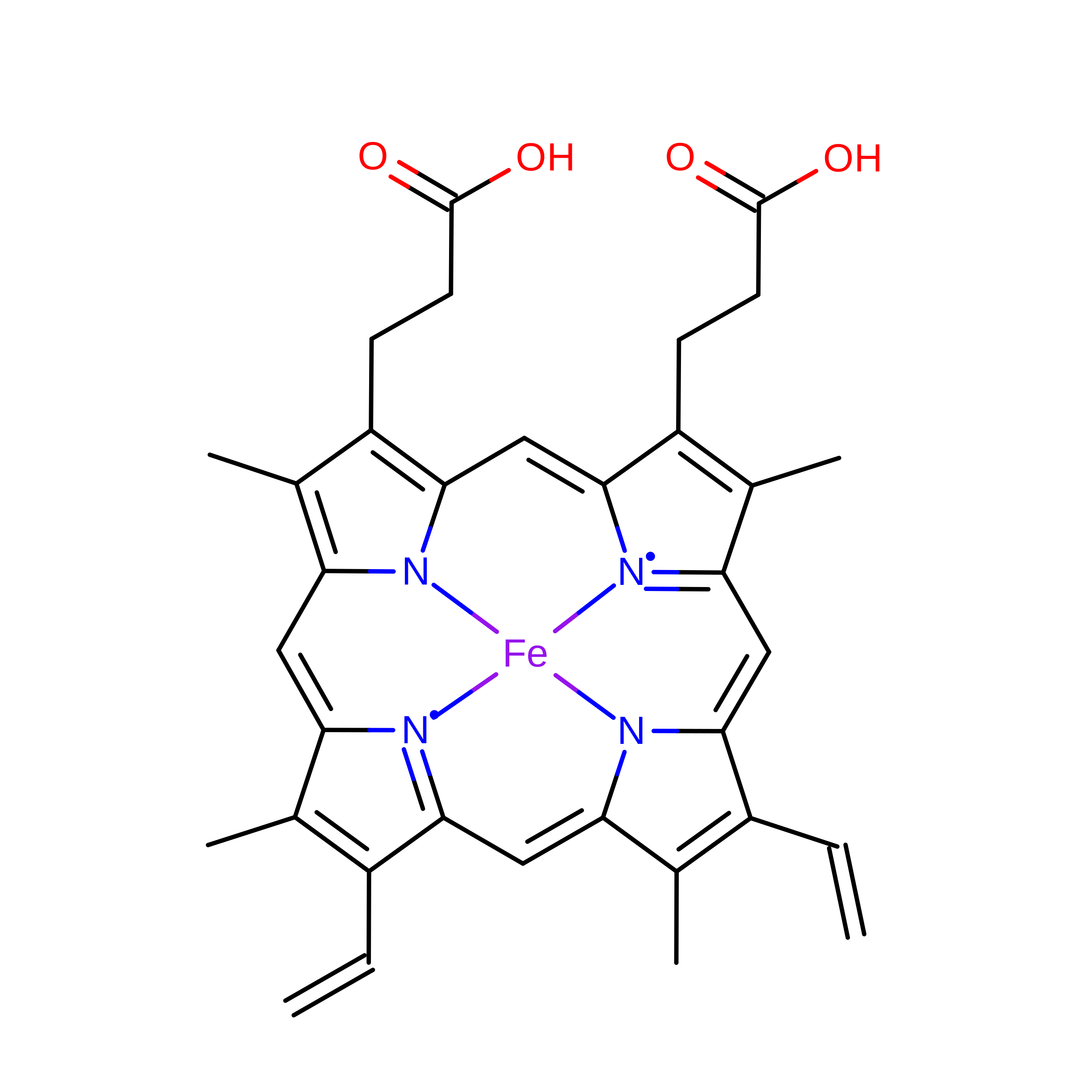
IDChains Name / Formula / InChI Key2D Diagram3D Interactions
HEM

Query on HEM


Download:Ideal Coordinates CCD File
B [auth A]PROTOPORPHYRIN IX CONTAINING FE
C34 H32 Fe N4 O4
KABFMIBPWCXCRK-RGGAHWMASA-L

Experimental Data & Validation

Experimental Data

  • Method: X-RAY DIFFRACTION
  • Resolution: 1.55 Å
  • R-Value Free:  0.220 (Depositor), 0.224 (DCC) 
  • R-Value Work:  0.185 (Depositor), 0.194 (DCC) 
  • R-Value Observed: 0.187 (Depositor) 
Space Group: P 1 21 1
Unit Cell:
Length ( Å )Angle ( ˚ )
a = 44.69α = 90
b = 55.02β = 91.67
c = 74.8γ = 90
Software Package:
Software NamePurpose
REFMACrefinement
XDSdata reduction
SCALAdata scaling
MOLREPphasing

Structure Validation

View Full Validation Report


Ligand Structure Quality Assessment 


Entry History 

Deposition Data

Revision History  (Full details and data files)

  • Version 1.0: 2019-03-27
    Type: Initial release
  • Version 1.1: 2024-01-17
    Changes: Data collection, Database references, Refinement description