6FSJ | pdb_00006fsj

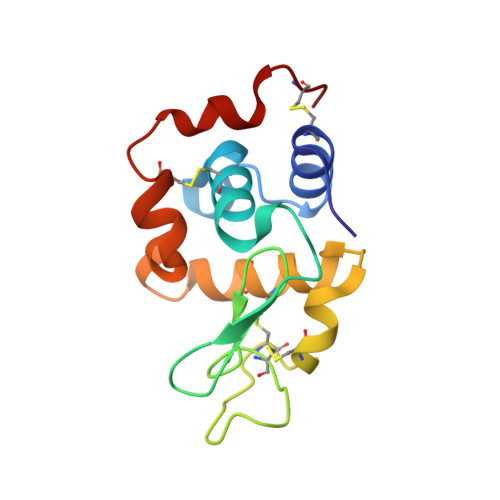
Crystal structure of TCE-treated Lysozyme


Experimental Data Snapshot

  • Method: X-RAY DIFFRACTION
  • Resolution: 1.20 Å
  • R-Value Free: 
    0.170 (Depositor), 0.179 (DCC) 
  • R-Value Work: 
    0.153 (Depositor) 
  • R-Value Observed: 
    0.154 (Depositor) 

Starting Model: experimental
View more details

wwPDB Validation 3D Report Full Report

Validation slider image for 6FSJ

This is version 1.3 of the entry. See complete history

Literature

Improved protein-crystal identification by using 2,2,2-trichloroethanol as a fluorescence enhancer.

Pichlo, C.Toelzer, C.Chojnacki, K.Ocal, S.Uthoff, M.Ruegenberg, S.Hermanns, T.Schacherl, M.Denzel, M.S.Hofmann, K.Niefind, K.Baumann, U.

(2018) Acta Crystallogr F Struct Biol Commun 74: 307-314

  • DOI: https://doi.org/10.1107/S2053230X18005253
  • Primary Citation Related Structures: 
    5N12, 6FSJ, 6FSM

  • PubMed Abstract: 

    The identification of initial lead conditions for successful protein crystallization is crucial for structural studies using X-ray crystallography. In order to reduce the number of false-negative conditions, an emerging number of fluorescence-based methods have been developed which allow more efficient identification of protein crystals and help to distinguish them from salt crystals. Detection of the native tryptophan fluorescence of protein crystals is one of the most widely used methods. However, this method can fail owing to the properties of the crystallized protein or the chemical composition of the crystallization trials. Here, a simple, fast and cost-efficient method employing 2,2,2-trichloroethanol (TCE) has been developed. It can be performed with a standard UV-light microscope and can be applied to cases in which detection of native tryptophan fluorescence fails. In four test cases this method had no effect on the diffraction properties of the crystals and no structural changes were observed. Further evidence is provided that TCE can be added to crystallization trials during their preparation, making this method compatible with high-throughput approaches.


  • Organizational Affiliation
    • Institute of Biochemistry, University of Cologne, Zülpicher Strasse 47, 50674 Cologne, Germany.

Macromolecule Content 

  • Total Structure Weight: 14.71 kDa 
  • Atom Count: 1,226 
  • Modeled Residue Count: 129 
  • Deposited Residue Count: 129 
  • Unique protein chains: 1

Macromolecules

Find similar proteins by:|  3D Structure
Entity ID: 1
MoleculeChains  Sequence LengthOrganismDetailsImage
Lysozyme C129Gallus gallusMutation(s): 0 
EC: 3.2.1.17
UniProt
Find proteins for P00698 (Gallus gallus)
Explore P00698 
Go to UniProtKB:  P00698
Entity Groups
Sequence Clusters30% Identity50% Identity70% Identity90% Identity95% Identity100% Identity
UniProt GroupP00698
Sequence Annotations
Expand
Reference Sequence

Experimental Data & Validation

Experimental Data

  • Method: X-RAY DIFFRACTION
  • Resolution: 1.20 Å
  • R-Value Free:  0.170 (Depositor), 0.179 (DCC) 
  • R-Value Work:  0.153 (Depositor) 
  • R-Value Observed: 0.154 (Depositor) 
Space Group: P 43 21 2
Unit Cell:
Length ( Å )Angle ( ˚ )
a = 78.462α = 90
b = 78.462β = 90
c = 37.503γ = 90
Software Package:
Software NamePurpose
PHENIXrefinement
XDSdata reduction
XDSdata scaling
PHASERphasing

Structure Validation

View Full Validation Report


Entry History 

Deposition Data

Revision History  (Full details and data files)

  • Version 1.0: 2018-05-02
    Type: Initial release
  • Version 1.1: 2018-05-09
    Changes: Data collection, Database references
  • Version 1.2: 2024-01-17
    Changes: Data collection, Database references, Refinement description
  • Version 1.3: 2024-10-23
    Changes: Structure summary