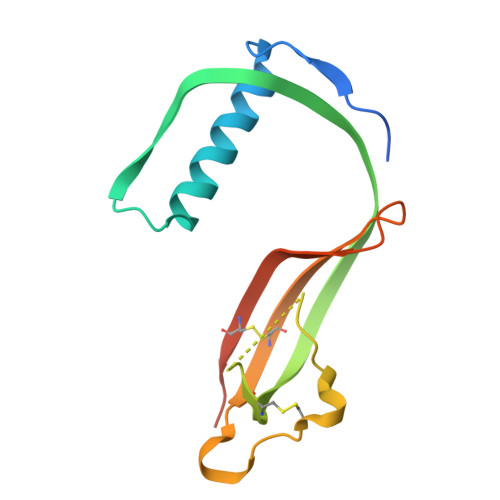
6FK0 | pdb_00006fk0

Xray structure of domain-swapped cystatin E dimer


Experimental Data Snapshot

  • Method: X-RAY DIFFRACTION
  • Resolution: 2.90 Å
  • R-Value Free: 
    0.273 (Depositor), 0.294 (DCC) 
  • R-Value Work: 
    0.268 (Depositor), 0.270 (DCC) 
  • R-Value Observed: 
    0.268 (Depositor) 

Starting Model: experimental
View more details

wwPDB Validation 3D Report Full Report

Validation slider image for 6FK0

This is version 1.3 of the entry. See complete history

Literature

Structural and functional analysis of cystatin E reveals enzymologically relevant dimer and amyloid fibril states.

Dall, E.Hollerweger, J.C.Dahms, S.O.Cui, H.Haussermann, K.Brandstetter, H.

(2018) J Biological Chem 293: 13151-13165

  • DOI: https://doi.org/10.1074/jbc.RA118.002154
  • Primary Citation Related Structures: 
    6FK0

  • PubMed Abstract: 

    Protein activity is often regulated by altering the oligomerization state. One mechanism of multimerization involves domain swapping, wherein proteins exchange parts of their structures and thereby form long-lived dimers or multimers. Domain swapping has been specifically observed in amyloidogenic proteins, for example the cystatin superfamily of cysteine protease inhibitors. Cystatins are twin-headed inhibitors, simultaneously targeting the lysosomal cathepsins and legumain, with important roles in cancer progression and Alzheimer's disease. Although cystatin E is the most potent legumain inhibitor identified so far, nothing is known about its propensity to oligomerize. In this study, we show that conformational destabilization of cystatin E leads to the formation of a domain-swapped dimer with increased conformational stability. This dimer was active as a legumain inhibitor by forming a trimeric complex. By contrast, the binding sites toward papain-like proteases were buried within the cystatin E dimer. We also showed that the dimers could further convert to amyloid fibrils. Unexpectedly, cystatin E amyloid fibrils contained functional protein, which inhibited both legumain and papain-like enzymes. Fibril formation was further regulated by glycosylation. We speculate that cystatin amyloid fibrils might serve as a binding platform to stabilize the pH-sensitive legumain and cathepsins in the extracellular environment, contributing to their physiological and pathological functions.


  • Organizational Affiliation
    • From the Department of Biosciences, University of Salzburg, A-5020 Salzburg, Austria and.

Macromolecule Content 

  • Total Structure Weight: 29.85 kDa 
  • Atom Count: 1,739 
  • Modeled Residue Count: 224 
  • Deposited Residue Count: 262 
  • Unique protein chains: 1

Macromolecules

Find similar proteins by:|  3D Structure
Entity ID: 1
MoleculeChains  Sequence LengthOrganismDetailsImage
Cystatin-M
A, B
131Homo sapiensMutation(s): 0 
Gene Names: CST6
UniProt & NIH Common Fund Data Resources
Find proteins for Q15828 (Homo sapiens)
Explore Q15828 
Go to UniProtKB:  Q15828
PHAROS:  Q15828
GTEx:  ENSG00000175315 
Entity Groups
Sequence Clusters30% Identity50% Identity70% Identity90% Identity95% Identity100% Identity
UniProt GroupQ15828
Sequence Annotations
Expand
Reference Sequence

Experimental Data & Validation

Experimental Data

  • Method: X-RAY DIFFRACTION
  • Resolution: 2.90 Å
  • R-Value Free:  0.273 (Depositor), 0.294 (DCC) 
  • R-Value Work:  0.268 (Depositor), 0.270 (DCC) 
  • R-Value Observed: 0.268 (Depositor) 
Space Group: P 2 2 21
Unit Cell:
Length ( Å )Angle ( ˚ )
a = 31.62α = 90
b = 64.07β = 90
c = 147.73γ = 90
Software Package:
Software NamePurpose
PHENIXrefinement
MOSFLMdata reduction
SCALAdata scaling
PHASERphasing

Structure Validation

View Full Validation Report


Entry History 

& Funding Information

Deposition Data


Funding OrganizationLocationGrant Number
Austrian Science FundAustriaW_01213

Revision History  (Full details and data files)

  • Version 1.0: 2018-07-11
    Type: Initial release
  • Version 1.1: 2018-09-05
    Changes: Data collection, Database references
  • Version 1.2: 2024-01-17
    Changes: Data collection, Database references, Refinement description
  • Version 1.3: 2024-10-16
    Changes: Structure summary