Download Mendeley
Highly active enzymes by automated combinatorial backbone assembly and sequence design.
Lapidoth, G., Khersonsky, O., Lipsh, R., Dym, O., Albeck, S., Rogotner, S., Fleishman, S.J.(2018) Nat Commun 9: 2780-2780
- PubMed: 30018322 Search on PubMedSearch on PubMed Central
- DOI: https://doi.org/10.1038/s41467-018-05205-5
- Primary Citation Related Structures:
6FHE, 6FHF - PubMed Abstract:
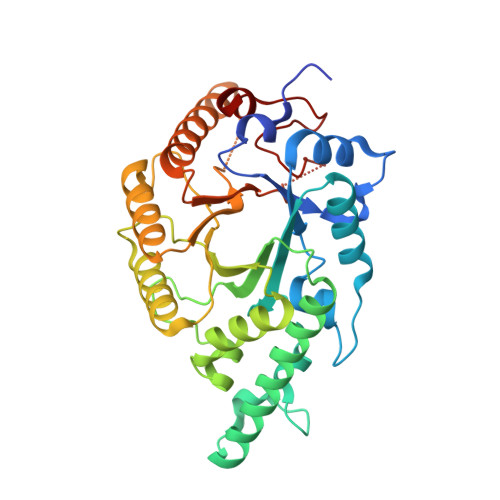
Automated design of enzymes with wild-type-like catalytic properties has been a long-standing but elusive goal. Here, we present a general, automated method for enzyme design through combinatorial backbone assembly. Starting from a set of homologous yet structurally diverse enzyme structures, the method assembles new backbone combinations and uses Rosetta to optimize the amino acid sequence, while conserving key catalytic residues. We apply this method to two unrelated enzyme families with TIM-barrel folds, glycoside hydrolase 10 (GH10) xylanases and phosphotriesterase-like lactonases (PLLs), designing 43 and 34 proteins, respectively. Twenty-one GH10 and seven PLL designs are active, including designs derived from templates with <25% sequence identity. Moreover, four designs are as active as natural enzymes in these families. Atomic accuracy in a high-activity GH10 design is further confirmed by crystallographic analysis. Thus, combinatorial-backbone assembly and design may be used to generate stable, active, and structurally diverse enzymes with altered selectivity or activity.
- Department of Biomolecular Sciences, Weizmann Institute of Science, 7610001, Rehovot, Israel.
Organizational Affiliation: