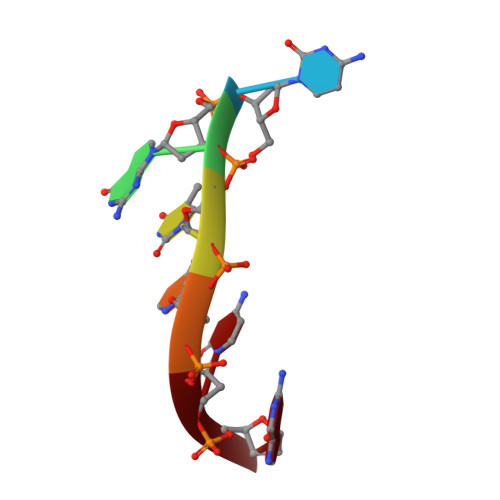
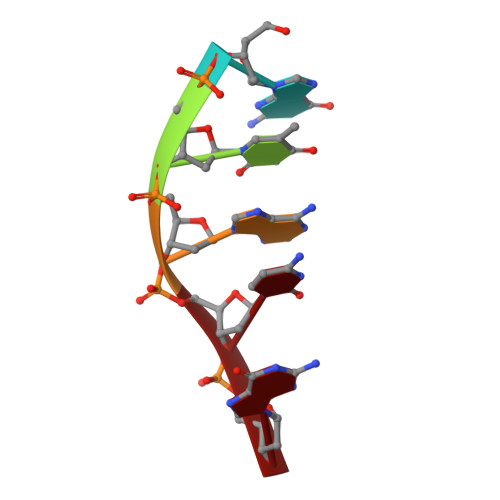
6F3C | pdb_00006f3c

The cytotoxic [Pt(H2bapbpy)] platinum complex interacting with the CGTACG hexamer


Experimental Data Snapshot

  • Method: X-RAY DIFFRACTION
  • Resolution: 2.30 Å
  • R-Value Free: 
    0.292 (Depositor), 0.285 (DCC) 
  • R-Value Work: 
    0.257 (Depositor), 0.273 (DCC) 
  • R-Value Observed: 
    0.261 (Depositor) 

Starting Model: experimental
View more details

wwPDB Validation 3D Report Full Report

Validation slider image for 6F3C

Ligand Structure Quality Assessment 


This is version 1.3 of the entry. See complete history

Literature

Induction of a Four-Way Junction Structure in the DNA Palindromic Hexanucleotide 5'-d(CGTACG)-3' by a Mononuclear Platinum Complex.

van Rixel, V.H.S.Busemann, A.Wissingh, M.F.Hopkins, S.L.Siewert, B.van de Griend, C.Siegler, M.A.Marzo, T.Papi, F.Ferraroni, M.Gratteri, P.Bazzicalupi, C.Messori, L.Bonnet, S.

(2019) Angew Chem Int Ed Engl 58: 9378-9382

  • DOI: https://doi.org/10.1002/anie.201814532
  • Primary Citation Related Structures: 
    6F3C

  • PubMed Abstract: 

    Four-way junctions (4WJs) are supramolecular DNA assemblies comprising four interacting DNA strands that in biology are involved in DNA-damage repair. In this study, a new mononuclear platinum(II) complex 1 was prepared that is capable of driving the crystallization of the DNA oligomer 5'-d(CGTACG)-3' specifically into a 4WJ-like motif. In the crystal structure of the 1-CGTACG adduct, the distorted-square-planar platinum complex binds to the core of the 4WJ-like motif through π-π stacking and hydrogen bonding, without forming any platinum-nitrogen coordination bonds. Our observations suggest that the specific molecular properties of the metal complex are crucially responsible for triggering the selective assembly of this peculiar DNA superstructure.


  • Organizational Affiliation
    • Leiden Institute of Chemistry, Leiden University, Einsteinweg 55, PO Box 9502, 2333CC, Leiden, The Netherlands.

Macromolecule Content 

  • Total Structure Weight: 7.75 kDa 
  • Atom Count: 506 
  • Modeled Residue Count: 22 
  • Deposited Residue Count: 22 
  • Unique nucleic acid chains: 2

Macromolecules

Find similar nucleic acids by:  Sequence
Entity ID: 1
MoleculeChains LengthOrganismImage
DNA (5'-D(*GP*TP*AP*CP*G)-3')A [auth B],
B [auth D]
6synthetic construct
Sequence Annotations
Expand
Reference Sequence
Find similar nucleic acids by:  Sequence
Entity ID: 2
MoleculeChains LengthOrganismImage
DNA (5'-D(*GP*TP*AP*CP*G)-3')C,
D [auth A]
5synthetic construct
Sequence Annotations
Expand
Reference Sequence

Experimental Data & Validation

Experimental Data

  • Method: X-RAY DIFFRACTION
  • Resolution: 2.30 Å
  • R-Value Free:  0.292 (Depositor), 0.285 (DCC) 
  • R-Value Work:  0.257 (Depositor), 0.273 (DCC) 
  • R-Value Observed: 0.261 (Depositor) 
Space Group: P 32 2 1
Unit Cell:
Length ( Å )Angle ( ˚ )
a = 30.09α = 90
b = 30.09β = 90
c = 116.99γ = 120
Software Package:
Software NamePurpose
XDSdata reduction
XSCALEdata scaling
REFMACrefinement
PDB_EXTRACTdata extraction
MOLREPphasing

Structure Validation

View Full Validation Report


Ligand Structure Quality Assessment 


Entry History 

Deposition Data

Revision History  (Full details and data files)

  • Version 1.0: 2019-05-29
    Type: Initial release
  • Version 1.1: 2019-06-05
    Changes: Data collection, Database references
  • Version 1.2: 2019-08-07
    Changes: Data collection, Database references
  • Version 1.3: 2024-01-17
    Changes: Data collection, Database references, Derived calculations, Refinement description