Download Mendeley
Specific phosphorothioate substitution within domain 6 of a group II intron ribozyme leads to changes in local structure and metal ion binding.
Erat, M.C., Besic, E., Oberhuber, M., Johannsen, S., Sigel, R.K.O.(2018) J Biol Inorg Chem 23: 167-177
- PubMed: 29218637 Search on PubMed
- DOI: https://doi.org/10.1007/s00775-017-1519-3
- Primary Citation Related Structures:
6EZ0 - PubMed Abstract:
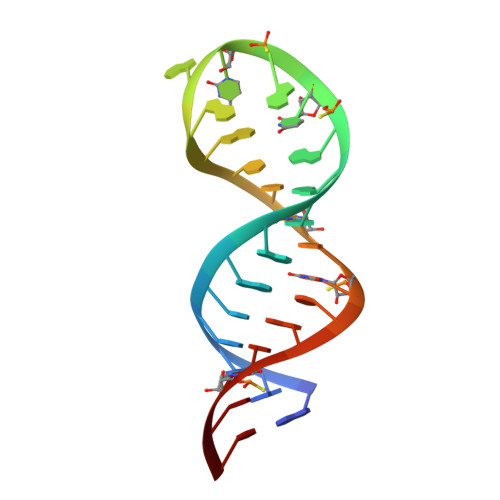
Group II introns are large self-splicing ribozymes that require high amounts of monovalent and divalent metal ions for folding and catalysis under in vitro conditions. Domain 6 of these ribozymes contains a highly conserved adenosine whose 2'-OH acts as a nucleophile during self-cleavage via the branching pathway. We have previously suggested a divalent metal ion that binds to the major groove at the GU wobble pair above the branch-A in a minimal, but active branch domain construct (D6-27) from the yeast mitochondrial intron Sc.ai5γ. Here we characterize metal ion binding to the phosphate oxygens at the branch site. In vitro transcription yielded a D6-27 construct where all R P oxygens of the uridine phosphate groups are replaced by sulfur (α-thio-D6-27). We determined its NMR structure, the second RNA-only structure containing thiophosphate groups. [ 31 P] resonances were assigned and chemical shift changes monitored upon titration with Cd 2+ . In addition, the two uridines flanking the branch-point, U19 and U21 were specifically thioated by chemical synthesis (thio-U19-D6-27 and thio-U19/U21-D6-27), enabling us to study Cd 2+ binding at the R P -, as well as the S P - position of the corresponding phosphate oxygens. Our studies reveal that both non-bridging phosphate oxygens of U19 are involved in metal ion coordination, whereas only the major groove phosphate oxygen of U21 is influenced. Together with NOE data of a hexaamminecobalt(III) titration, this suggests a single metal ion binding site at the GU wobble pair above the branch point in the major groove of D6 of this group II intron ribozyme.
- Department of Chemistry, University of Zürich, Winterthurerstrasse 190, 8057, Zurich, Switzerland.
Organizational Affiliation: