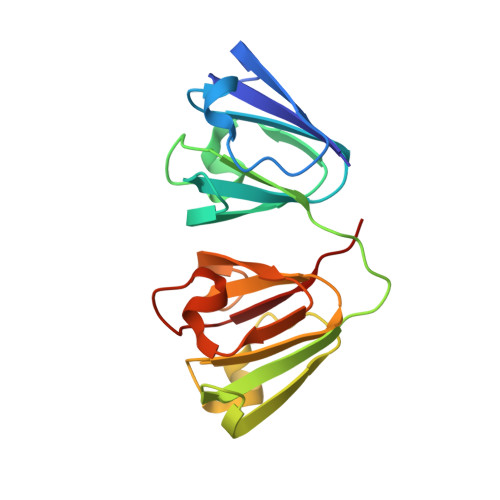
6ETA | pdb_00006eta

Crystal Structure of Human Gamma-D crystallin Mutant P23T+R36S at Room Temperature


Experimental Data Snapshot

  • Method: X-RAY DIFFRACTION
  • Resolution: 2.20 Å
  • R-Value Free: 
    0.265 (Depositor), 0.268 (DCC) 
  • R-Value Work: 
    0.233 (Depositor), 0.235 (DCC) 
  • R-Value Observed: 
    0.234 (Depositor) 

Starting Model: experimental
View more details

wwPDB Validation 3D Report Full Report

Validation slider image for 6ETA

This is version 1.2 of the entry. See complete history

Literature

Temperature-Dependent Interactions Explain Normal and Inverted Solubility in a gamma D-Crystallin Mutant.

Khan, A.R.James, S.Quinn, M.K.Altan, I.Charbonneau, P.McManus, J.J.

(2019) Biophys J 117: 930-937

  • DOI: https://doi.org/10.1016/j.bpj.2019.07.019
  • Primary Citation Related Structures: 
    6ETA, 6ETC

  • PubMed Abstract: 

    Protein crystal production is a major bottleneck in the structural characterization of proteins. To advance beyond large-scale screening, rational strategies for protein crystallization are crucial. Understanding how chemical anisotropy (or patchiness) of the protein surface, due to the variety of amino-acid side chains in contact with solvent, contributes to protein-protein contact formation in the crystal lattice is a major obstacle to predicting and optimizing crystallization. The relative scarcity of sophisticated theoretical models that include sufficient detail to link collective behavior, captured in protein phase diagrams, and molecular-level details, determined from high-resolution structural information, is a further barrier. Here, we present two crystal structures for the P23T + R36S mutant of γD-crystallin, each with opposite solubility behavior: one melts when heated, the other when cooled. When combined with the protein phase diagram and a tailored patchy particle model, we show that a single temperature-dependent interaction is sufficient to stabilize the inverted solubility crystal. This contact, at the P23T substitution site, relates to a genetic cataract and reveals at a molecular level the origin of the lowered and retrograde solubility of the protein. Our results show that the approach employed here may present a productive strategy for the rationalization of protein crystallization.


  • Organizational Affiliation
    • School of Biochemistry and Immunology, Trinity College Dublin, Dublin, Ireland.

Macromolecule Content 

  • Total Structure Weight: 41.4 kDa 
  • Atom Count: 2,888 
  • Modeled Residue Count: 341 
  • Deposited Residue Count: 348 
  • Unique protein chains: 1

Macromolecules

Find similar proteins by:|  3D Structure
Entity ID: 1
MoleculeChains  Sequence LengthOrganismDetailsImage
Gamma-crystallin D
A, B
174Homo sapiensMutation(s): 2 
Gene Names: CRYGDCRYG4
UniProt & NIH Common Fund Data Resources
Find proteins for P07320 (Homo sapiens)
Explore P07320 
Go to UniProtKB:  P07320
PHAROS:  P07320
GTEx:  ENSG00000118231 
Entity Groups
Sequence Clusters30% Identity50% Identity70% Identity90% Identity95% Identity100% Identity
UniProt GroupP07320
Sequence Annotations
Expand
Reference Sequence

Experimental Data & Validation

Experimental Data

  • Method: X-RAY DIFFRACTION
  • Resolution: 2.20 Å
  • R-Value Free:  0.265 (Depositor), 0.268 (DCC) 
  • R-Value Work:  0.233 (Depositor), 0.235 (DCC) 
  • R-Value Observed: 0.234 (Depositor) 
Space Group: P 21 21 21
Unit Cell:
Length ( Å )Angle ( ˚ )
a = 54.036α = 90
b = 82.103β = 90
c = 106.248γ = 90
Software Package:
Software NamePurpose
PHENIXrefinement
XDSdata reduction
Aimlessdata scaling
PHASERphasing

Structure Validation

View Full Validation Report


Entry History 

& Funding Information

Deposition Data


Funding OrganizationLocationGrant Number
Science Foundation IrelandIrelandSFI 12/1A/1239

Revision History  (Full details and data files)

  • Version 1.0: 2018-11-07
    Type: Initial release
  • Version 1.1: 2019-11-27
    Changes: Database references
  • Version 1.2: 2024-01-17
    Changes: Data collection, Database references, Refinement description