6EGM | pdb_00006egm

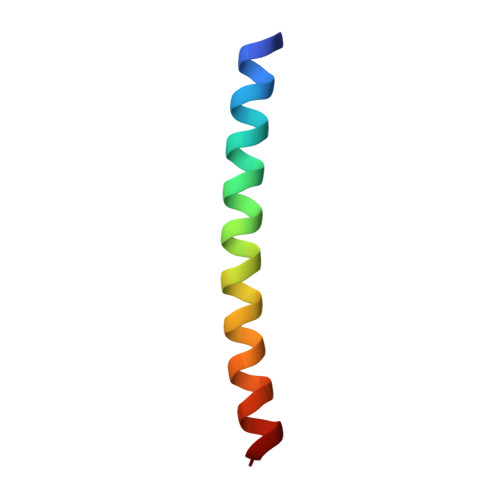
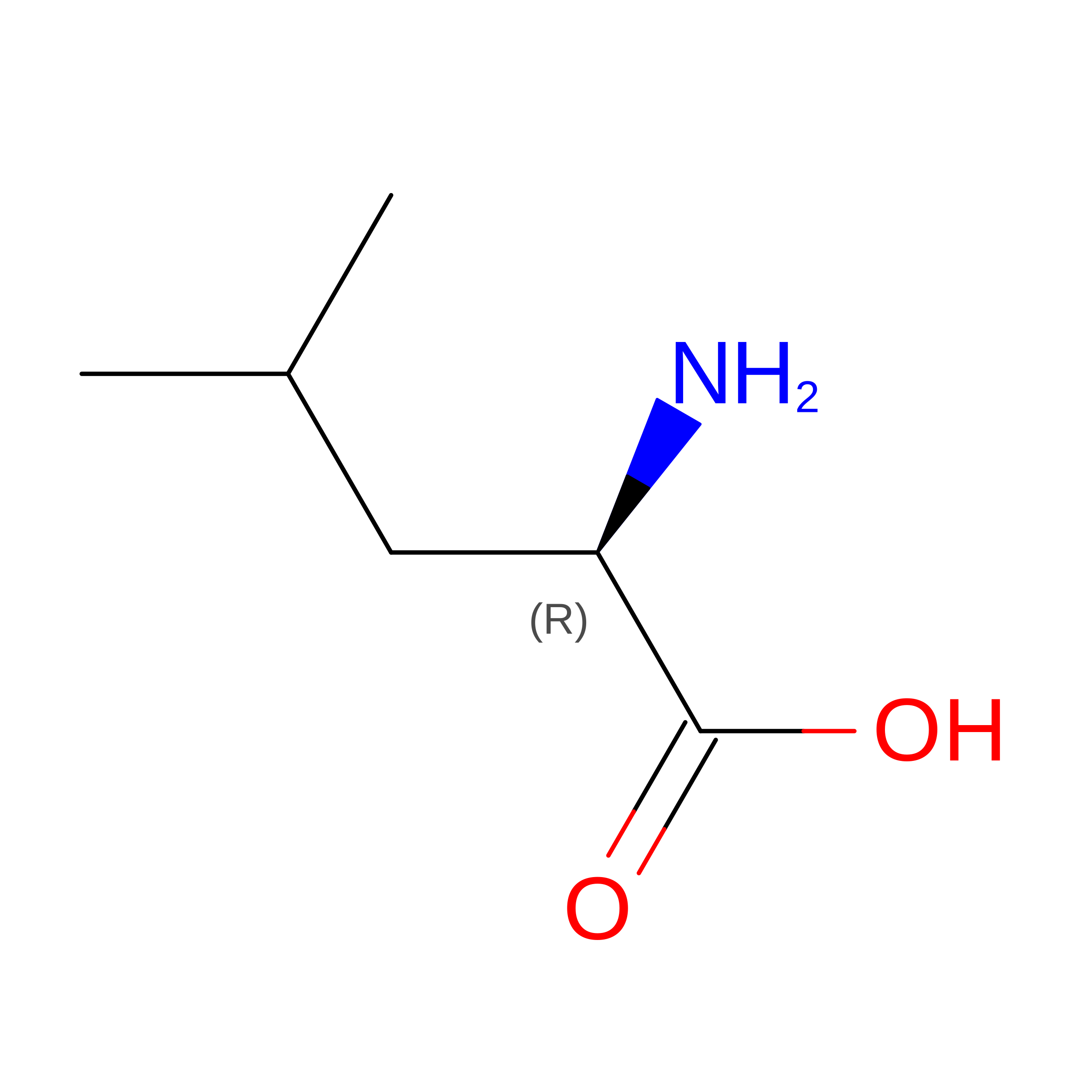
Crystal Structure of a de novo Three-stranded Coiled Coil Peptide Containing D-Leu in a d-site Position of a Tris-thiolate Binding Site


Experimental Data Snapshot

  • Method: X-RAY DIFFRACTION
  • Resolution: 1.84 Å
  • R-Value Free: 
    0.206 (Depositor), 0.213 (DCC) 
  • R-Value Work: 
    0.201 (Depositor), 0.195 (DCC) 
  • R-Value Observed: 
    0.201 (Depositor) 

wwPDB Validation 3D Report Full Report

Validation slider image for 6EGM

This is version 1.4 of the entry. See complete history

Literature

How Outer Coordination Sphere Modifications Can Impact Metal Structures in Proteins: A Crystallographic Evaluation.

Ruckthong, L.Stuckey, J.A.Pecoraro, V.L.

(2019) Chemistry 25: 6773-6787

  • DOI: https://doi.org/10.1002/chem.201806040
  • Primary Citation Related Structures: 
    6EGL, 6EGM, 6EGN, 6EGO

  • PubMed Abstract: 

    A challenging objective of de novo metalloprotein design is to control of the outer coordination spheres of an active site to fine tune metal properties. The well-defined three stranded coiled coils, TRI and CoilSer peptides, are used to address this question. Substitution of Cys for Leu yields a thiophilic site within the core. Metals such as Hg II , Pb II , and As III result in trigonal planar or trigonal pyramidal geometries; however, spectroscopic studies have shown that Cd II forms three-, four- or five-coordinate Cd II S 3 (OH 2 ) x (in which x=0-2) when the outer coordination spheres are perturbed. Unfortunately, there has been little crystallographic examination of these proteins to explain the observations. Here, the high-resolution X-ray structures of apo- and mercurated proteins are compared to explain the modifications that lead to metal coordination number and geometry variation. It reveals that Ala substitution for Leu opens a cavity above the Cys site allowing for water excess, facilitating Cd II S 3 (OH 2 ). Replacement of Cys by Pen restricts thiol rotation, causing a shift in the metal-binding plane, which displaces water, forming Cd II S 3 . Residue d-Leu, above the Cys site, reorients the side chain towards the Cys layer, diminishing the space for water accommodation yielding Cd II S 3 , whereas d-Leu below opens more space, allowing for equal Cd II S 3 (OH 2 ) and Cd II S 3 (OH 2 ) 2 . These studies provide insights into how to control desired metal geometries in metalloproteins by using coded and non-coded amino acids.


  • Organizational Affiliation
    • Department of Chemistry, University of Michigan, Ann Arbor, Michigan, 48109, USA.

Macromolecule Content 

  • Total Structure Weight: 4.18 kDa 
  • Atom Count: 327 
  • Modeled Residue Count: 36 
  • Deposited Residue Count: 36 
  • Unique protein chains: 1

Macromolecules

Find similar proteins by:|  3D Structure
Entity ID: 1
MoleculeChains  Sequence LengthOrganismDetailsImage
Apo-(GRAND CoilSerL16CL19(DLE))336synthetic constructMutation(s): 0 

Small Molecules

Ligands 1 Unique
IDChains Name / Formula / InChI Key2D Diagram3D Interactions
ZN

Query on ZN


Download:Ideal Coordinates CCD File
B [auth A]ZINC ION
Zn
PTFCDOFLOPIGGS-UHFFFAOYSA-N

Experimental Data & Validation

Experimental Data

  • Method: X-RAY DIFFRACTION
  • Resolution: 1.84 Å
  • R-Value Free:  0.206 (Depositor), 0.213 (DCC) 
  • R-Value Work:  0.201 (Depositor), 0.195 (DCC) 
  • R-Value Observed: 0.201 (Depositor) 
Space Group: H 3 2
Unit Cell:
Length ( Å )Angle ( ˚ )
a = 37.898α = 90
b = 37.898β = 90
c = 140.667γ = 120
Software Package:
Software NamePurpose
HKL-2000data scaling
BUSTER-TNTrefinement
PDB_EXTRACTdata extraction
HKL-2000data reduction
MOLREPphasing

Structure Validation

View Full Validation Report


Entry History 

& Funding Information

Deposition Data


Funding OrganizationLocationGrant Number
National Institutes of Health/National Human Genome Research Institute (NIH/NHGRI)United StatesR01ES012236

Revision History  (Full details and data files)

  • Version 1.0: 2019-04-03
    Type: Initial release
  • Version 1.1: 2019-05-08
    Changes: Data collection, Database references
  • Version 1.2: 2019-05-22
    Changes: Data collection, Database references
  • Version 1.3: 2019-12-18
    Changes: Author supporting evidence
  • Version 1.4: 2024-10-16
    Changes: Data collection, Database references, Derived calculations, Structure summary