6DSP | pdb_00006dsp

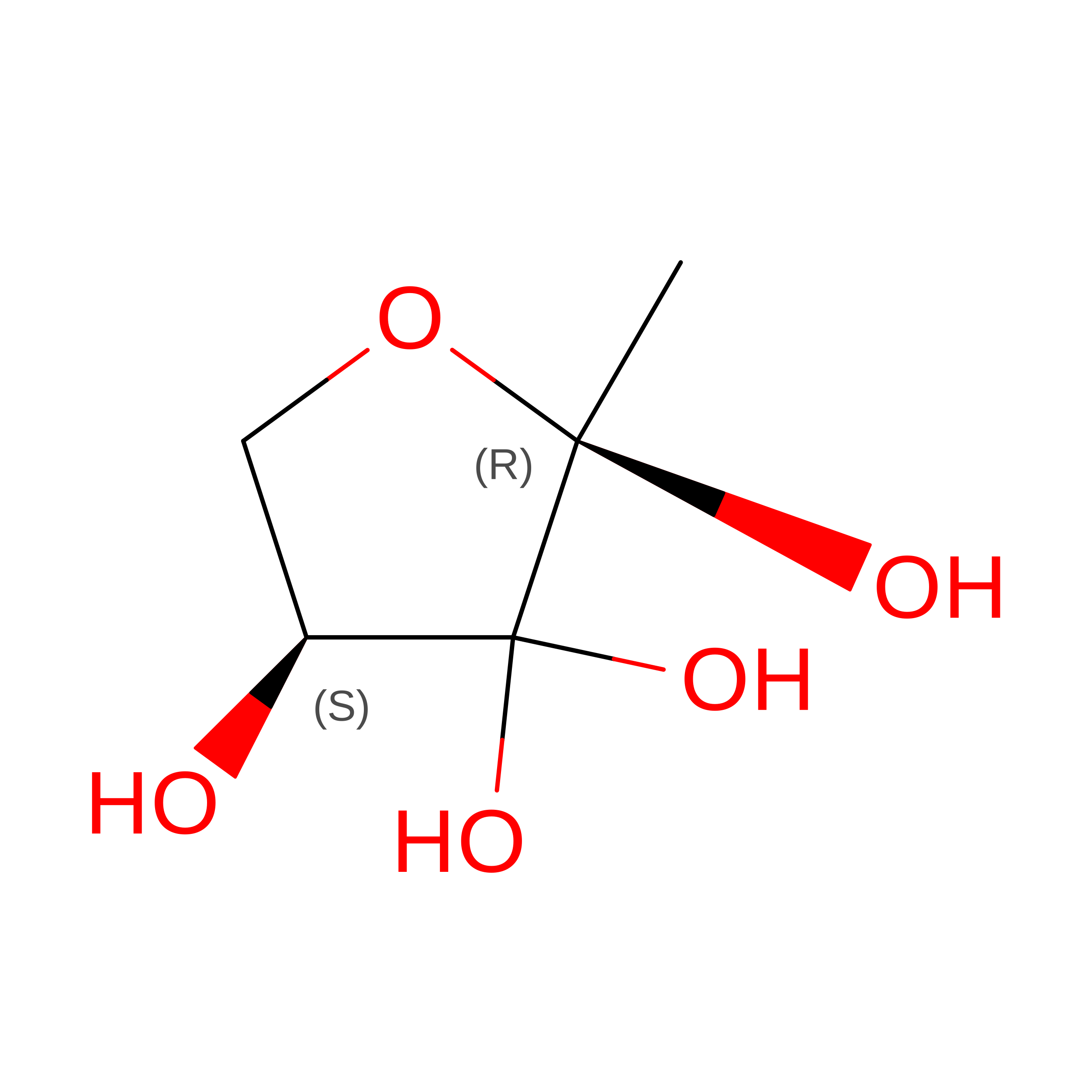
LsrB from Clostridium saccharobutylicum in complex with AI-2


Experimental Data Snapshot

  • Method: X-RAY DIFFRACTION
  • Resolution: 1.37 Å
  • R-Value Free: 
    0.177 (Depositor), 0.177 (DCC) 
  • R-Value Work: 
    0.159 (Depositor), 0.160 (DCC) 

Starting Model: experimental
View more details

wwPDB Validation 3D Report Full Report

Validation slider image for 6DSP

Ligand Structure Quality Assessment 


This is version 2.1 of the entry. See complete history

Literature

Identification of novel autoinducer-2 receptors inClostridiareveals plasticity in the binding site of the LsrB receptor family.

Torcato, I.M.Kasal, M.R.Brito, P.H.Miller, S.T.Xavier, K.B.

(2019) J Biological Chem 294: 4450-4463

  • DOI: https://doi.org/10.1074/jbc.RA118.006938
  • Primary Citation Related Structures: 
    6DSP

  • PubMed Abstract: 

    Autoinducer-2 (AI-2) is unique among quorum-sensing signaling molecules, as it is produced and recognized by a wide variety of bacteria and thus facilitates interspecies communication. To date, two classes of AI-2 receptors have been identified: the LuxP-type, present in the Vibrionales , and the LsrB-type, found in a number of phylogenetically distinct bacterial families. Recently, AI-2 was shown to affect the colonization levels of a variety of bacteria in the microbiome of the mouse gut, including members of the genus Clostridium , but no AI-2 receptor had been identified in this genus. Here, we identify a noncanonical, functional LsrB-type receptor in Clostridium saccharobutylicum. This novel LsrB-like receptor is the first one reported with variations in the binding-site amino acid residues that interact with AI-2. The crystal structure of the C. saccharobutylicum receptor determined at 1.35 Å resolution revealed that it binds the same form of AI-2 as the other known LsrB-type receptors, and isothermal titration calorimetry (ITC) assays showed that binding of AI-2 occurs at a submicromolar concentration. Using phylogenetic analysis, we inferred that the newly identified noncanonical LsrB receptor shares a common ancestor with known LsrB receptors and that noncanonical receptors are present in bacteria from different phyla. This led us to identify putative AI-2 receptors in bacterial species in which no receptors were known, as in bacteria belonging to the Spirochaetes and Actinobacteria phyla. Thus, this work represents a significant step toward understanding how AI-2-mediated quorum sensing influences bacterial interactions in complex biological niches.


  • Organizational Affiliation
    • From the Instituto Gulbenkian de Ciência, Rua da Quinta Grande, 6, 2780-156 Oeiras, Portugal.

Macromolecule Content 

  • Total Structure Weight: 75.06 kDa 
  • Atom Count: 5,327 
  • Modeled Residue Count: 652 
  • Deposited Residue Count: 694 
  • Unique protein chains: 1

Macromolecules

Find similar proteins by:|  3D Structure
Entity ID: 1
MoleculeChains  Sequence LengthOrganismDetailsImage
Autoinducer 2-binding protein LsrB
A, B
347Clostridium saccharobutylicum DSM 13864Mutation(s): 0 
Gene Names: lsrBCLSA_c21430
UniProt
Find proteins for U5MRH9 (Clostridium saccharobutylicum DSM 13864)
Explore U5MRH9 
Go to UniProtKB:  U5MRH9
Entity Groups
Sequence Clusters30% Identity50% Identity70% Identity90% Identity95% Identity100% Identity
UniProt GroupU5MRH9
Sequence Annotations
Expand
Reference Sequence

Small Molecules

Experimental Data & Validation

Experimental Data

  • Method: X-RAY DIFFRACTION
  • Resolution: 1.37 Å
  • R-Value Free:  0.177 (Depositor), 0.177 (DCC) 
  • R-Value Work:  0.159 (Depositor), 0.160 (DCC) 
Space Group: P 43 2 2
Unit Cell:
Length ( Å )Angle ( ˚ )
a = 90.78α = 90
b = 90.78β = 90
c = 182.81γ = 90
Software Package:
Software NamePurpose
PHENIXrefinement
iMOSFLMdata reduction
Aimlessdata scaling
PHASERphasing

Structure Validation

View Full Validation Report


Ligand Structure Quality Assessment 


Entry History 

& Funding Information

Deposition Data


Funding OrganizationLocationGrant Number
Other governmentPortugalPTDC/BIA-MIC/4188/14

Revision History  (Full details and data files)

  • Version 1.0: 2019-02-06
    Type: Initial release
  • Version 1.1: 2019-04-17
    Changes: Author supporting evidence, Data collection
  • Version 1.2: 2019-08-21
    Changes: Data collection, Database references
  • Version 2.0: 2020-07-29
    Type: Remediation
    Reason: Carbohydrate remediation
    Changes: Atomic model, Derived calculations, Structure summary
  • Version 2.1: 2023-10-11
    Changes: Data collection, Database references, Refinement description