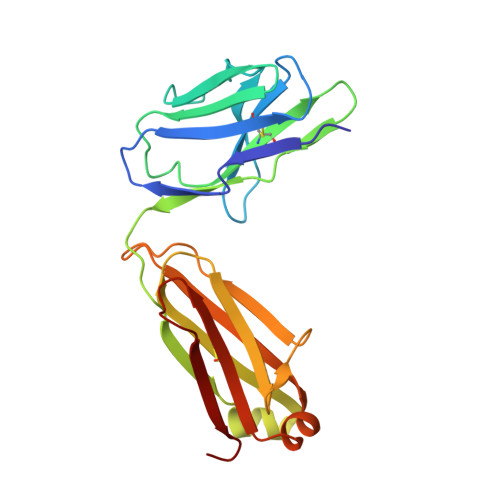
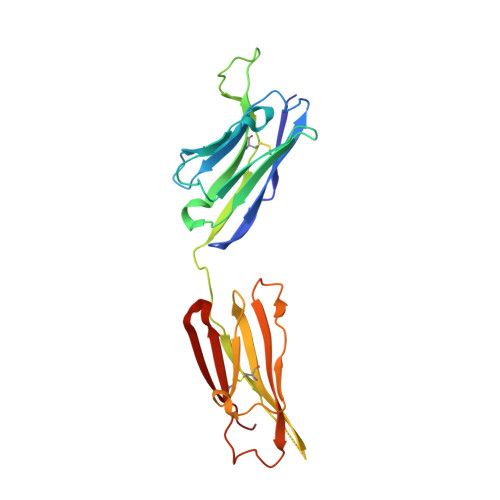
6CXL | pdb_00006cxl

anti-HIV-1 Fab 2G12 in complex with glycopeptide 10F5


Experimental Data Snapshot

  • Method: X-RAY DIFFRACTION
  • Resolution: 3.59 Å
  • R-Value Free: 
    0.248 (Depositor), 0.250 (DCC) 
  • R-Value Work: 
    0.219 (Depositor), 0.221 (DCC) 
  • R-Value Observed: 
    0.220 (Depositor) 

wwPDB Validation 3D Report Full Report

Validation slider image for 6CXL

This is version 2.1 of the entry. See complete history

Literature

Oligomannose Glycopeptide Conjugates Elicit Antibodies Targeting the Glycan Core Rather than Its Extremities.

Nguyen, D.N.Xu, B.Stanfield, R.L.Bailey, J.K.Horiya, S.Temme, J.S.Leon, D.R.LaBranche, C.C.Montefiori, D.C.Costello, C.E.Wilson, I.A.Krauss, I.J.

(2019) ACS Cent Sci 5: 237-249

  • DOI: https://doi.org/10.1021/acscentsci.8b00588
  • Primary Citation Related Structures: 
    6CXG, 6CXL

  • PubMed Abstract: 

    Up to ∼20% of HIV-infected individuals eventually develop broadly neutralizing antibodies (bnAbs), and many of these antibodies (∼40%) target a region of dense high-mannose glycosylation on gp120 of the HIV envelope protein, known as the "high-mannose patch" (HMP). Thus, there have been numerous attempts to develop glycoconjugate vaccine immunogens that structurally mimic the HMP and might elicit bnAbs targeting this conserved neutralization epitope. Herein, we report on the immunogenicity of glycopeptides, designed by in vitro selection, that bind tightly to anti-HMP antibody 2G12. By analyzing the fine carbohydrate specificity of rabbit antibodies elicited by these immunogens, we found that they differ from some natural human bnAbs, such as 2G12 and PGT128, in that they bind primarily to the core structures within the glycan, rather than to the Manα1 → 2Man termini (2G12) or to the whole glycan (PGT128). Antibody specificity for the glycan core may result from extensive serum mannosidase trimming of the immunogen in the vaccinated animals. This finding has broad implications for vaccine design aiming to target glycan-dependent HIV neutralizing antibodies.


  • Organizational Affiliation
    • Department of Chemistry, Brandeis University, Waltham, Massachusetts 02454-9110, United States.

Macromolecule Content 

  • Total Structure Weight: 97.05 kDa 
  • Atom Count: 6,771 
  • Modeled Residue Count: 864 
  • Deposited Residue Count: 874 
  • Unique protein chains: 2

Macromolecules

Find similar proteins by:|  3D Structure
Entity ID: 1
MoleculeChains  Sequence LengthOrganismDetailsImage
anti-HIV-1 Fab 2G12 light chainA [auth L],
C [auth K]
213Homo sapiensMutation(s): 0 
Find similar proteins by:|  3D Structure
Entity ID: 2
MoleculeChains  Sequence LengthOrganismDetailsImage
anti-HIV-1 Fab 2G12 heavy chainB [auth H],
D [auth M]
224Homo sapiensMutation(s): 0 

Oligosaccharides

Help  
Entity ID: 3
MoleculeChains Length2D Diagram GlycosylationD Interactions
alpha-D-mannopyranose-(1-2)-alpha-D-mannopyranose-(1-2)-alpha-D-mannopyranose-(1-3)-[alpha-D-mannopyranose-(1-2)-alpha-D-mannopyranose-(1-3)-[alpha-D-mannopyranose-(1-2)-alpha-D-mannopyranose-(1-6)]alpha-D-mannopyranose-(1-6)]beta-D-mannopyranoseE [auth A],
F [auth B]
9N/A
Glycosylation Resources
GlyTouCan: G27127BL
GlyCosmos: G27127BL

Experimental Data & Validation

Experimental Data

  • Method: X-RAY DIFFRACTION
  • Resolution: 3.59 Å
  • R-Value Free:  0.248 (Depositor), 0.250 (DCC) 
  • R-Value Work:  0.219 (Depositor), 0.221 (DCC) 
  • R-Value Observed: 0.220 (Depositor) 
Space Group: I 2 2 2
Unit Cell:
Length ( Å )Angle ( ˚ )
a = 137.641α = 90
b = 146.308β = 90
c = 148.213γ = 90
Software Package:
Software NamePurpose
PHENIXrefinement
HKL-2000data reduction
HKL-2000data scaling
PHASERphasing

Structure Validation

View Full Validation Report


Entry History 

Deposition Data

Revision History  (Full details and data files)

  • Version 1.0: 2019-02-20
    Type: Initial release
  • Version 1.1: 2019-03-20
    Changes: Data collection, Database references
  • Version 2.0: 2020-07-29
    Type: Remediation
    Reason: Carbohydrate remediation
    Changes: Advisory, Atomic model, Data collection, Derived calculations, Structure summary
  • Version 2.1: 2024-10-23
    Changes: Data collection, Database references, Derived calculations, Structure summary