6CJ3 | pdb_00006cj3

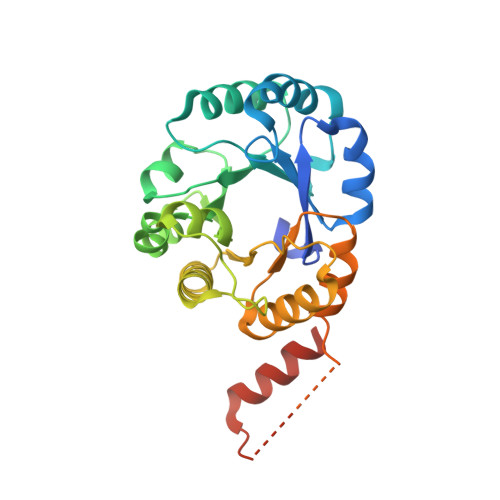
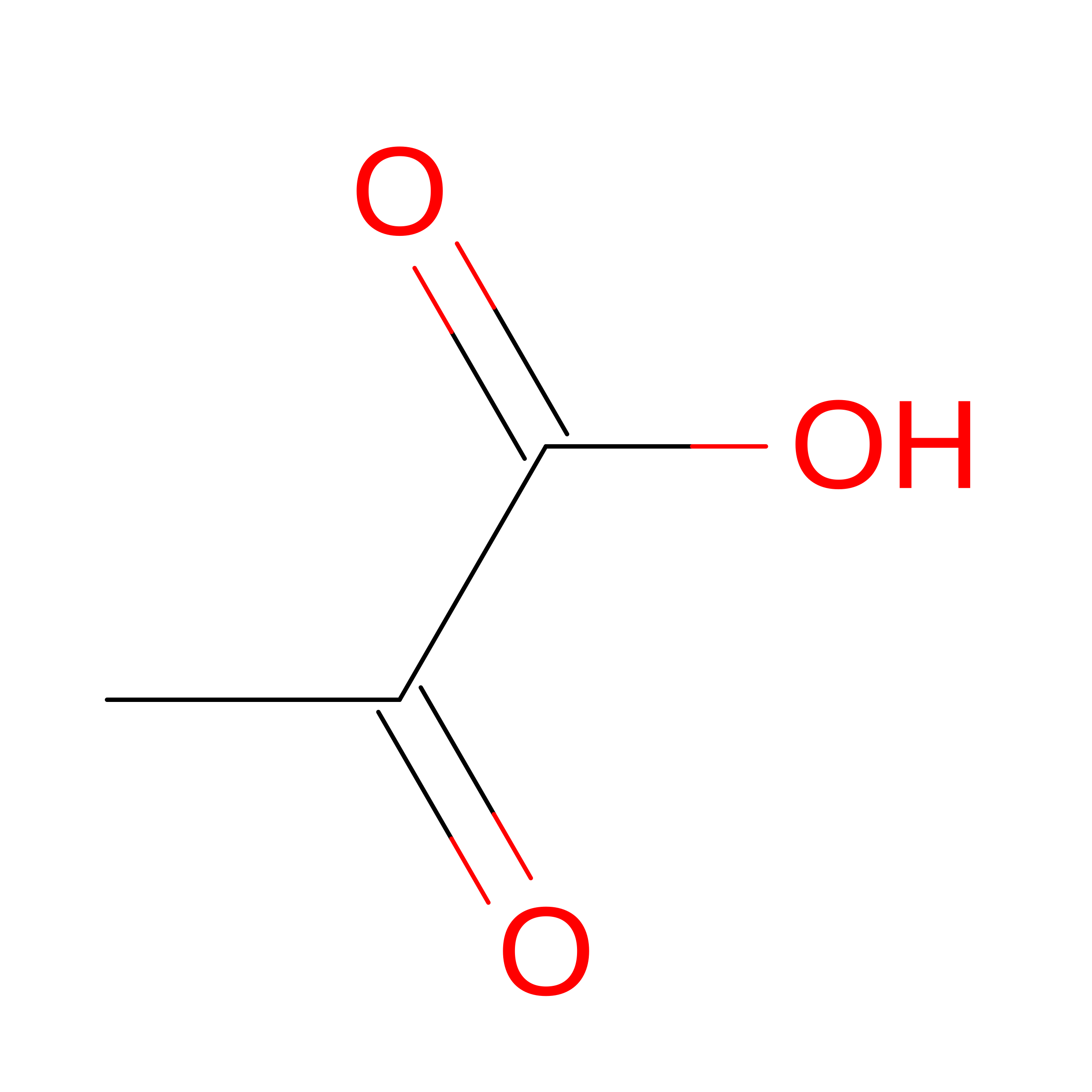
CRYSTAL STRUCTURE OF PROTEIN CITE FROM MYCOBACTERIUM TUBERCULOSIS IN COMPLEX WITH MAGNESIUM AND PYRUVATE


Experimental Data Snapshot

  • Method: X-RAY DIFFRACTION
  • Resolution: 1.73 Å
  • R-Value Free: 
    0.218 (Depositor), 0.217 (DCC) 
  • R-Value Work: 
    0.193 (Depositor), 0.191 (DCC) 
  • R-Value Observed: 
    0.194 (Depositor) 

Starting Model: experimental
View more details

wwPDB Validation 3D Report Full Report

Validation slider image for 6CJ3

This is version 2.0 of the entry. See complete history

Literature

An essential bifunctional enzyme inMycobacterium tuberculosisfor itaconate dissimilation and leucine catabolism.

Wang, H.Fedorov, A.A.Fedorov, E.V.Hunt, D.M.Rodgers, A.Douglas, H.L.Garza-Garcia, A.Bonanno, J.B.Almo, S.C.de Carvalho, L.P.S.

(2019) Proc Natl Acad Sci U S A 116: 15907-15913

  • DOI: https://doi.org/10.1073/pnas.1906606116
  • Primary Citation Related Structures: 
    6AQ4, 6ARB, 6AS5, 6CHU, 6CJ3, 6CJ4

  • PubMed Abstract: 

    Mycobacterium tuberculosis (Mtb) is the etiological agent of tuberculosis. One-fourth of the global population is estimated to be infected with Mtb, accounting for ∼1.3 million deaths in 2017. As part of the immune response to Mtb infection, macrophages produce metabolites with the purpose of inhibiting or killing the bacterial cell. Itaconate is an abundant host metabolite thought to be both an antimicrobial agent and a modulator of the host inflammatory response. However, the exact mode of action of itaconate remains unclear. Here, we show that Mtb has an itaconate dissimilation pathway and that the last enzyme in this pathway, Rv2498c, also participates in l-leucine catabolism. Our results from phylogenetic analysis, in vitro enzymatic assays, X-ray crystallography, and in vivo Mtb experiments, identified Mtb Rv2498c as a bifunctional β-hydroxyacyl-CoA lyase and that deletion of the rv2498c gene from the Mtb genome resulted in attenuation in a mouse infection model. Altogether, this report describes an itaconate resistance mechanism in Mtb and an l-leucine catabolic pathway that proceeds via an unprecedented ( R )-3-hydroxy-3-methylglutaryl-CoA (HMG-CoA) stereospecific route in nature.


  • Organizational Affiliation
    • Mycobacterial Metabolism and Antibiotic Research Laboratory, The Francis Crick Institute, London NW1 1AT, United Kingdom.

Macromolecule Content 

  • Total Structure Weight: 30.33 kDa 
  • Atom Count: 1,937 
  • Modeled Residue Count: 239 
  • Deposited Residue Count: 281 
  • Unique protein chains: 1

Macromolecules

Find similar proteins by:|  3D Structure
Entity ID: 1
MoleculeChains  Sequence LengthOrganismDetailsImage
Citrate lyase subunit beta-like protein281Mycobacterium tuberculosis H37RvMutation(s): 0 
Gene Names: citERv2498c
EC: 4.1
UniProt
Find proteins for P9WPE1 (Mycobacterium tuberculosis (strain ATCC 25618 / H37Rv))
Explore P9WPE1 
Go to UniProtKB:  P9WPE1
Entity Groups
Sequence Clusters30% Identity50% Identity70% Identity90% Identity95% Identity100% Identity
UniProt GroupP9WPE1
Sequence Annotations
Expand
Reference Sequence

Experimental Data & Validation

Experimental Data

  • Method: X-RAY DIFFRACTION
  • Resolution: 1.73 Å
  • R-Value Free:  0.218 (Depositor), 0.217 (DCC) 
  • R-Value Work:  0.193 (Depositor), 0.191 (DCC) 
  • R-Value Observed: 0.194 (Depositor) 
Space Group: H 3 2
Unit Cell:
Length ( Å )Angle ( ˚ )
a = 91.992α = 90
b = 91.992β = 90
c = 221.137γ = 120
Software Package:
Software NamePurpose
PHENIXrefinement
HKL-2000data reduction
HKL-2000data scaling
PHENIXphasing

Structure Validation

View Full Validation Report


Entry History 

Deposition Data

Revision History  (Full details and data files)

  • Version 1.0: 2018-08-01
    Type: Initial release
  • Version 1.1: 2018-08-08
    Changes: Data collection, Structure summary
  • Version 1.2: 2019-02-13
    Changes: Data collection, Database references
  • Version 1.3: 2019-07-31
    Changes: Data collection, Database references
  • Version 1.4: 2019-08-21
    Changes: Data collection, Database references
  • Version 1.5: 2020-07-29
    Changes: Derived calculations, Structure summary
  • Version 1.6: 2023-03-01
    Changes: Database references, Source and taxonomy
  • Version 1.7: 2023-10-25
    Changes: Data collection, Refinement description
  • Version 2.0: 2023-11-15
    Changes: Atomic model, Data collection, Derived calculations