6BXD | pdb_00006bxd

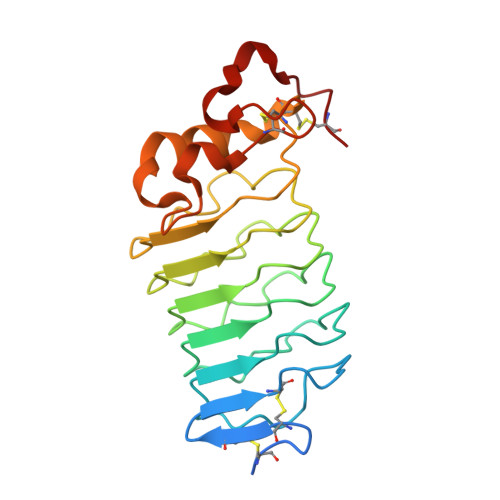
Crystal structure of Variable Lymphocyte Receptor 2 (VLR2)


Experimental Data Snapshot

  • Method: X-RAY DIFFRACTION
  • Resolution: 1.10 Å
  • R-Value Free: 
    0.179 (Depositor), 0.180 (DCC) 
  • R-Value Work: 
    0.177 (Depositor), 0.178 (DCC) 
  • R-Value Observed: 
    0.177 (Depositor) 

Starting Model: experimental
View more details

wwPDB Validation 3D Report Full Report

Validation slider image for 6BXD

This is version 1.5 of the entry. See complete history

Literature

VLR Recognition of TLR5 Expands the Molecular Characterization of Protein Antigen Binding by Non-Ig-based Antibodies.

Gunn, R.J.Herrin, B.R.Acharya, S.Cooper, M.D.Wilson, I.A.

(2018) J Mol Biology 430: 1350-1367

  • DOI: https://doi.org/10.1016/j.jmb.2018.03.016
  • Primary Citation Related Structures: 
    6BXA, 6BXC, 6BXD, 6BXE

  • PubMed Abstract: 

    Variable lymphocyte receptors (VLRs) are unconventional adaptive immune receptors relatively recently discovered in the phylogenetically ancient jawless vertebrates, lamprey and hagfish. VLRs bind antigens using a leucine-rich repeat fold and are the only known adaptive immune receptors that do not utilize an immunoglobulin fold for antigen recognition. While immunoglobulin antibodies have been studied extensively, there are comparatively few studies on antigen recognition by VLRs, particularly for protein antigens. Here we report isolation, functional and structural characterization of three VLRs that bind the protein toll-like receptor 5 (TLR5) from zebrafish. Two of the VLRs block binding of TLR5 to its cognate ligand flagellin in functional assays using reporter cells. Co-crystal structures revealed that these VLRs bind to two different epitopes on TLR5, both of which include regions involved in flagellin binding. Our work here demonstrates that the lamprey adaptive immune system can be used to generate high-affinity VLR clones that recognize different epitopes and differentially impact natural ligand binding to a protein antigen.


  • Organizational Affiliation
    • Department of Integrative Structural and Computational Biology and the Skaggs Institute for Chemical Biology, The Scripps Research Institute, La Jolla, CA 92037, USA.

Macromolecule Content 

  • Total Structure Weight: 22.99 kDa 
  • Atom Count: 1,762 
  • Modeled Residue Count: 192 
  • Deposited Residue Count: 209 
  • Unique protein chains: 1

Macromolecules

Find similar proteins by:|  3D Structure
Entity ID: 1
MoleculeChains  Sequence LengthOrganismDetailsImage
Variable Lymphocyte Receptor 2209Petromyzon marinusMutation(s): 0 

Small Molecules

Ligands 2 Unique
IDChains Name / Formula / InChI Key2D Diagram3D Interactions
ETE

Query on ETE


Download:Ideal Coordinates CCD File
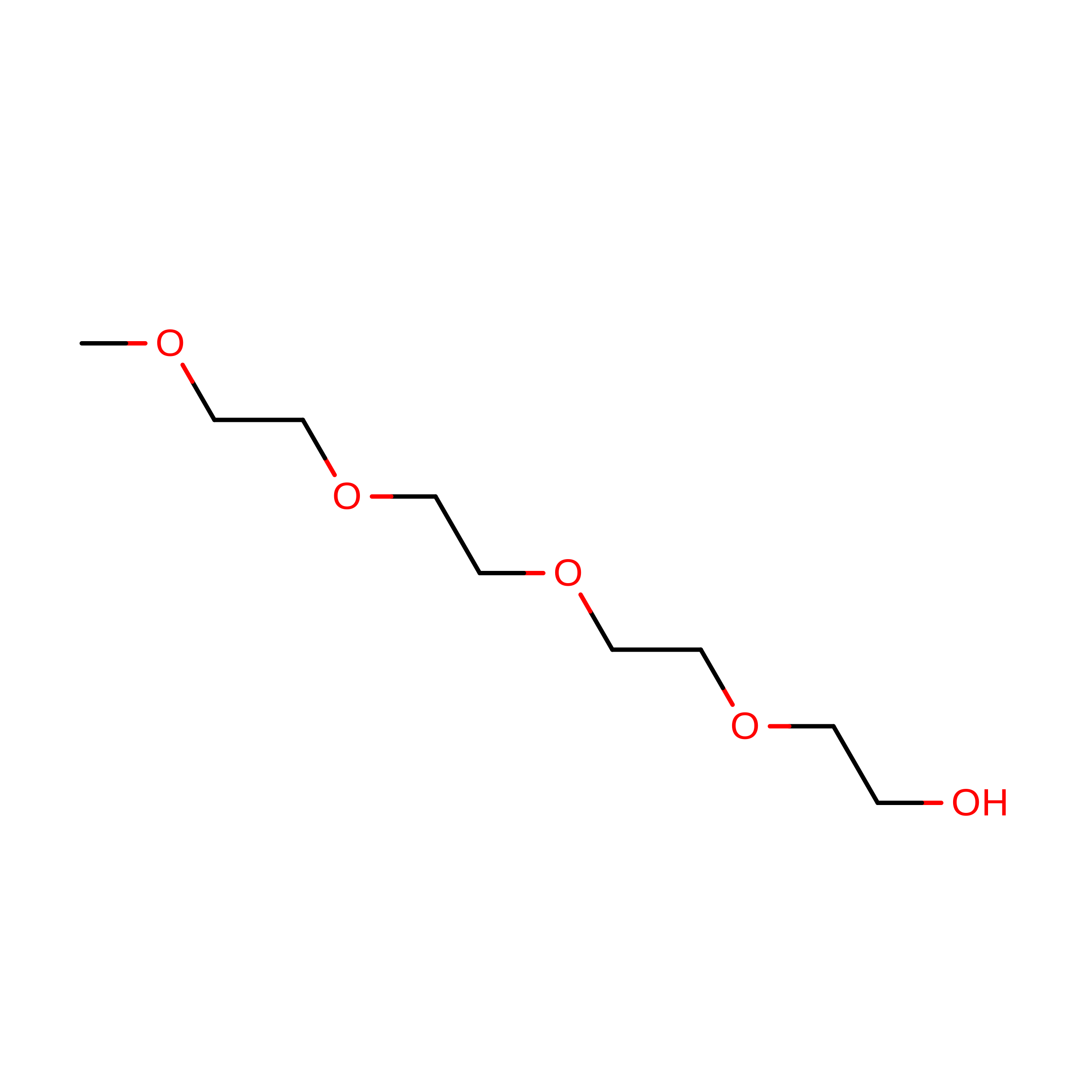
C [auth A]2-{2-[2-2-(METHOXY-ETHOXY)-ETHOXY]-ETHOXY}-ETHANOL
C9 H20 O5
ZNYRFEPBTVGZDN-UHFFFAOYSA-N
SO4

Query on SO4


Download:Ideal Coordinates CCD File
B [auth A]SULFATE ION
O4 S
QAOWNCQODCNURD-UHFFFAOYSA-L

Experimental Data & Validation

Experimental Data

  • Method: X-RAY DIFFRACTION
  • Resolution: 1.10 Å
  • R-Value Free:  0.179 (Depositor), 0.180 (DCC) 
  • R-Value Work:  0.177 (Depositor), 0.178 (DCC) 
  • R-Value Observed: 0.177 (Depositor) 
Space Group: P 21 21 2
Unit Cell:
Length ( Å )Angle ( ˚ )
a = 63.033α = 90
b = 74.731β = 90
c = 40.84γ = 90
Software Package:
Software NamePurpose
PHENIXrefinement
HKL-2000data reduction
HKL-2000data scaling
PHASERphasing

Structure Validation

View Full Validation Report


Entry History 

& Funding Information

Deposition Data


Funding OrganizationLocationGrant Number
National Institutes of Health/National Institute Of Allergy and Infectious Diseases (NIH/NIAID)United StatesA1042266
National Institutes of Health/National Institute Of Allergy and Infectious Diseases (NIH/NIAID)United StatesAI072435

Revision History  (Full details and data files)

  • Version 1.0: 2018-05-09
    Type: Initial release
  • Version 1.1: 2019-02-20
    Changes: Author supporting evidence, Data collection
  • Version 1.2: 2019-12-18
    Changes: Author supporting evidence
  • Version 1.3: 2022-03-23
    Changes: Author supporting evidence, Database references
  • Version 1.4: 2023-10-04
    Changes: Data collection, Refinement description
  • Version 1.5: 2024-11-13
    Changes: Structure summary