6BIG | pdb_00006big

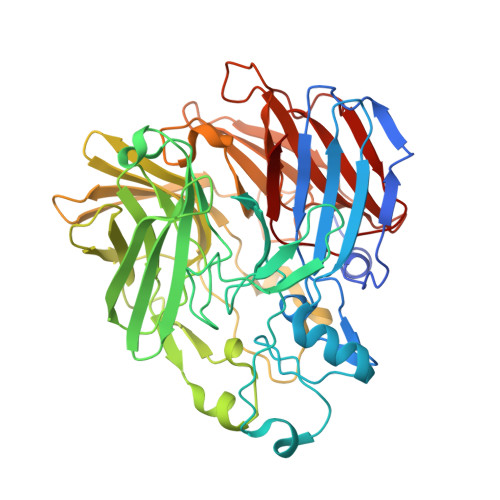
Crystal structure of cobalt-substituted Synechocystis ACO


Experimental Data Snapshot

  • Method: X-RAY DIFFRACTION
  • Resolution: 2.21 Å
  • R-Value Free: 
    0.229 (Depositor), 0.235 (DCC) 
  • R-Value Work: 
    0.208 (Depositor), 0.214 (DCC) 
  • R-Value Observed: 
    0.209 (Depositor) 

Starting Model: experimental
View more details

wwPDB Validation 3D Report Full Report

Validation slider image for 6BIG

This is version 1.5 of the entry. See complete history

Literature

Preparation and characterization of metal-substituted carotenoid cleavage oxygenases.

Sui, X.Farquhar, E.R.Hill, H.E.von Lintig, J.Shi, W.Kiser, P.D.

(2018) J Biol Inorg Chem 23: 887-901

  • DOI: https://doi.org/10.1007/s00775-018-1586-0
  • Primary Citation Related Structures: 
    6B86, 6BIG

  • PubMed Abstract: 

    Carotenoid cleavage oxygenases (CCO) are non-heme iron enzymes that catalyze oxidative cleavage of alkene bonds in carotenoid and stilbenoid substrates. Previously, we showed that the iron cofactor of CAO1, a resveratrol-cleaving member of this family, can be substituted with cobalt to yield a catalytically inert enzyme useful for trapping active site-bound stilbenoid substrates for structural characterization. Metal substitution may provide a general method for identifying the natural substrates for CCOs in addition to facilitating structural and biophysical characterization of CCO-carotenoid complexes under normal aerobic conditions. Here, we demonstrate the general applicability of cobalt substitution in a prototypical carotenoid cleaving CCO, apocarotenoid oxygenase (ACO) from Synechocystis. Among the non-native divalent metals investigated, cobalt was uniquely able to stably occupy the ACO metal binding site and inhibit catalysis. Analysis by X-ray crystallography and X-ray absorption spectroscopy demonstrate that the Co(II) forms of both ACO and CAO1 exhibit a close structural correspondence to the native Fe(II) enzyme forms. Hence, cobalt substitution is an effective strategy for generating catalytically inert but structurally intact forms of CCOs.


  • Organizational Affiliation
    • Department of Pharmacology, School of Medicine, Case Western Reserve University, 10900 Euclid Ave., Cleveland, OH, 44106, USA.

Macromolecule Content 

  • Total Structure Weight: 217.72 kDa 
  • Atom Count: 15,788 
  • Modeled Residue Count: 1,916 
  • Deposited Residue Count: 1,960 
  • Unique protein chains: 1

Macromolecules

Find similar proteins by:|  3D Structure
Entity ID: 1
MoleculeChains  Sequence LengthOrganismDetailsImage
Apocarotenoid-15,15'-oxygenase
A, B, C, D
490Synechocystis sp. PCC 6803 substr. KazusaMutation(s): 0 
Gene Names: sll1541
EC: 1.13.11.75
UniProt
Find proteins for P74334 (Synechocystis sp. (strain ATCC 27184 / PCC 6803 / Kazusa))
Explore P74334 
Go to UniProtKB:  P74334
Entity Groups
Sequence Clusters30% Identity50% Identity70% Identity90% Identity95% Identity100% Identity
UniProt GroupP74334
Sequence Annotations
Expand
Reference Sequence

Experimental Data & Validation

Experimental Data

  • Method: X-RAY DIFFRACTION
  • Resolution: 2.21 Å
  • R-Value Free:  0.229 (Depositor), 0.235 (DCC) 
  • R-Value Work:  0.208 (Depositor), 0.214 (DCC) 
  • R-Value Observed: 0.209 (Depositor) 
Space Group: P 21 21 21
Unit Cell:
Length ( Å )Angle ( ˚ )
a = 118.074α = 90
b = 124.531β = 90
c = 202.608γ = 90
Software Package:
Software NamePurpose
REFMACrefinement
XDSdata reduction
XDSdata scaling
REFMACphasing

Structure Validation

View Full Validation Report


Entry History 

& Funding Information

Deposition Data


Funding OrganizationLocationGrant Number
National Institutes of Health/National Eye Institute (NIH/NEI)United StatesEY009339

Revision History  (Full details and data files)

  • Version 1.0: 2018-07-04
    Type: Initial release
  • Version 1.1: 2018-08-01
    Changes: Data collection, Database references
  • Version 1.2: 2018-08-08
    Changes: Data collection, Database references
  • Version 1.3: 2019-02-20
    Changes: Author supporting evidence, Data collection
  • Version 1.4: 2019-12-11
    Changes: Author supporting evidence
  • Version 1.5: 2023-10-04
    Changes: Data collection, Database references, Derived calculations, Refinement description