6BI2 | pdb_00006bi2

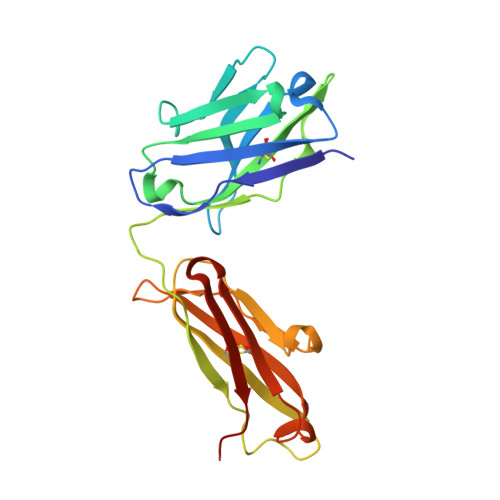
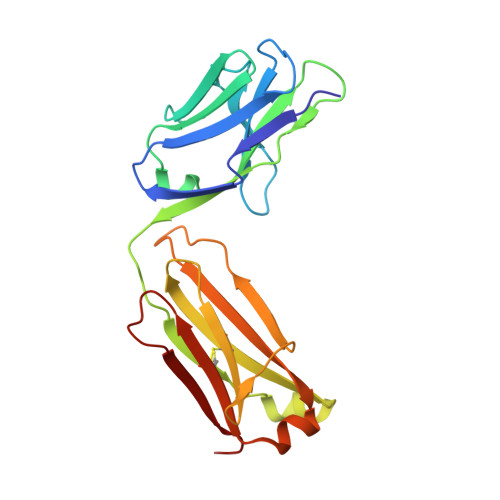
Trastuzumab Fab D185A (Light Chain) Mutant Biotin Conjugation.


Experimental Data Snapshot

  • Method: X-RAY DIFFRACTION
  • Resolution: 1.80 Å
  • R-Value Free: 
    0.202 (Depositor) 
  • R-Value Work: 
    0.166 (Depositor) 
  • R-Value Observed: 
    0.168 (Depositor) 

Starting Model: experimental
View more details

wwPDB Validation 3D Report Full Report

Validation slider image for 6BI2

Ligand Structure Quality Assessment 


This is version 1.4 of the entry. See complete history

Literature

Tuning a Protein-Labeling Reaction to Achieve Highly Site Selective Lysine Conjugation.

Pham, G.H.Ou, W.Bursulaya, B.DiDonato, M.Herath, A.Jin, Y.Hao, X.Loren, J.Spraggon, G.Brock, A.Uno, T.Geierstanger, B.H.Cellitti, S.E.

(2018) Chembiochem 19: 799-804

  • DOI: https://doi.org/10.1002/cbic.201700611
  • Primary Citation Related Structures: 
    6BHZ, 6BI0, 6BI2

  • PubMed Abstract: 

    Activated esters are widely used to label proteins at lysine side chains and N termini. These reagents are useful for labeling virtually any protein, but robust reactivity toward primary amines generally precludes site-selective modification. In a unique case, fluorophenyl esters are shown to preferentially label human kappa antibodies at a single lysine (Lys188) within the light-chain constant domain. Neighboring residues His189 and Asp151 contribute to the accelerated rate of labeling at Lys188 relative to the ≈40 other lysine sites. Enriched Lys188 labeling can be enhanced from 50-70 % to >95 % by any of these approaches: lowering reaction temperature, applying flow chemistry, or mutagenesis of specific residues in the surrounding protein environment. Our results demonstrated that activated esters with fluoro-substituted aromatic leaving groups, including a fluoronaphthyl ester, can be generally useful reagents for site-selective lysine labeling of antibodies and other immunoglobulin-type proteins.


  • Organizational Affiliation
    • Genomics Institute of the Novartis Research Foundation (GNF), Biotherapeutics & Biotechnology, 10675 John Jay Hopkins Drive, San Diego, CA, 92121, USA.

Macromolecule Content 

  • Total Structure Weight: 95.74 kDa 
  • Atom Count: 7,536 
  • Modeled Residue Count: 861 
  • Deposited Residue Count: 878 
  • Unique protein chains: 2

Macromolecules

Find similar proteins by:|  3D Structure
Entity ID: 1
MoleculeChains  Sequence LengthOrganismDetailsImage
Trastuzumab Anti-HER2 Fab Heavy ChainA [auth H],
C [auth I]
225Homo sapiensMutation(s): 0 
Find similar proteins by:|  3D Structure
Entity ID: 2
MoleculeChains  Sequence LengthOrganismDetailsImage
Trastuzumab Anti-HER2 Fab Light ChainB [auth L],
D [auth M]
214Homo sapiensMutation(s): 0 

Small Molecules

Ligands 2 Unique
IDChains Name / Formula / InChI Key2D Diagram3D Interactions
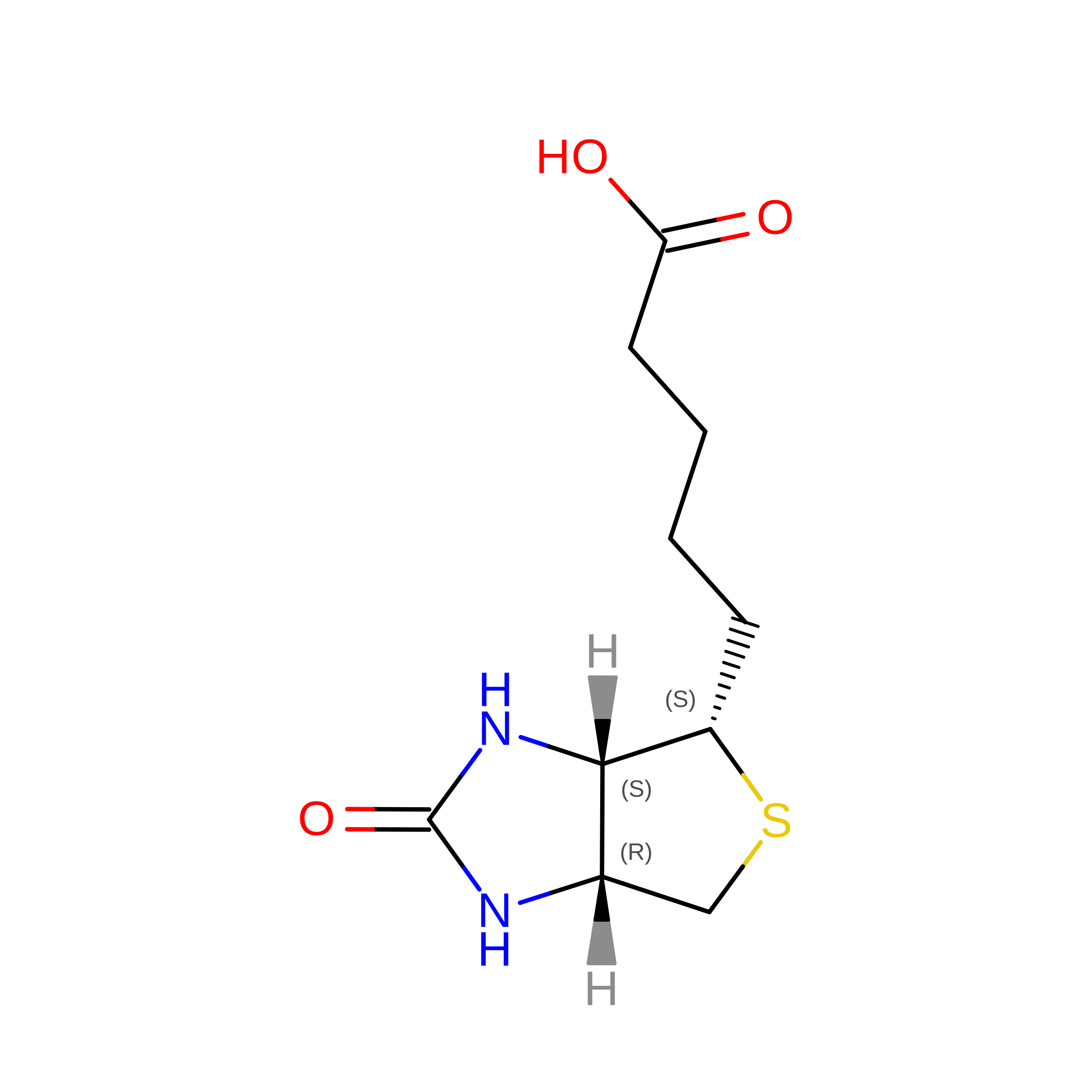
BTN
(Subject of Investigation/LOI)

Query on BTN


Download:Ideal Coordinates CCD File
G [auth L],
M
BIOTIN
C10 H16 N2 O3 S
YBJHBAHKTGYVGT-ZKWXMUAHSA-N
EDO

Query on EDO


Download:Ideal Coordinates CCD File
E [auth H]
F [auth H]
H [auth L]
I [auth L]
J [auth I]
E [auth H],
F [auth H],
H [auth L],
I [auth L],
J [auth I],
K [auth I],
L [auth I]
1,2-ETHANEDIOL
C2 H6 O2
LYCAIKOWRPUZTN-UHFFFAOYSA-N

Experimental Data & Validation

Experimental Data

  • Method: X-RAY DIFFRACTION
  • Resolution: 1.80 Å
  • R-Value Free:  0.202 (Depositor) 
  • R-Value Work:  0.166 (Depositor) 
  • R-Value Observed: 0.168 (Depositor) 
Space Group: P 1
Unit Cell:
Length ( Å )Angle ( ˚ )
a = 38.646α = 109.8
b = 69.139β = 100.29
c = 91.471γ = 90.08
Software Package:
Software NamePurpose
PHENIXrefinement
HKL-2000data reduction
SCALEPACKdata scaling
PHASERphasing
Cootmodel building

Structure Validation

View Full Validation Report


Ligand Structure Quality Assessment 


Entry History 

Deposition Data

Revision History  (Full details and data files)

  • Version 1.0: 2018-02-14
    Type: Initial release
  • Version 1.1: 2018-03-28
    Changes: Data collection, Database references
  • Version 1.2: 2018-04-25
    Changes: Data collection, Database references
  • Version 1.3: 2023-10-04
    Changes: Data collection, Database references, Refinement description
  • Version 1.4: 2024-10-30
    Changes: Structure summary