6B0W | pdb_00006b0w

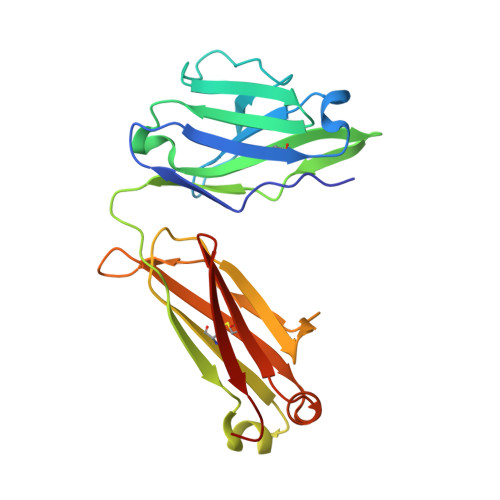
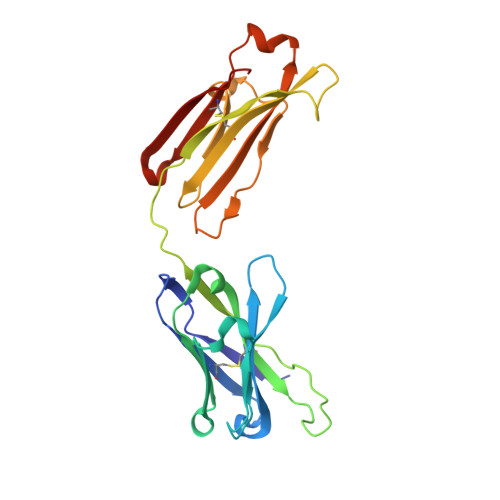
Crystal structure of the anti-circumsporozoite protein 1710 antibody


Experimental Data Snapshot

  • Method: X-RAY DIFFRACTION
  • Resolution: 1.90 Å
  • R-Value Free: 
    0.218 (Depositor), 0.218 (DCC) 
  • R-Value Work: 
    0.183 (Depositor), 0.184 (DCC) 
  • R-Value Observed: 
    0.185 (Depositor) 

Starting Model: experimental
View more details

wwPDB Validation 3D Report Full Report

Validation slider image for 6B0W

This is version 1.4 of the entry. See complete history

Literature

Rare PfCSP C-terminal antibodies induced by live sporozoite vaccination are ineffective against malaria infection.

Scally, S.W.Murugan, R.Bosch, A.Triller, G.Costa, G.Mordmuller, B.Kremsner, P.G.Sim, B.K.L.Hoffman, S.L.Levashina, E.A.Wardemann, H.Julien, J.P.

(2018) J Exp Medicine 215: 63-75

  • DOI: https://doi.org/10.1084/jem.20170869
  • Primary Citation Related Structures: 
    6B0S, 6B0W

  • PubMed Abstract: 

    Antibodies against the central repeat of the Plasmodium falciparum (Pf) circumsporozoite protein (CSP) inhibit parasite activity and correlate with protection from malaria. However, the humoral response to the PfCSP C terminus (C-PfCSP) is less well characterized. Here, we describe B cell responses to C-PfCSP from European donors who underwent immunization with live Pf sporozoites (PfSPZ Challenge) under chloroquine prophylaxis (PfSPZ-CVac), and were protected against controlled human malaria infection. Out of 215 PfCSP-reactive monoclonal antibodies, only two unique antibodies were specific for C-PfCSP, highlighting the rare occurrence of C-PfCSP-reactive B cells in PfSPZ-CVac-induced protective immunity. These two antibodies showed poor sporozoite binding and weak inhibition of parasite traversal and development, and did not protect mice from infection with PfCSP transgenic Plasmodium berghei sporozoites. Structural analyses demonstrated that one antibody interacts with a polymorphic region overlapping two T cell epitopes, suggesting that variability in C-PfCSP may benefit parasite escape from humoral and cellular immunity. Our data identify important features underlying C-PfCSP shortcomings as a vaccine target.


  • Organizational Affiliation
    • Program in Molecular Medicine, Hospital for Sick Children Research Institute, Toronto, Ontario, Canada.

Macromolecule Content 

  • Total Structure Weight: 47.48 kDa 
  • Atom Count: 3,544 
  • Modeled Residue Count: 433 
  • Deposited Residue Count: 439 
  • Unique protein chains: 2

Macromolecules

Find similar proteins by:|  3D Structure
Entity ID: 1
MoleculeChains  Sequence LengthOrganismDetailsImage
1710 antibody, light chainA [auth L]213Homo sapiensMutation(s): 0 
Find similar proteins by:|  3D Structure
Entity ID: 2
MoleculeChains  Sequence LengthOrganismDetailsImage
1710 antibody, heavy chainB [auth H]226Homo sapiensMutation(s): 0 

Small Molecules

Ligands 2 Unique
IDChains Name / Formula / InChI Key2D Diagram3D Interactions
GOL

Query on GOL


Download:Ideal Coordinates CCD File
D [auth L]
E [auth L]
F [auth L]
G [auth L]
M [auth H]
D [auth L],
E [auth L],
F [auth L],
G [auth L],
M [auth H],
N [auth H]
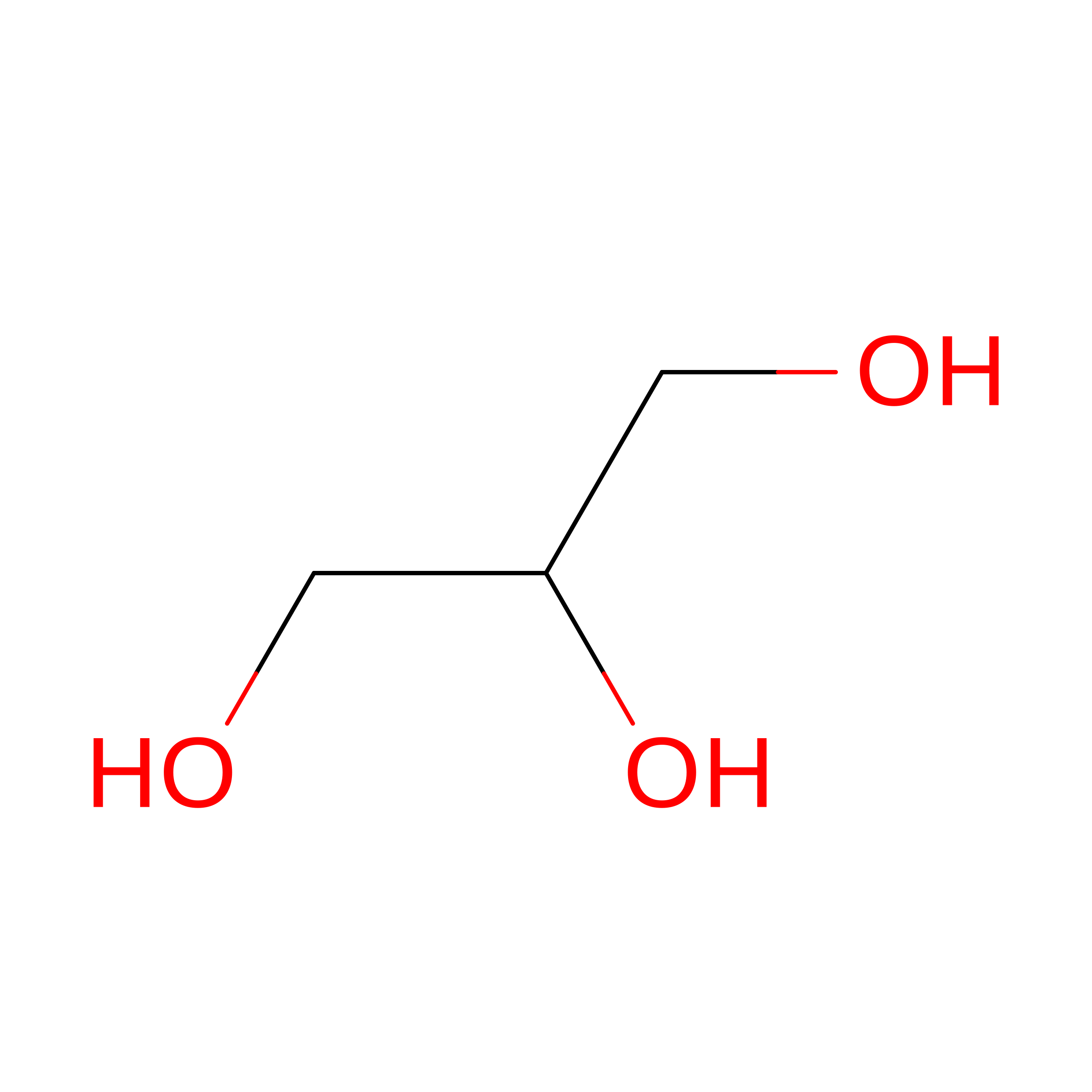
GLYCEROL
C3 H8 O3
PEDCQBHIVMGVHV-UHFFFAOYSA-N
IPA

Query on IPA


Download:Ideal Coordinates CCD File
C [auth L]
H
I [auth H]
J [auth H]
K [auth H]
C [auth L],
H,
I [auth H],
J [auth H],
K [auth H],
L [auth H]
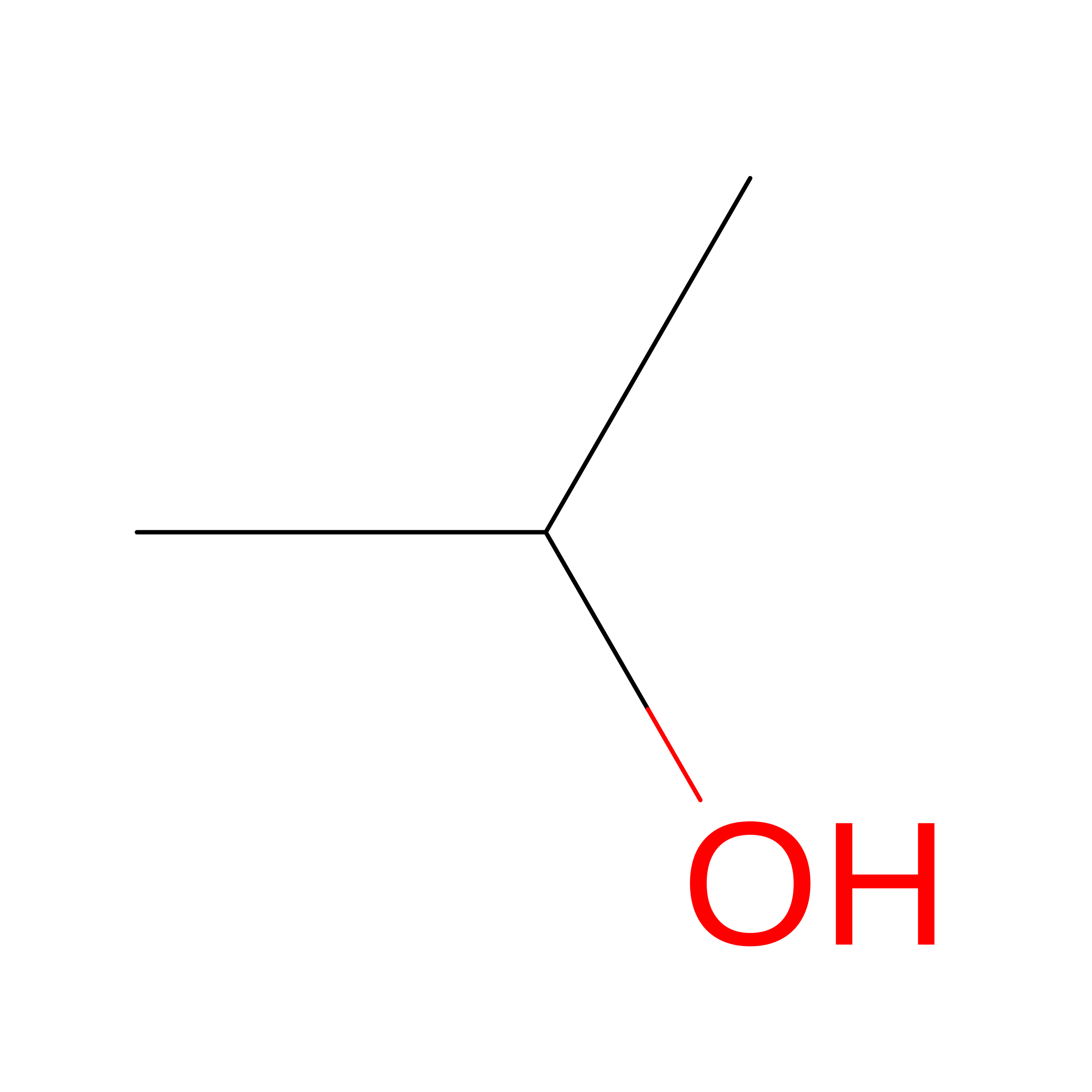
ISOPROPYL ALCOHOL
C3 H8 O
KFZMGEQAYNKOFK-UHFFFAOYSA-N

Experimental Data & Validation

Experimental Data

  • Method: X-RAY DIFFRACTION
  • Resolution: 1.90 Å
  • R-Value Free:  0.218 (Depositor), 0.218 (DCC) 
  • R-Value Work:  0.183 (Depositor), 0.184 (DCC) 
  • R-Value Observed: 0.185 (Depositor) 
Space Group: P 21 21 21
Unit Cell:
Length ( Å )Angle ( ˚ )
a = 61.063α = 90
b = 66.724β = 90
c = 124.027γ = 90
Software Package:
Software NamePurpose
PHENIXrefinement
XDSdata reduction
XPREPdata scaling
PHENIXphasing

Structure Validation

View Full Validation Report


Entry History 

Deposition Data

Revision History  (Full details and data files)

  • Version 1.0: 2017-11-08
    Type: Initial release
  • Version 1.1: 2017-12-06
    Changes: Database references
  • Version 1.2: 2018-01-10
    Changes: Database references
  • Version 1.3: 2023-10-04
    Changes: Data collection, Database references, Refinement description
  • Version 1.4: 2024-10-30
    Changes: Structure summary