6ATE | pdb_00006ate

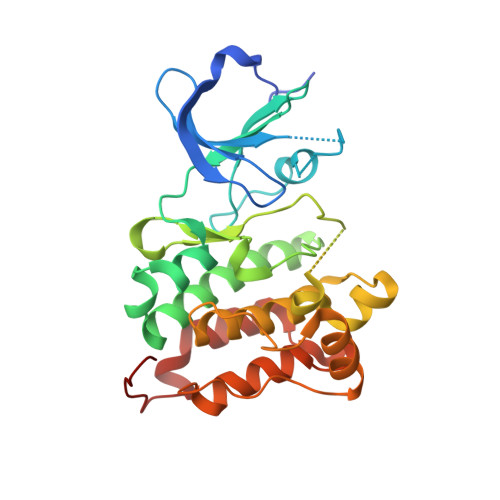
SRC kinase bound to covalent inhibitor


Experimental Data Snapshot

  • Method: X-RAY DIFFRACTION
  • Resolution: 2.40 Å
  • R-Value Free: 
    0.228 (Depositor), 0.225 (DCC) 
  • R-Value Work: 
    0.193 (Depositor) 
  • R-Value Observed: 
    0.195 (Depositor) 

Starting Model: experimental
View more details

wwPDB Validation 3D Report Full Report

Validation slider image for 6ATE

Ligand Structure Quality Assessment 


This is version 2.2 of the entry. See complete history

Literature

Leveraging Compound Promiscuity to Identify Targetable Cysteines within the Kinome.

Rao, S.Gurbani, D.Du, G.Everley, R.A.Browne, C.M.Chaikuad, A.Tan, L.Schroder, M.Gondi, S.Ficarro, S.B.Sim, T.Kim, N.D.Berberich, M.J.Knapp, S.Marto, J.A.Westover, K.D.Sorger, P.K.Gray, N.S.

(2019) Cell Chem Biol 26: 818-829.e9

  • DOI: https://doi.org/10.1016/j.chembiol.2019.02.021
  • Primary Citation Related Structures: 
    6ATE, 6G54, 6GES

  • PubMed Abstract: 

    Covalent kinase inhibitors, which typically target cysteine residues, represent an important class of clinically relevant compounds. Approximately 215 kinases are known to have potentially targetable cysteines distributed across 18 spatially distinct locations proximal to the ATP-binding pocket. However, only 40 kinases have been covalently targeted, with certain cysteine sites being the primary focus. To address this disparity, we have developed a strategy that combines the use of a multi-targeted acrylamide-modified inhibitor, SM1-71, with a suite of complementary chemoproteomic and cellular approaches to identify additional targetable cysteines. Using this single multi-targeted compound, we successfully identified 23 kinases that are amenable to covalent inhibition including MKNK2, MAP2K1/2/3/4/6/7, GAK, AAK1, BMP2K, MAP3K7, MAPKAPK5, GSK3A/B, MAPK1/3, SRC, YES1, FGFR1, ZAK (MLTK), MAP3K1, LIMK1, and RSK2. The identification of nine of these kinases previously not targeted by a covalent inhibitor increases the number of targetable kinases and highlights opportunities for covalent kinase inhibitor development.


  • Organizational Affiliation
    • Laboratory of Systems Pharmacology, Harvard Medical School, Boston, MA 02115, USA; Department of Cancer Biology, Dana-Farber Cancer Institute, Boston, MA 02115, USA; Department of Biological Chemistry and Molecular Pharmacology, Harvard Medical School, Boston, MA 02115, USA.

Macromolecule Content 

  • Total Structure Weight: 33.18 kDa 
  • Atom Count: 2,155 
  • Modeled Residue Count: 255 
  • Deposited Residue Count: 286 
  • Unique protein chains: 1

Macromolecules

Find similar proteins by:|  3D Structure
Entity ID: 1
MoleculeChains  Sequence LengthOrganismDetailsImage
Proto-oncogene tyrosine-protein kinase Src286Homo sapiensMutation(s): 0 
Gene Names: SRCSRC1
EC: 2.7.10.2
UniProt & NIH Common Fund Data Resources
Find proteins for P12931 (Homo sapiens)
Explore P12931 
Go to UniProtKB:  P12931
PHAROS:  P12931
GTEx:  ENSG00000197122 
Entity Groups
Sequence Clusters30% Identity50% Identity70% Identity90% Identity95% Identity100% Identity
UniProt GroupP12931
Sequence Annotations
Expand
Reference Sequence

Small Molecules

Ligands 1 Unique
IDChains Name / Formula / InChI Key2D Diagram3D Interactions
6H3

Query on 6H3


Download:Ideal Coordinates CCD File
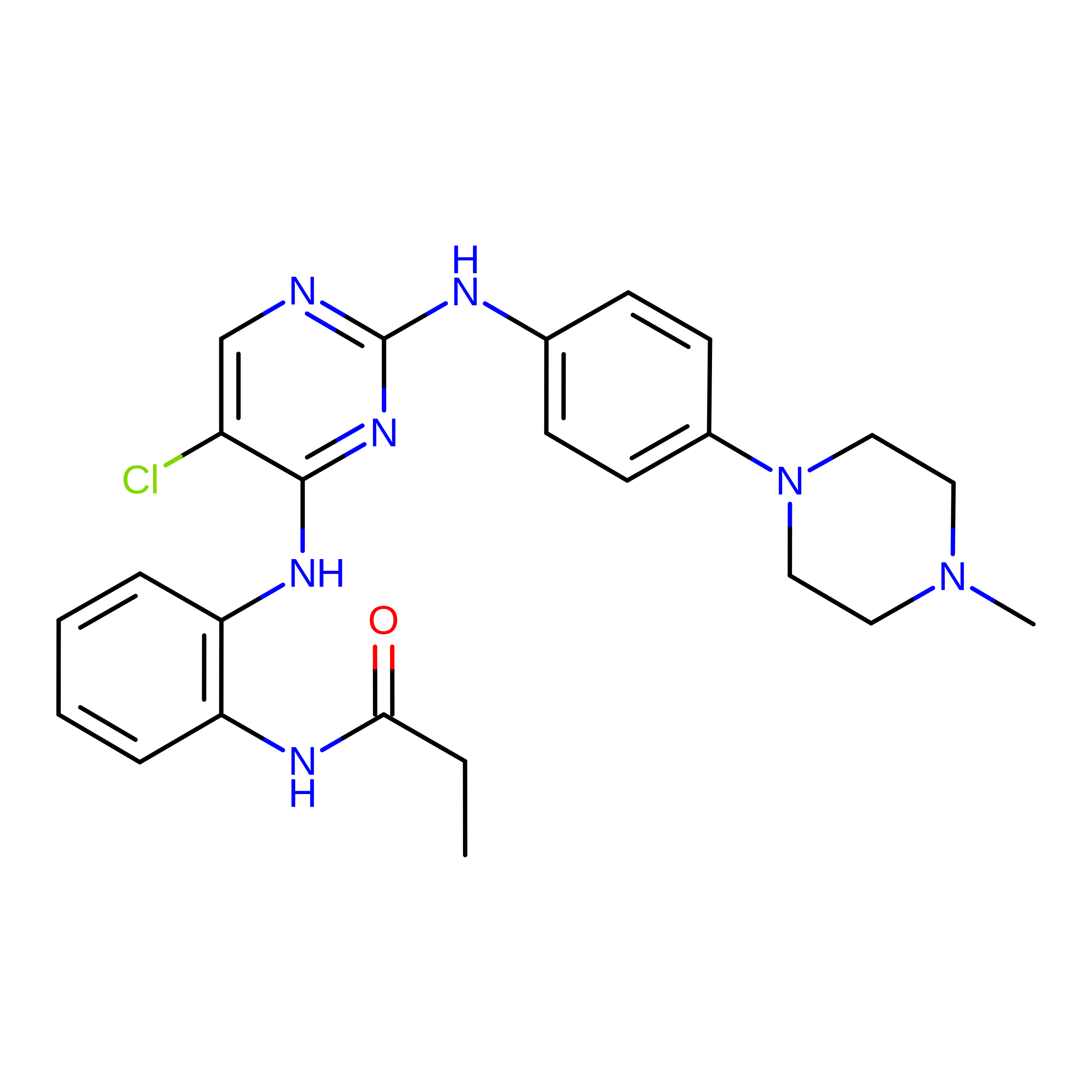
B [auth A]N-{2-[(5-chloro-2-{[4-(4-methylpiperazin-1-yl)phenyl]amino}pyrimidin-4-yl)amino]phenyl}propanamide
C24 H28 Cl N7 O
IIMJCIGRKJCCHT-UHFFFAOYSA-N

Experimental Data & Validation

Experimental Data

  • Method: X-RAY DIFFRACTION
  • Resolution: 2.40 Å
  • R-Value Free:  0.228 (Depositor), 0.225 (DCC) 
  • R-Value Work:  0.193 (Depositor) 
  • R-Value Observed: 0.195 (Depositor) 
Space Group: P 21 21 21
Unit Cell:
Length ( Å )Angle ( ˚ )
a = 41.51α = 90
b = 62.758β = 90
c = 105.892γ = 90
Software Package:
Software NamePurpose
PHENIXrefinement
HKL-3000data reduction
SCALEPACKdata scaling
PHASERphasing

Structure Validation

View Full Validation Report


Ligand Structure Quality Assessment 


Entry History 

Deposition Data

Revision History  (Full details and data files)

  • Version 1.0: 2019-02-27
    Type: Initial release
  • Version 2.0: 2019-12-18
    Changes: Advisory, Atomic model, Data collection, Database references, Derived calculations, Refinement description, Structure summary
  • Version 2.1: 2023-10-04
    Changes: Data collection, Database references, Refinement description
  • Version 2.2: 2024-11-20
    Changes: Structure summary