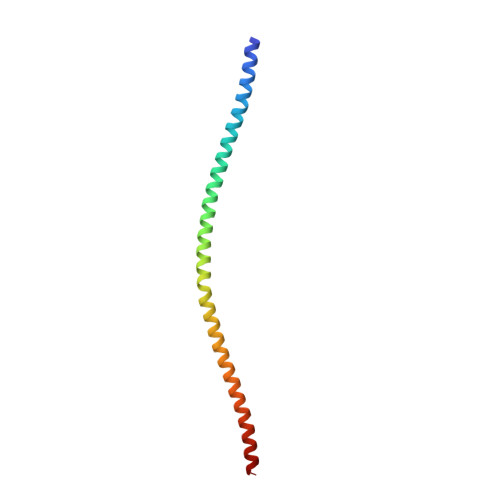
6A9P | pdb_00006a9p

Crystal structure of the human glial fibrillary acidic protein 1B domain


Experimental Data Snapshot

  • Method: X-RAY DIFFRACTION
  • Resolution: 2.51 Å
  • R-Value Free: 
    0.311 (Depositor), 0.311 (DCC) 
  • R-Value Work: 
    0.269 (Depositor), 0.272 (DCC) 
  • R-Value Observed: 
    0.271 (Depositor) 

Starting Model: experimental
View more details

wwPDB Validation 3D Report Full Report

Validation slider image for 6A9P

This is version 1.1 of the entry. See complete history

Literature

Crystal structure of the human glial fibrillary acidic protein 1B domain

Kim, B.Kim, S.Jin, M.S.

(2018) Biochem Biophys Res Commun 503: 2899-2905

  • DOI: https://doi.org/10.1016/j.bbrc.2018.08.066
  • Primary Citation Related Structures: 
    6A9P

  • PubMed Abstract: 

    Glial fibrillary acidic protein (GFAP) is a homopolymeric type III intermediate filament (IF) that plays essential roles in cell migration, mitosis, development, and signaling in astrocytes and a specific type of glial cells. Its overexpression and genetic mutations lead to abnormal IF networks and accumulation of Rosenthal fibers, which results in the fatal neurodegenerative disorder Alexander disease. Herein, we present the first crystal structure of human GFAP spanning the central coiled-coil 1B domain at 2.5 Å resolution. The domain forms a tetramer comprising two equivalent parallel coiled-coil dimers that pack together in an antiparallel manner. Its assembly is stabilized by extensive networks of intermolecular hydrogen bonds, salt bridges, and hydrophobic interactions. Furthermore, mapping of the GFAP mutations associated with Alexander disease reveals that most involve residues buried in the core of the interface, and are likely to disrupt the intermolecular interactions and/or introduce steric clashes, thereby decreasing GFAP solubility and promoting aggregation. Based on our structural analysis and previous biochemical studies, we propose that GFAP assembles in the A11 mode in which coiled-coil 1B dimers lie in close axial proximity in an antiparallel fashion to provide a stable tetrameric platform for the organization of the GFAP filament.


  • Organizational Affiliation
    • School of Life Sciences, GIST, 123 Cheomdan-gwagiro, Buk-gu, Gwangju 61005, Republic of Korea; Advanced Photonics Research Institute, GIST, 123 Cheomdan-gwagiro, Buk-gu, Gwangju 61005, Republic of Korea.

Macromolecule Content 

  • Total Structure Weight: 100.83 kDa 
  • Atom Count: 6,940 
  • Modeled Residue Count: 820 
  • Deposited Residue Count: 848 
  • Unique protein chains: 1

Macromolecules

Find similar proteins by:|  3D Structure
Entity ID: 1
MoleculeChains  Sequence LengthOrganismDetailsImage
Glial fibrillary acidic protein
A, B, C, D, E
A, B, C, D, E, F, G, H
106Homo sapiensMutation(s): 0 
Gene Names: GFAP
UniProt & NIH Common Fund Data Resources
Find proteins for P14136 (Homo sapiens)
Explore P14136 
Go to UniProtKB:  P14136
PHAROS:  P14136
GTEx:  ENSG00000131095 
Entity Groups
Sequence Clusters30% Identity50% Identity70% Identity90% Identity95% Identity100% Identity
UniProt GroupP14136
Sequence Annotations
Expand
Reference Sequence

Experimental Data & Validation

Experimental Data

  • Method: X-RAY DIFFRACTION
  • Resolution: 2.51 Å
  • R-Value Free:  0.311 (Depositor), 0.311 (DCC) 
  • R-Value Work:  0.269 (Depositor), 0.272 (DCC) 
  • R-Value Observed: 0.271 (Depositor) 
Space Group: P 1
Unit Cell:
Length ( Å )Angle ( ˚ )
a = 23.588α = 77.56
b = 106.158β = 90.14
c = 113.225γ = 83.8
Software Package:
Software NamePurpose
REFMACrefinement
HKL-2000data reduction
HKL-2000data scaling
PHASERphasing

Structure Validation

View Full Validation Report


Entry History 

& Funding Information

Deposition Data


Funding OrganizationLocationGrant Number
National Research Foundation (Korea)Korea, Republic OfNRF-2017R1A2B4003278

Revision History  (Full details and data files)

  • Version 1.0: 2018-09-12
    Type: Initial release
  • Version 1.1: 2023-11-22
    Changes: Data collection, Database references, Refinement description