Download Mendeley
Design, Synthesis, Antibacterial Potential, and Structural Characterization of N-Acylated Derivatives of the Human Autophagy 16 Polypeptide.
Varnava, K.G., Mohid, S.A., Calligari, P., Stella, L., Reynison, J., Bhunia, A., Sarojini, V.(2019) Bioconjug Chem 30: 1998-2010
- PubMed: 31145591 Search on PubMed
- DOI: https://doi.org/10.1021/acs.bioconjchem.9b00290
- Primary Citation Related Structures:
5ZYX - PubMed Abstract:
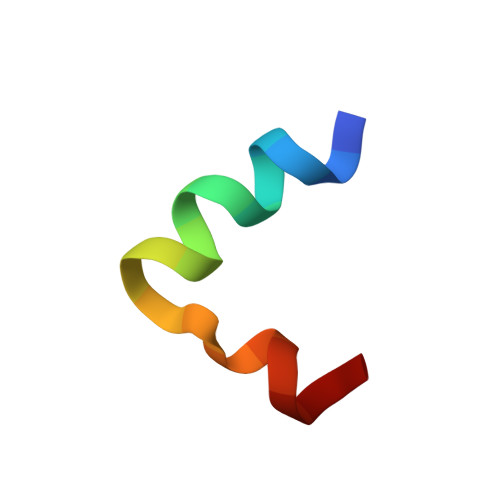
A synthetic antimicrobial peptide library based on the human autophagy 16 polypeptide has been developed. Designed acetylated peptides bearing lipids of different chain lengths resulted in peptides with enhanced potency compared to the parent Atg16. A 21-residue fragment of Atg16 conjugated to 4-methylhexanoic acid ( K30 ) emerged as the most potent antibacterial, with negligible hemolysis. Several studies, including microscopy, dye leakage, and ITC, were conducted to gain insight into the antibacterial mechanism of action of the peptide. Visual inspection using both SEM and TEM revealed the membranolytic effect of the peptide on bacterial cells. The selectivity of the peptide against bacterial cell membranes was also proven using dye leakage assays. ITC analysis revealed the exothermic nature of the binding interaction of the peptide to D8PG micelles. The three-dimensional solution NMR structure of K30 in complex with dioctanoylphosphatidylglycerol (D8PG) micelles revealed that the peptide adopts a helix-loop-helix structure in the presence of anionic membrane lipids mimicking bacterial membranes. Intermolecular NOEs between the peptide and lipid deciphered the location of the peptide in the bound state, which was subsequently supported by the paramagnetic relaxation enhancement (PRE) NMR experiment. Collectively, these results describe the structure-function relationship of the peptide in the bacterial membrane.
- School of Chemical Sciences , The University of Auckland , Private Bag 92019 , Auckland , New Zealand.
Organizational Affiliation: