5WXG | pdb_00005wxg

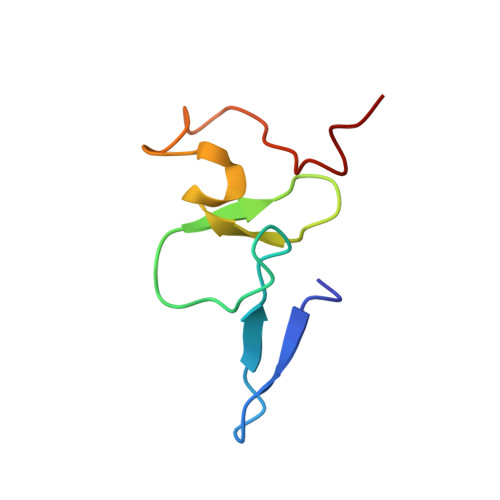
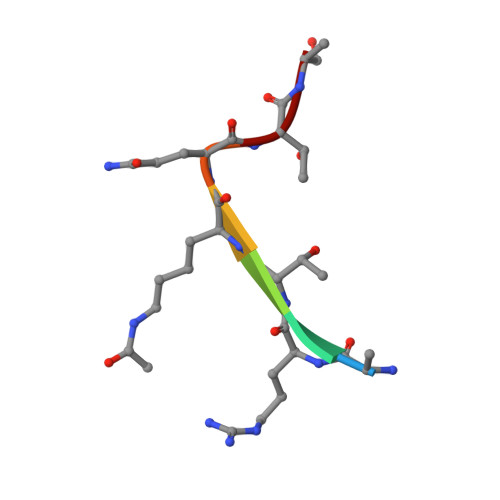
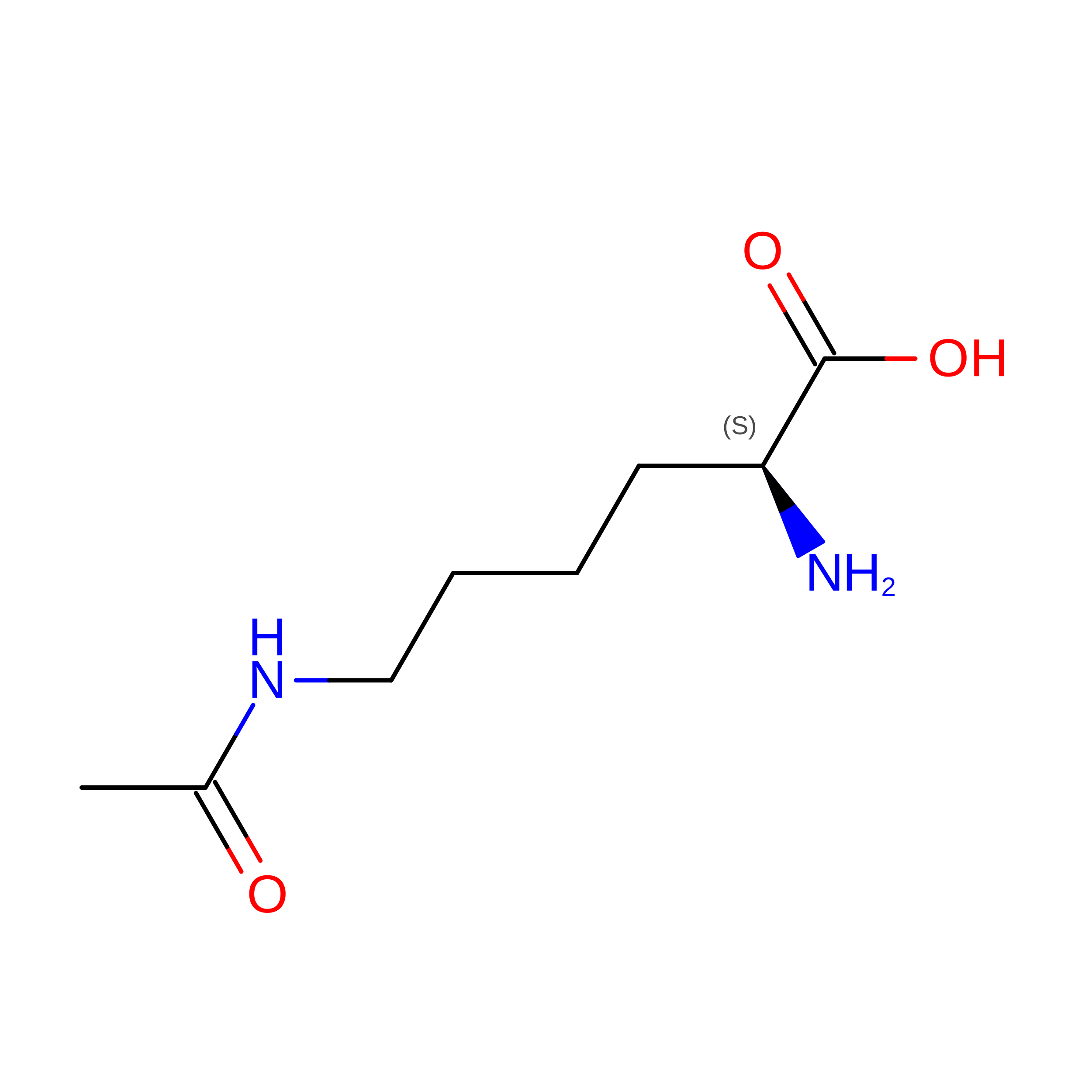
Structure of TAF PHD finger domain binds to H3(1-15)K4ac


Experimental Data Snapshot

  • Method: X-RAY DIFFRACTION
  • Resolution: 1.70 Å
  • R-Value Free: 
    0.195 (Depositor), 0.195 (DCC) 
  • R-Value Work: 
    0.167 (Depositor), 0.167 (DCC) 
  • R-Value Observed: 
    0.170 (Depositor) 

wwPDB Validation 3D Report Full Report

Validation slider image for 5WXG

This is version 1.3 of the entry. See complete history

Literature

Kinetic and high-throughput profiling of epigenetic interactions by 3D-carbene chip-based surface plasmon resonance imaging technology

Zhao, S.Yang, M.Zhou, W.Zhang, B.Cheng, Z.Huang, J.Zhang, M.Wang, Z.Wang, R.Chen, Z.Zhu, J.Li, H.

(2017) Proc Natl Acad Sci U S A 114: E7245-E7254

  • DOI: https://doi.org/10.1073/pnas.1704155114
  • Primary Citation Related Structures: 
    5WXG, 5WXH

  • PubMed Abstract: 

    Chemical modifications on histones and DNA/RNA constitute a fundamental mechanism for epigenetic regulation. These modifications often function as docking marks to recruit or stabilize cognate "reader" proteins. So far, a platform for quantitative and high-throughput profiling of the epigenetic interactome is urgently needed but still lacking. Here, we report a 3D-carbene chip-based surface plasmon resonance imaging (SPRi) technology for this purpose. The 3D-carbene chip is suitable for immobilizing versatile biomolecules (e.g., peptides, antibody, DNA/RNA) and features low nonspecific binding, random yet function-retaining immobilization, and robustness for reuses. We systematically profiled binding kinetics of 1,000 histone "reader-mark" pairs on a single 3D-carbene chip and validated two recognition events by calorimetric and structural studies. Notably, a discovery on H3K4me3 recognition by the DNA mismatch repair protein MSH6 in Capsella rubella suggests a mechanism of H3K4me3-mediated DNA damage repair in plant.


  • Organizational Affiliation
    • Ministry of Education Key Laboratory of Protein Sciences, Beijing Advanced Innovation Center for Structural Biology, Department of Basic Medical Sciences, School of Medicine, Tsinghua University, Beijing 100084, China.

Macromolecule Content 

  • Total Structure Weight: 8.26 kDa 
  • Atom Count: 632 
  • Modeled Residue Count: 70 
  • Deposited Residue Count: 70 
  • Unique protein chains: 2

Macromolecules

Find similar proteins by:|  3D Structure
Entity ID: 1
MoleculeChains  Sequence LengthOrganismDetailsImage
Transcription initiation factor TFIID subunit 363Homo sapiensMutation(s): 1 
Gene Names: TAF3
UniProt & NIH Common Fund Data Resources
Find proteins for Q5VWG9 (Homo sapiens)
Explore Q5VWG9 
Go to UniProtKB:  Q5VWG9
PHAROS:  Q5VWG9
GTEx:  ENSG00000165632 
Entity Groups
Sequence Clusters30% Identity50% Identity70% Identity90% Identity95% Identity100% Identity
UniProt GroupQ5VWG9
Sequence Annotations
Expand
Reference Sequence
Find similar proteins by:  Sequence   |   3D Structure  
Entity ID: 2
MoleculeChains  Sequence LengthOrganismDetailsImage
Histone H3K4acB [auth P]7Homo sapiensMutation(s): 0 
UniProt & NIH Common Fund Data Resources
Find proteins for P68431 (Homo sapiens)
Explore P68431 
Go to UniProtKB:  P68431
Entity Groups
UniProt GroupP68431
Sequence Annotations
Expand
Reference Sequence

Experimental Data & Validation

Experimental Data

  • Method: X-RAY DIFFRACTION
  • Resolution: 1.70 Å
  • R-Value Free:  0.195 (Depositor), 0.195 (DCC) 
  • R-Value Work:  0.167 (Depositor), 0.167 (DCC) 
  • R-Value Observed: 0.170 (Depositor) 
Space Group: C 2 2 21
Unit Cell:
Length ( Å )Angle ( ˚ )
a = 50.84α = 90
b = 52.868β = 90
c = 54.122γ = 90
Software Package:
Software NamePurpose
PHENIXrefinement
HKL-2000data reduction
HKL-2000data scaling
MOLREPphasing

Structure Validation

View Full Validation Report


Entry History 

Deposition Data

Revision History  (Full details and data files)

  • Version 1.0: 2017-08-16
    Type: Initial release
  • Version 1.1: 2017-08-30
    Changes: Data collection
  • Version 1.2: 2017-09-13
    Changes: Database references
  • Version 1.3: 2024-11-20
    Changes: Data collection, Database references, Derived calculations, Structure summary