5WSL | pdb_00005wsl

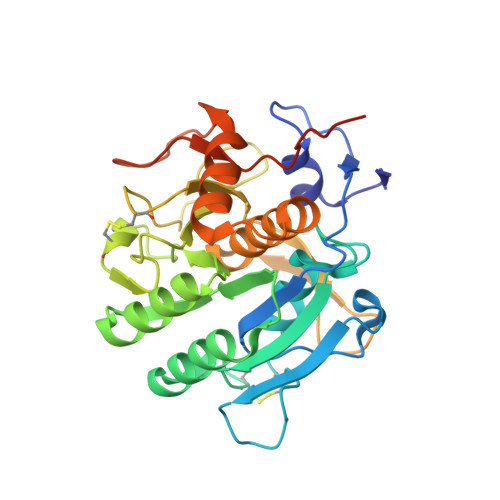
Structural studies of keratinase from Meiothermus taiwanensis WR-220


Experimental Data Snapshot

  • Method: X-RAY DIFFRACTION
  • Resolution: 1.50 Å
  • R-Value Free: 
    0.175 (Depositor), 0.175 (DCC) 
  • R-Value Work: 
    0.145 (Depositor), 0.145 (DCC) 
  • R-Value Observed: 
    0.147 (Depositor) 

Starting Model: experimental
View more details

wwPDB Validation 3D Report Full Report

Validation slider image for 5WSL

This is version 1.2 of the entry. See complete history

Literature

The discovery of novel heat-stable keratinases from Meiothermus taiwanensis WR-220 and other extremophiles

Wu, W.L.Chen, M.Y.Tu, I.F.Lin, Y.C.EswarKumar, N.Chen, M.Y.Ho, M.C.Wu, S.H.

(2017) Sci Rep 7: 4658-4658

  • DOI: https://doi.org/10.1038/s41598-017-04723-4
  • Primary Citation Related Structures: 
    5WSL

  • PubMed Abstract: 

    Billions of tons of keratin bio-wastes are generated by poultry industry annually but discarded that result in serious environmental pollution. Keratinase is a broad spectrum protease with the unique ability to degrade keratin, providing an eco-friendly way to convert keratin wastes to valuable amino acids. In this report, a feather-degrading thermophilic bacterium, Meiothermus taiwanensis WR-220, was investigated due to its ability to apparently complete feather decay at 65 °C in two days. By genomics, proteomics, and biochemical approaches, the extracellular heat-stable keratinase (MtaKer) from M. taiwanensis WR-220 was identified. The recombinant MtaKer (rMtaKer) possesses keratinolytic activities at temperatures ranging from 25 to 75 °C and pH from 4 to 11, with a maximum keratinolytic activity at 65 °C and pH 10. The phylogenetic and structural analysis revealed that MtaKer shares low sequence identity but high structural similarity with known keratinases. Accordingly, our findings have enabled the discovery of more keratinases from other extremophiles, Thermus and Deinococcus. Proteins encoded in the extremophiles shall be evolved to be functional in the extreme conditions. Hence, our study expands the current boundary of hunting keratinases that can tolerate extreme conditions for keratin wastes biorecycle and other industrial applications.


  • Organizational Affiliation
    • Institute of Biological Chemistry, Academia Sinica, Taipei, 11529, Taiwan.

Macromolecule Content 

  • Total Structure Weight: 93.5 kDa 
  • Atom Count: 6,788 
  • Modeled Residue Count: 846 
  • Deposited Residue Count: 897 
  • Unique protein chains: 1

Macromolecules

Find similar proteins by:|  3D Structure
Entity ID: 1
MoleculeChains  Sequence LengthOrganismDetailsImage
keratinase
A, B, C
299Meiothermus taiwanensis WR-220Mutation(s): 0 
UniProt
Find proteins for A0A2H4A2Y5 (Meiothermus taiwanensis WR-220)
Explore A0A2H4A2Y5 
Go to UniProtKB:  A0A2H4A2Y5
Entity Groups
Sequence Clusters30% Identity50% Identity70% Identity90% Identity95% Identity100% Identity
UniProt GroupA0A2H4A2Y5
Sequence Annotations
Expand
Reference Sequence

Small Molecules

Ligands 2 Unique
IDChains Name / Formula / InChI Key2D Diagram3D Interactions
SO4

Query on SO4


Download:Ideal Coordinates CCD File
F [auth A]
G [auth A]
H [auth A]
I [auth A]
L [auth B]
F [auth A],
G [auth A],
H [auth A],
I [auth A],
L [auth B],
M [auth B],
N [auth B],
O [auth B],
R [auth C]
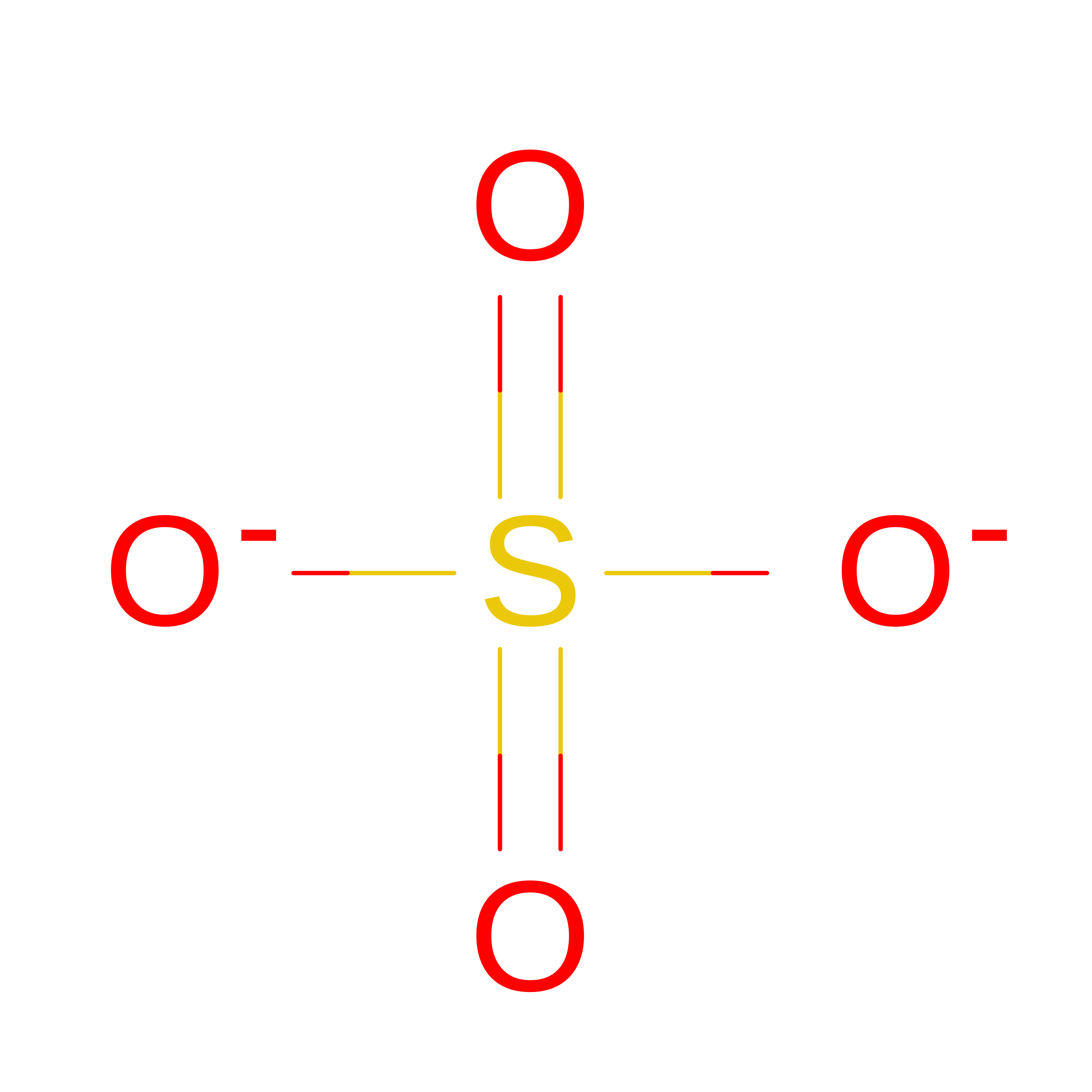
SULFATE ION
O4 S
QAOWNCQODCNURD-UHFFFAOYSA-L
CA

Query on CA


Download:Ideal Coordinates CCD File
D [auth A]
E [auth A]
J [auth B]
K [auth B]
P [auth C]
D [auth A],
E [auth A],
J [auth B],
K [auth B],
P [auth C],
Q [auth C]
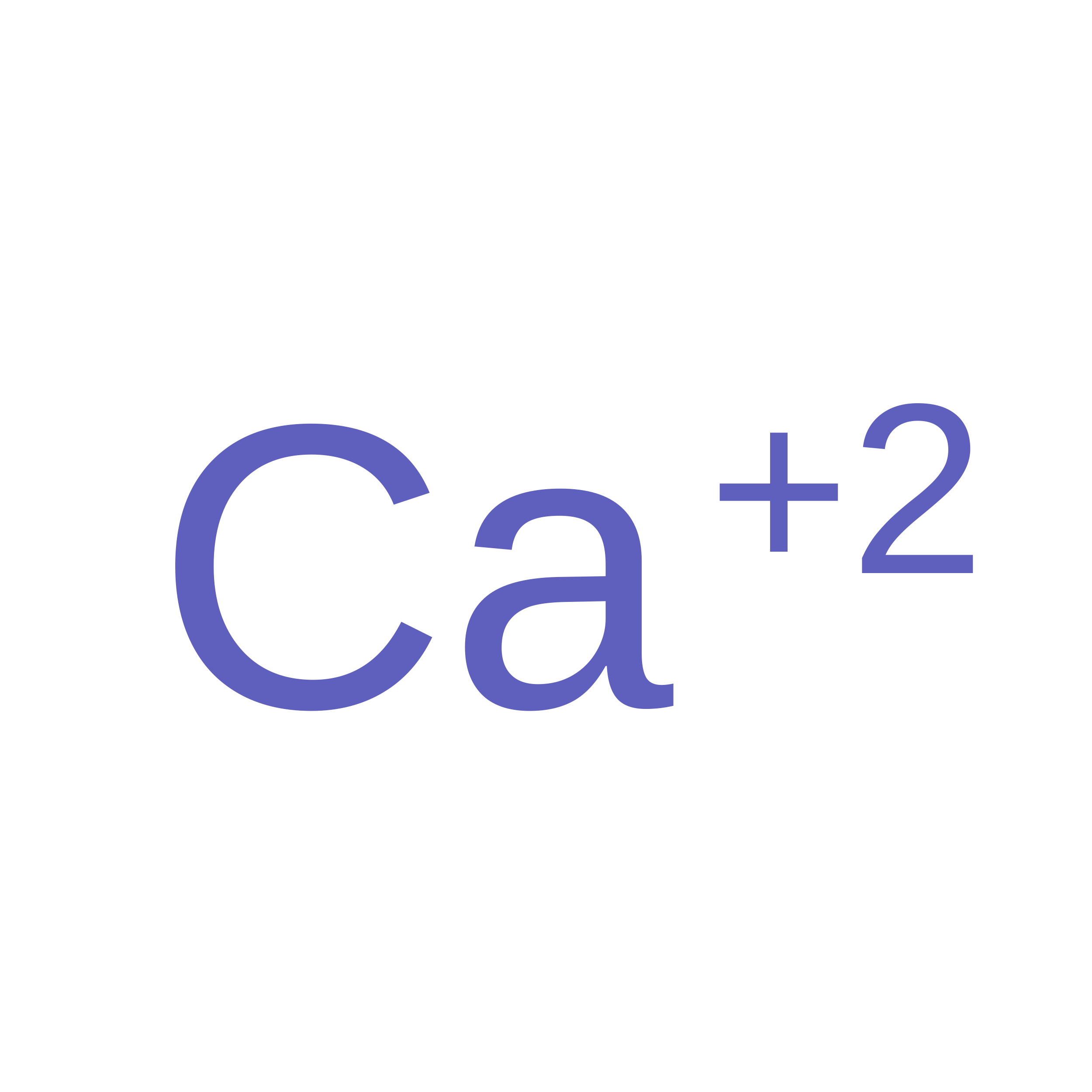
CALCIUM ION
Ca
BHPQYMZQTOCNFJ-UHFFFAOYSA-N

Experimental Data & Validation

Experimental Data

  • Method: X-RAY DIFFRACTION
  • Resolution: 1.50 Å
  • R-Value Free:  0.175 (Depositor), 0.175 (DCC) 
  • R-Value Work:  0.145 (Depositor), 0.145 (DCC) 
  • R-Value Observed: 0.147 (Depositor) 
Space Group: P 1 21 1
Unit Cell:
Length ( Å )Angle ( ˚ )
a = 59.21α = 90
b = 67.088β = 96.07
c = 92.857γ = 90
Software Package:
Software NamePurpose
HKL-2000data collection
REFMACrefinement
PDB_EXTRACTdata extraction
HKL-2000data reduction
HKL-2000data scaling
MOLREPphasing
HKLdata reduction

Structure Validation

View Full Validation Report


Entry History 

Deposition Data

Revision History  (Full details and data files)

  • Version 1.0: 2017-10-18
    Type: Initial release
  • Version 1.1: 2023-11-08
    Changes: Data collection, Database references, Derived calculations, Refinement description
  • Version 1.2: 2024-10-23
    Changes: Structure summary