5WHC | pdb_00005whc

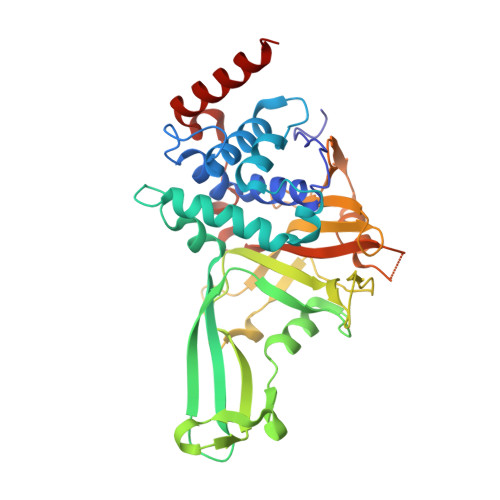
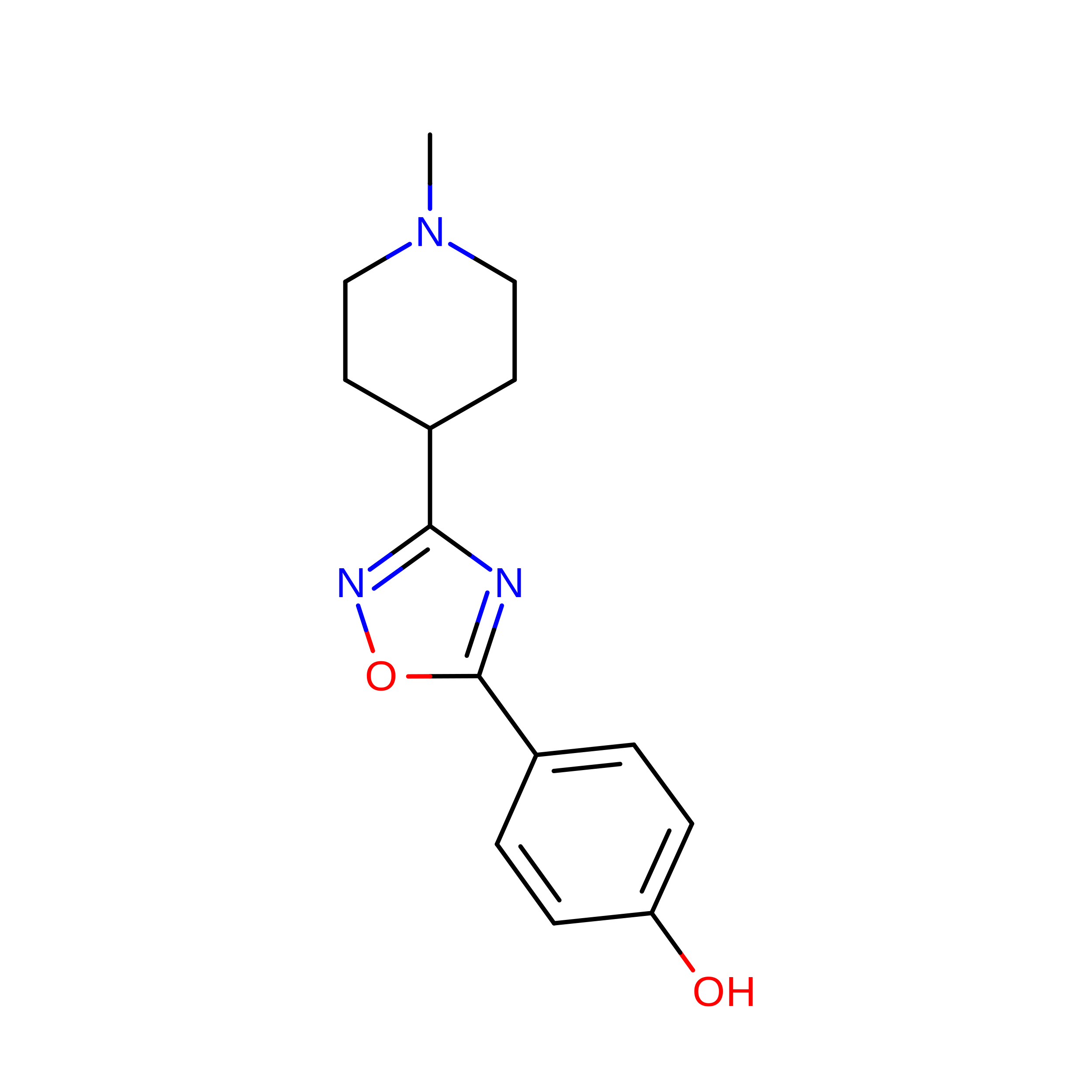
USP7 in complex with Cpd2 (4-(3-(1-methylpiperidin-4-yl)-1,2,4-oxadiazol-5-yl)phenol)


Experimental Data Snapshot

  • Method: X-RAY DIFFRACTION
  • Resolution: 2.55 Å
  • R-Value Free: 
    0.260 (Depositor), 0.267 (DCC) 
  • R-Value Work: 
    0.209 (Depositor), 0.217 (DCC) 
  • R-Value Observed: 
    0.211 (Depositor) 

Starting Model: experimental
View more details

wwPDB Validation 3D Report Full Report

Validation slider image for 5WHC

Ligand Structure Quality Assessment 


This is version 1.2 of the entry. See complete history

Literature

Discovery of Small-Molecule Inhibitors of Ubiquitin Specific Protease 7 (USP7) Using Integrated NMR and in Silico Techniques.

Di Lello, P.Pastor, R.Murray, J.M.Blake, R.A.Cohen, F.Crawford, T.D.Drobnick, J.Drummond, J.Kategaya, L.Kleinheinz, T.Maurer, T.Rouge, L.Zhao, X.Wertz, I.Ndubaku, C.Tsui, V.

(2017) J Med Chem 60: 10056-10070

  • DOI: https://doi.org/10.1021/acs.jmedchem.7b01293
  • Primary Citation Related Structures: 
    5WHC

  • PubMed Abstract: 

    USP7 is a deubiquitinase implicated in destabilizing the tumor suppressor p53, and for this reason it has gained increasing attention as a potential oncology target for small molecule inhibitors. Herein we describe the biophysical, biochemical, and computational approaches that led to the identification of 4-(2-aminopyridin-3-yl)phenol compounds described by Kategaya ( Nature 2017 , 550 , 534 - 538 ) as specific inhibitors of USP7. Fragment based lead discovery (FBLD) by NMR combined with virtual screening and re-mining of biochemical high-throughput screening (HTS) hits led to the discovery of a series of ligands that bind in the "palm" region of the catalytic domain of USP7 and inhibit its catalytic activity. These ligands were then optimized by structure-based design to yield cell-active molecules with reasonable physical properties. This discovery process not only involved multiple techniques working in concert but also illustrated a unique way in which hits from orthogonal screening approaches complemented each other for lead identification.


  • Organizational Affiliation
    • Genentech, Inc. , 1 DNA Way, South San Francisco, California 94080, United States.

Macromolecule Content 

  • Total Structure Weight: 80.79 kDa 
  • Atom Count: 5,556 
  • Modeled Residue Count: 676 
  • Deposited Residue Count: 692 
  • Unique protein chains: 1

Macromolecules

Find similar proteins by:|  3D Structure
Entity ID: 1
MoleculeChains  Sequence LengthOrganismDetailsImage
Ubiquitin carboxyl-terminal hydrolase 7
A, B
346Homo sapiensMutation(s): 0 
Gene Names: USP7HAUSP
EC: 3.4.19.12
UniProt & NIH Common Fund Data Resources
Find proteins for Q93009 (Homo sapiens)
Explore Q93009 
Go to UniProtKB:  Q93009
PHAROS:  Q93009
GTEx:  ENSG00000187555 
Entity Groups
Sequence Clusters30% Identity50% Identity70% Identity90% Identity95% Identity100% Identity
UniProt GroupQ93009
Sequence Annotations
Expand
Reference Sequence

Experimental Data & Validation

Experimental Data

  • Method: X-RAY DIFFRACTION
  • Resolution: 2.55 Å
  • R-Value Free:  0.260 (Depositor), 0.267 (DCC) 
  • R-Value Work:  0.209 (Depositor), 0.217 (DCC) 
  • R-Value Observed: 0.211 (Depositor) 
Space Group: P 1 21 1
Unit Cell:
Length ( Å )Angle ( ˚ )
a = 76.292α = 90
b = 69.279β = 95
c = 77.07γ = 90
Software Package:
Software NamePurpose
Aimlessdata scaling
PHENIXrefinement
PDB_EXTRACTdata extraction
PHASERphasing

Structure Validation

View Full Validation Report


Ligand Structure Quality Assessment 


Entry History 

Deposition Data

Revision History  (Full details and data files)

  • Version 1.0: 2017-12-13
    Type: Initial release
  • Version 1.1: 2018-01-10
    Changes: Database references
  • Version 1.2: 2023-10-04
    Changes: Advisory, Data collection, Database references, Refinement description