5VYA | pdb_00005vya

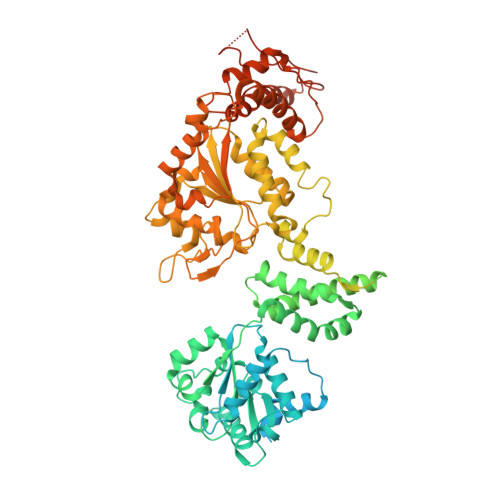
S. cerevisiae Hsp104:casein complex, Extended Conformation


Experimental Data Snapshot

  • Method: ELECTRON MICROSCOPY
  • Resolution: 4.00 Å
  • Aggregation State: PARTICLE 
  • Reconstruction Method: SINGLE PARTICLE 

wwPDB Validation 3D Report Full Report

Validation slider image for 5VYA

This is version 3.0 of the entry. See complete history. 

Literature

Ratchet-like polypeptide translocation mechanism of the AAA+ disaggregase Hsp104.

Gates, S.N., Yokom, A.L., Lin, J., Jackrel, M.E., Rizo, A.N., Kendsersky, N.M., Buell, C.E., Sweeny, E.A., Mack, K.L., Chuang, E., Torrente, M.P., Su, M., Shorter, J., Southworth, D.R.

(2017) Science 357: 273-279

  • DOI: https://doi.org/10.1126/science.aan1052
  • Primary Citation Related Structures: 
    5VJH, 5VY8, 5VY9, 5VYA

  • PubMed Abstract: 

    Hsp100 polypeptide translocases are conserved members of the AAA+ family (adenosine triphosphatases associated with diverse cellular activities) that maintain proteostasis by unfolding aberrant and toxic proteins for refolding or proteolytic degradation. The Hsp104 disaggregase from Saccharomyces cerevisiae solubilizes stress-induced amorphous aggregates and amyloids. The structural basis for substrate recognition and translocation is unknown. Using a model substrate (casein), we report cryo-electron microscopy structures at near-atomic resolution of Hsp104 in different translocation states. Substrate interactions are mediated by conserved, pore-loop tyrosines that contact an 80-angstrom-long unfolded polypeptide along the axial channel. Two protomers undergo a ratchet-like conformational change that advances pore loop-substrate interactions by two amino acids. These changes are coupled to activation of specific nucleotide hydrolysis sites and, when transmitted around the hexamer, reveal a processive rotary translocation mechanism and substrate-responsive flexibility during Hsp104-catalyzed disaggregation.


  • Organizational Affiliation: 
    • Department of Biological Chemistry, Life Sciences Institute, University of Michigan, Ann Arbor, MI 48109, USA.

Macromolecule Content 

  • Total Structure Weight: 621.72 kDa 
  • Atom Count: 27,691 
  • Modeled Residue Count: 3,502 
  • Deposited Residue Count: 5,476 
  • Unique protein chains: 2

Macromolecules

Find similar proteins by:|  3D Structure
Entity ID: 1
MoleculeChains  Sequence LengthOrganismDetailsImage
Heat shock protein 104
A, B, C, D, E
A, B, C, D, E, F
908Saccharomyces cerevisiae S288CMutation(s): 0 
Gene Names: HSP104, YLL026W, L0948
UniProt
Find proteins for P31539 (Saccharomyces cerevisiae (strain ATCC 204508 / S288c))
Explore P31539 
Go to UniProtKB:  P31539
Entity Groups
Sequence Clusters30% Identity50% Identity70% Identity90% Identity95% Identity100% Identity
UniProt GroupP31539
Sequence Annotations
Expand
Reference Sequence
Find similar proteins by:|  3D Structure
Entity ID: 2
MoleculeChains  Sequence LengthOrganismDetailsImage
Alpha-S1-caseinG [auth P]28Bos taurusMutation(s): 0 
Sequence Annotations
Expand
Reference Sequence

Small Molecules

Ligands 1 Unique
IDChains Name / Formula / InChI Key2D Diagram3D Interactions
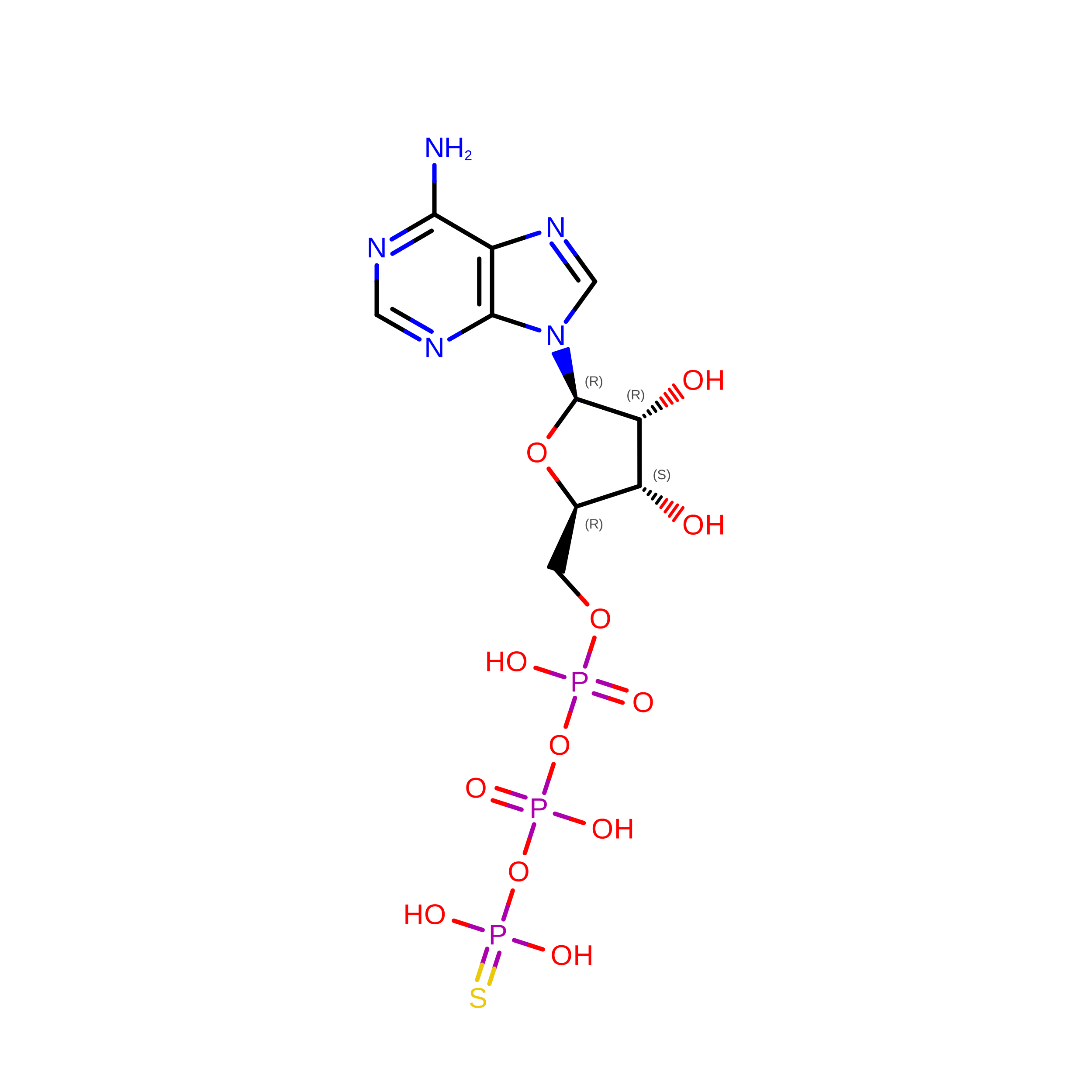
AGS

Query on AGS


Download:Ideal Coordinates CCD File
H [auth A]
I [auth A]
J [auth B]
K [auth B]
L [auth C]
H [auth A],
I [auth A],
J [auth B],
K [auth B],
L [auth C],
M [auth C],
N [auth C],
O [auth D],
P [auth D],
Q [auth E],
R [auth E],
S [auth E]
PHOSPHOTHIOPHOSPHORIC ACID-ADENYLATE ESTER
C10 H16 N5 O12 P3 S
NLTUCYMLOPLUHL-KQYNXXCUSA-N
Modified Residues  1 Unique
IDChains TypeFormula2D DiagramParent
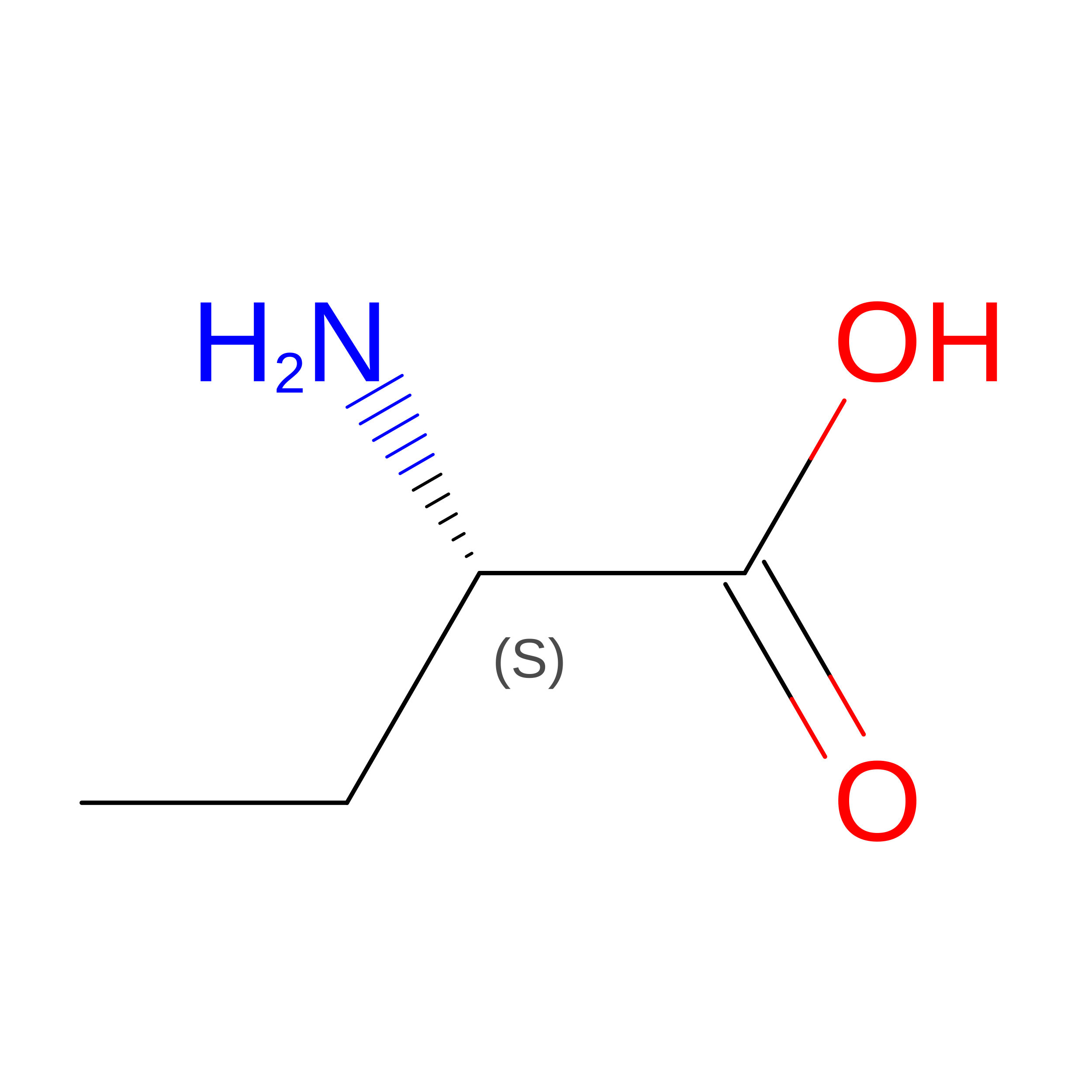
UNK
Query on UNK
G [auth P]L-PEPTIDE LINKINGC4 H9 N O2

--

Experimental Data & Validation

Experimental Data

  • Method: ELECTRON MICROSCOPY
  • Resolution: 4.00 Å
  • Aggregation State: PARTICLE 
  • Reconstruction Method: SINGLE PARTICLE 

Structure Validation

View Full Validation Report


Entry History 

Revision History  (Full details and data files)

  • Version 1.0: 2017-07-05
    Type: Initial release
  • Version 2.0: 2017-07-19
    Changes: Advisory, Atomic model, Data collection, Derived calculations
  • Version 2.1: 2017-08-02
    Changes: Database references
  • Version 3.0: 2024-12-25
    Changes: Advisory, Atomic model, Data collection, Database references, Derived calculations, Structure summary