5VJO | pdb_00005vjo

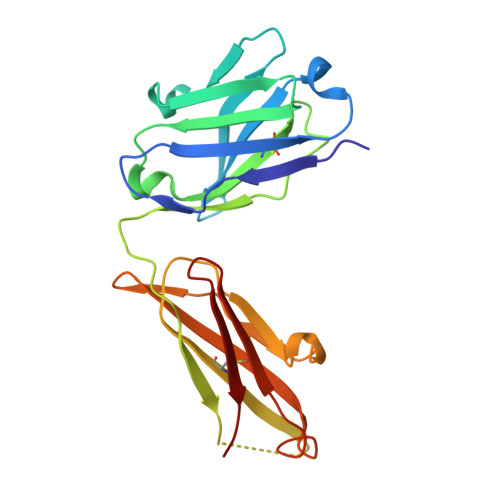
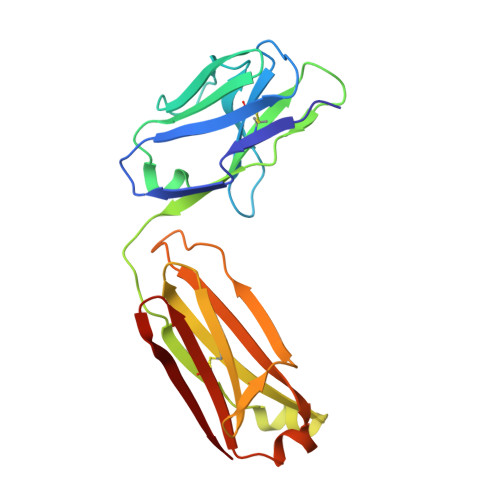
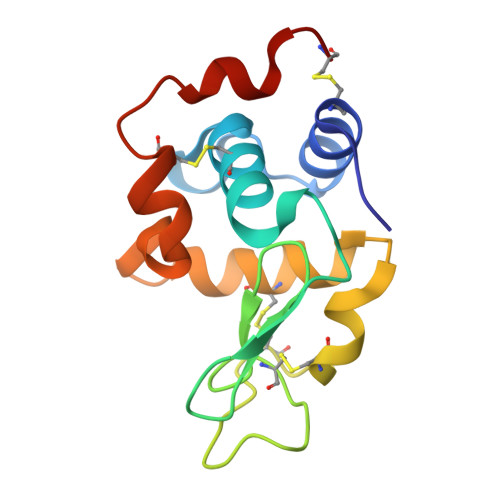
Complex between HyHEL10 Fab fragment heavy chain mutant I29F and Pekin duck egg lysozyme isoform I (DEL-I)


Experimental Data Snapshot

  • Method: X-RAY DIFFRACTION
  • Resolution: 2.43 Å
  • R-Value Free: 
    0.296 (Depositor), 0.297 (DCC) 
  • R-Value Work: 
    0.262 (Depositor), 0.264 (DCC) 
  • R-Value Observed: 
    0.264 (Depositor) 

Starting Models: experimental
View more details

wwPDB Validation 3D Report Full Report

Validation slider image for 5VJO

This is version 1.4 of the entry. See complete history

Literature

Germinal center antibody mutation trajectories are determined by rapid self/foreign discrimination.

Burnett, D.L.Langley, D.B.Schofield, P.Hermes, J.R.Chan, T.D.Jackson, J.Bourne, K.Reed, J.H.Patterson, K.Porebski, B.T.Brink, R.Christ, D.Goodnow, C.C.

(2018) Science 360: 223-226

  • DOI: https://doi.org/10.1126/science.aao3859
  • Primary Citation Related Structures: 
    5VJO, 5VJQ

  • PubMed Abstract: 

    Antibodies have the specificity to differentiate foreign antigens that mimic self antigens, but it remains unclear how such specificity is acquired. In a mouse model, we generated B cells displaying an antibody that cross-reacts with two related protein antigens expressed on self versus foreign cells. B cell anergy was imposed by self antigen but reversed upon challenge with high-density foreign antigen, leading to germinal center recruitment and antibody gene hypermutation. Single-cell analysis detected rapid selection for mutations that decrease self affinity and slower selection for epistatic mutations that specifically increase foreign affinity. Crystal structures revealed that these mutations exploited subtle topological differences to achieve 5000-fold preferential binding to foreign over self epitopes. Resolution of antigenic mimicry drove the optimal affinity maturation trajectory, highlighting the value of retaining self-reactive clones as substrates for protective antibody responses.


  • Organizational Affiliation
    • Garvan Institute of Medical Research, 384 Victoria Street, Darlinghurst, New South Wales 2010, Australia.

Macromolecule Content 

  • Total Structure Weight: 121.78 kDa 
  • Atom Count: 8,226 
  • Modeled Residue Count: 1,092 
  • Deposited Residue Count: 1,106 
  • Unique protein chains: 3

Macromolecules

Find similar proteins by:|  3D Structure
Entity ID: 1
MoleculeChains  Sequence LengthOrganismDetailsImage
HyHEL10 heavy chain Fab fragment carrying I29F mutation.
A, C
213Mus musculusMutation(s): 0 
EC: 3.2.1.18
Find similar proteins by:|  3D Structure
Entity ID: 2
MoleculeChains  Sequence LengthOrganismDetailsImage
HyHEL10 light chain Fab fragment
B, D
211Mus musculusMutation(s): 0 
Gene Names: IgG light chain
Find similar proteins by:|  3D Structure
Entity ID: 3
MoleculeChains  Sequence LengthOrganismDetailsImage
lysozyme isoform I (DEL-I)
E, F
129Anas platyrhynchosMutation(s): 0 

Experimental Data & Validation

Experimental Data

  • Method: X-RAY DIFFRACTION
  • Resolution: 2.43 Å
  • R-Value Free:  0.296 (Depositor), 0.297 (DCC) 
  • R-Value Work:  0.262 (Depositor), 0.264 (DCC) 
  • R-Value Observed: 0.264 (Depositor) 
Space Group: P 21 2 21
Unit Cell:
Length ( Å )Angle ( ˚ )
a = 89.02α = 90
b = 102.91β = 90
c = 133.98γ = 90
Software Package:
Software NamePurpose
MOSFLMdata reduction
Aimlessdata scaling
REFMACrefinement
PDB_EXTRACTdata extraction

Structure Validation

View Full Validation Report


Entry History 

& Funding Information

Deposition Data


Funding OrganizationLocationGrant Number
National Health and Medical Research Council (NHMRC, Australia)Australia--

Revision History  (Full details and data files)

  • Version 1.0: 2018-04-11
    Type: Initial release
  • Version 1.1: 2018-05-30
    Changes: Data collection, Database references
  • Version 1.2: 2020-01-08
    Changes: Author supporting evidence
  • Version 1.3: 2023-10-04
    Changes: Data collection, Database references, Refinement description
  • Version 1.4: 2024-10-09
    Changes: Structure summary