5VHC | pdb_00005vhc

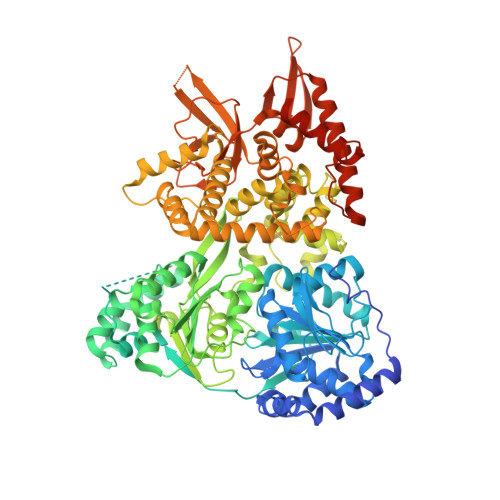
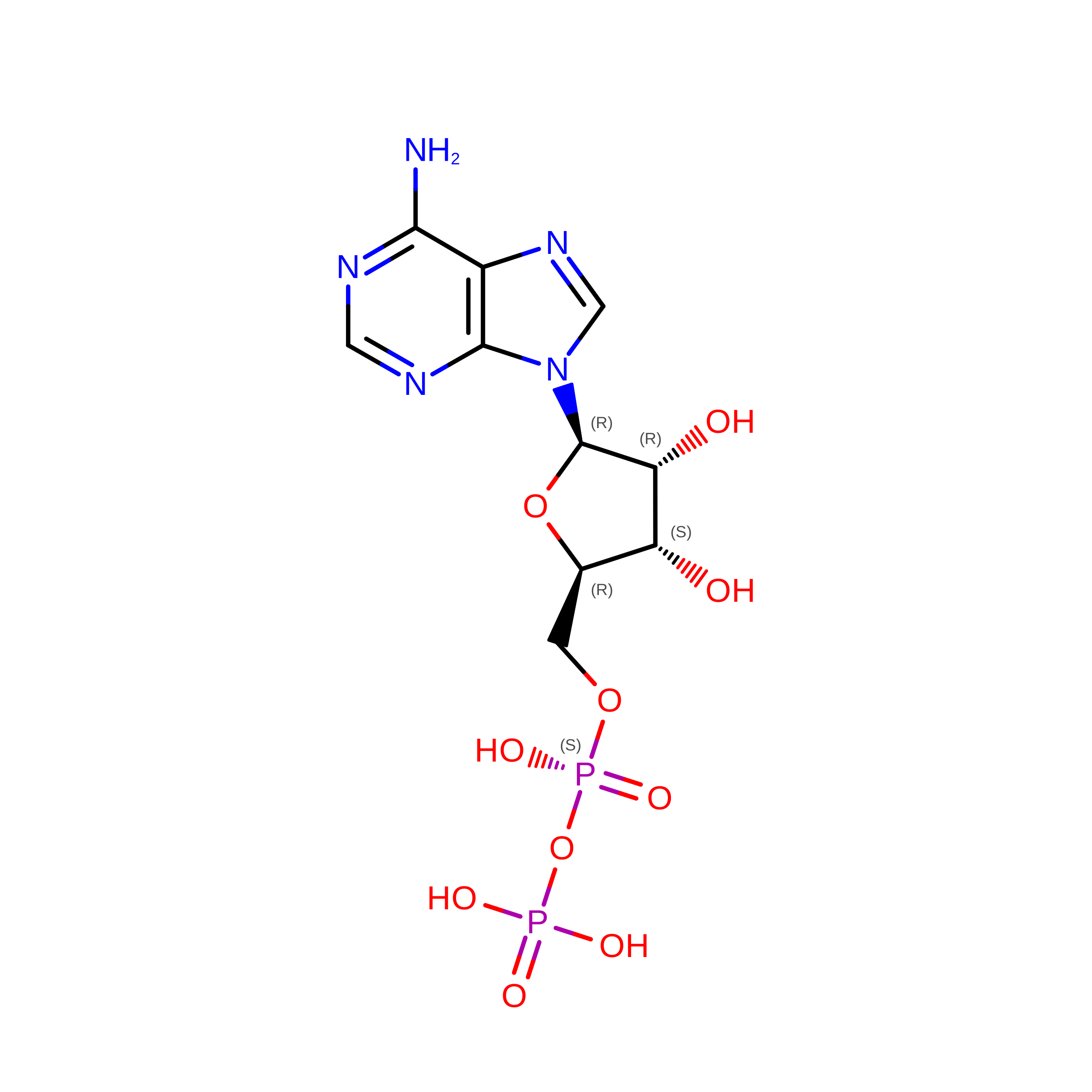
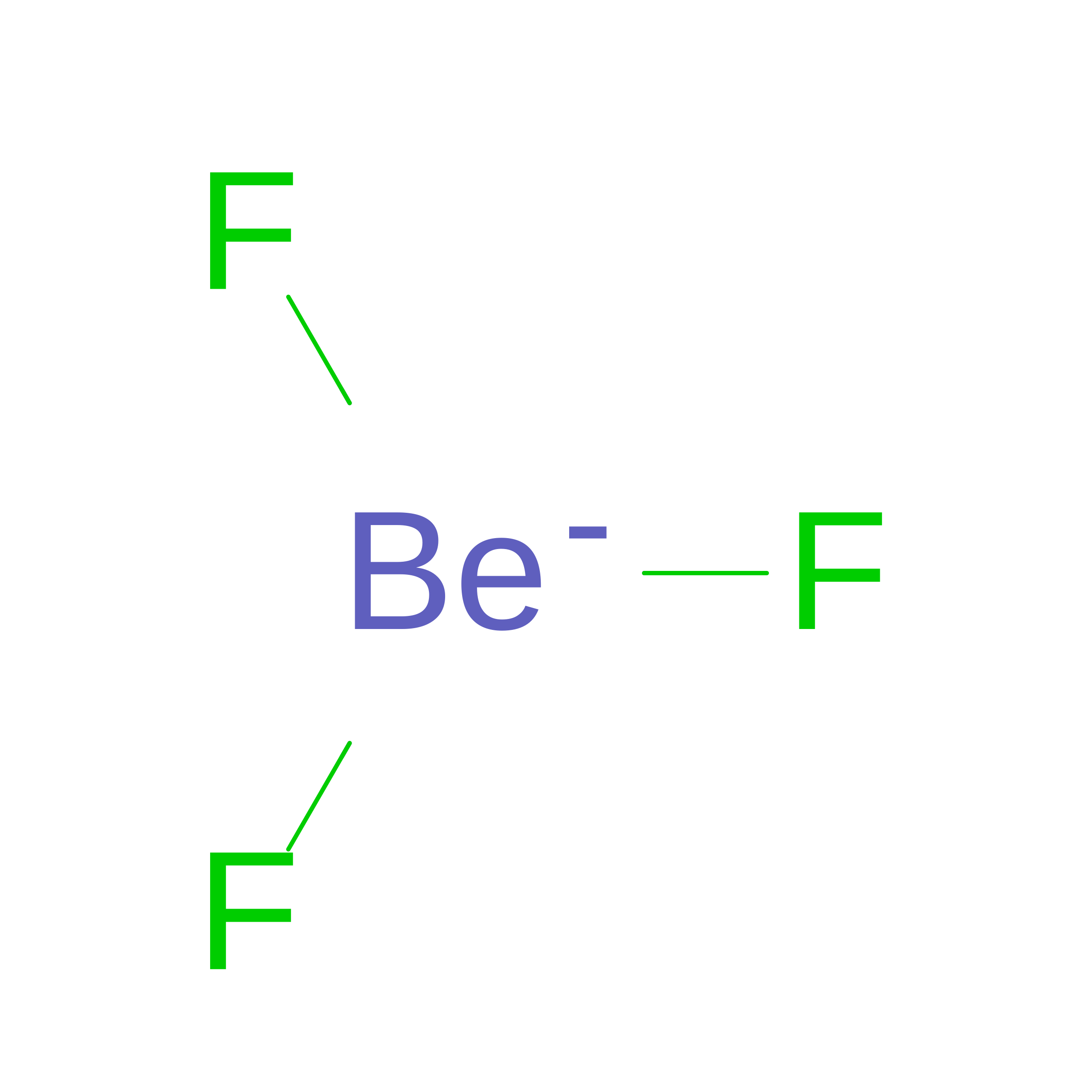
DHX36 with an N-terminal truncation bound to ADP-BeF3


Experimental Data Snapshot

  • Method: X-RAY DIFFRACTION
  • Resolution: 2.49 Å
  • R-Value Free: 
    0.233 (Depositor), 0.236 (DCC) 
  • R-Value Work: 
    0.194 (Depositor), 0.196 (DCC) 
  • R-Value Observed: 
    0.196 (Depositor) 

Starting Model: experimental
View more details

wwPDB Validation 3D Report Full Report

Validation slider image for 5VHC

Ligand Structure Quality Assessment 


This is version 1.5 of the entry. See complete history

Literature

Structural basis of G-quadruplex unfolding by the DEAH/RHA helicase DHX36.

Chen, M.C.Tippana, R.Demeshkina, N.A.Murat, P.Balasubramanian, S.Myong, S.Ferre-D'Amare, A.R.

(2018) Nature 558: 465-469

  • DOI: https://doi.org/10.1038/s41586-018-0209-9
  • Primary Citation Related Structures: 
    5VHA, 5VHC, 5VHD, 5VHE

  • PubMed Abstract: 

    Guanine-rich nucleic acid sequences challenge the replication, transcription, and translation machinery by spontaneously folding into G-quadruplexes, the unfolding of which requires forces greater than most polymerases can exert 1,2 . Eukaryotic cells contain numerous helicases that can unfold G-quadruplexes 3 . The molecular basis of the recognition and unfolding of G-quadruplexes by helicases remains poorly understood. DHX36 (also known as RHAU and G4R1), a member of the DEAH/RHA family of helicases, binds both DNA and RNA G-quadruplexes with extremely high affinity 4-6 , is consistently found bound to G-quadruplexes in cells 7,8 , and is a major source of G-quadruplex unfolding activity in HeLa cell lysates 6 . DHX36 is a multi-functional helicase that has been implicated in G-quadruplex-mediated transcriptional and post-transcriptional regulation, and is essential for heart development, haematopoiesis, and embryogenesis in mice 9-12 . Here we report the co-crystal structure of bovine DHX36 bound to a DNA with a G-quadruplex and a 3' single-stranded DNA segment. We show that the N-terminal DHX36-specific motif folds into a DNA-binding-induced α-helix that, together with the OB-fold-like subdomain, selectively binds parallel G-quadruplexes. Comparison with unliganded and ATP-analogue-bound DHX36 structures, together with single-molecule fluorescence resonance energy transfer (FRET) analysis, suggests that G-quadruplex binding alone induces rearrangements of the helicase core; by pulling on the single-stranded DNA tail, these rearrangements drive G-quadruplex unfolding one residue at a time.


  • Organizational Affiliation
    • Biochemistry and Biophysics Center, National Heart, Lung and Blood Institute, Bethesda, MD, USA.

Macromolecule Content 

  • Total Structure Weight: 100.73 kDa 
  • Atom Count: 6,318 
  • Modeled Residue Count: 799 
  • Deposited Residue Count: 870 
  • Unique protein chains: 1

Macromolecules

Find similar proteins by:|  3D Structure
Entity ID: 1
MoleculeChains  Sequence LengthOrganismDetailsImage
DEAH (Asp-Glu-Ala-His) box polypeptide 36A [auth D]870Bos taurusMutation(s): 0 
Gene Names: DHX36
EC: 3.6.4.13 (UniProt), 3.6.4.12 (UniProt)
UniProt
Find proteins for Q05B79 (Bos taurus)
Explore Q05B79 
Go to UniProtKB:  Q05B79
Entity Groups
Sequence Clusters30% Identity50% Identity70% Identity90% Identity95% Identity100% Identity
UniProt GroupQ05B79
Sequence Annotations
Expand
Reference Sequence

Experimental Data & Validation

Experimental Data

  • Method: X-RAY DIFFRACTION
  • Resolution: 2.49 Å
  • R-Value Free:  0.233 (Depositor), 0.236 (DCC) 
  • R-Value Work:  0.194 (Depositor), 0.196 (DCC) 
  • R-Value Observed: 0.196 (Depositor) 
Space Group: P 1 21 1
Unit Cell:
Length ( Å )Angle ( ˚ )
a = 61.878α = 90
b = 111.516β = 110.67
c = 62.966γ = 90
Software Package:
Software NamePurpose
PHENIXrefinement
HKL-2000data scaling
HKL-2000data reduction
PHASERphasing

Structure Validation

View Full Validation Report


Ligand Structure Quality Assessment 


Entry History 

Deposition Data

Revision History  (Full details and data files)

  • Version 1.0: 2018-06-13
    Type: Initial release
  • Version 1.1: 2018-06-27
    Changes: Data collection, Database references
  • Version 1.2: 2018-07-04
    Changes: Data collection, Database references
  • Version 1.3: 2019-11-06
    Changes: Author supporting evidence, Data collection
  • Version 1.4: 2024-03-13
    Changes: Data collection, Database references
  • Version 1.5: 2024-04-03
    Changes: Refinement description