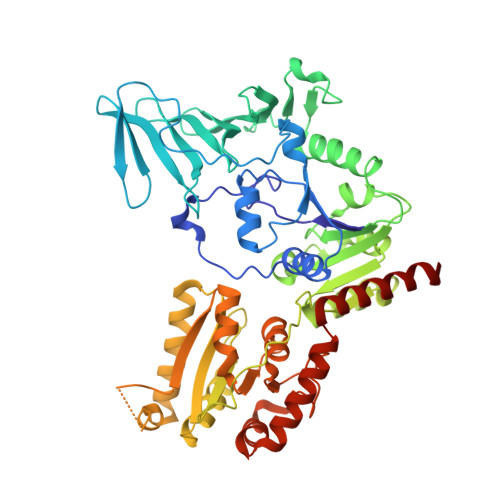
5VAF | pdb_00005vaf

Crystal structure of accessory secretion protein 1


Experimental Data Snapshot

  • Method: X-RAY DIFFRACTION
  • Resolution: 2.77 Å
  • R-Value Free: 
    0.282 (Depositor), 0.281 (DCC) 
  • R-Value Work: 
    0.208 (Depositor), 0.212 (DCC) 
  • R-Value Observed: 
    0.212 (Depositor) 

Starting Model: experimental
View more details

wwPDB Validation 3D Report Full Report

Validation slider image for 5VAF

This is version 1.6 of the entry. See complete history

Literature

Unraveling the sequence of cytosolic reactions in the export of GspB adhesin fromStreptococcus gordonii.

Chen, Y.Bensing, B.A.Seepersaud, R.Mi, W.Liao, M.Jeffrey, P.D.Shajahan, A.Sonon, R.N.Azadi, P.Sullam, P.M.Rapoport, T.A.

(2018) J Biological Chem 293: 5360-5373

  • DOI: https://doi.org/10.1074/jbc.RA117.000963
  • Primary Citation Related Structures: 
    5VAE, 5VAF

  • PubMed Abstract: 

    Many pathogenic bacteria, including Streptococcus gordonii , possess a pathway for the cellular export of a single serine-rich-repeat protein that mediates the adhesion of bacteria to host cells and the extracellular matrix. This adhesin protein is O -glycosylated by several cytosolic glycosyltransferases and requires three accessory Sec proteins (Asp1-3) for export, but how the adhesin protein is processed for export is not well understood. Here, we report that the S. gordonii adhesin GspB is sequentially O -glycosylated by three enzymes (GtfA/B, Nss, and Gly) that attach N -acetylglucosamine and glucose to Ser/Thr residues. We also found that modified GspB is transferred from the last glycosyltransferase to the Asp1/2/3 complex. Crystal structures revealed that both Asp1 and Asp3 are related to carbohydrate-binding proteins, suggesting that they interact with carbohydrates and bind glycosylated adhesin, a notion that was supported by further analyses. We further observed that Asp1 also has an affinity for phospholipids, which is attenuated by Asp2. In summary, our findings support a model in which the GspB adhesin is sequentially glycosylated by GtfA/B, Nss, and Gly and then transferred to the Asp1/2/3 complex in which Asp1 mediates the interaction of the Asp1/2/3 complex with the lipid bilayer for targeting of matured GspB to the export machinery.


  • Organizational Affiliation
    • From the Department of Cell Biology, Harvard Medical School, Boston, Massachusetts 02115.

Macromolecule Content 

  • Total Structure Weight: 253.2 kDa 
  • Atom Count: 17,260 
  • Modeled Residue Count: 2,052 
  • Deposited Residue Count: 2,132 
  • Unique protein chains: 1

Macromolecules

Find similar proteins by:|  3D Structure
Entity ID: 1
MoleculeChains  Sequence LengthOrganismDetailsImage
Accessory Sec system protein Asp1
A, B, C, D
533Streptococcus gordoniiMutation(s): 0 
Gene Names: asp1
UniProt
Find proteins for Q9AET9 (Streptococcus gordonii)
Explore Q9AET9 
Go to UniProtKB:  Q9AET9
Entity Groups
Sequence Clusters30% Identity50% Identity70% Identity90% Identity95% Identity100% Identity
UniProt GroupQ9AET9
Sequence Annotations
Expand
Reference Sequence

Experimental Data & Validation

Experimental Data

  • Method: X-RAY DIFFRACTION
  • Resolution: 2.77 Å
  • R-Value Free:  0.282 (Depositor), 0.281 (DCC) 
  • R-Value Work:  0.208 (Depositor), 0.212 (DCC) 
  • R-Value Observed: 0.212 (Depositor) 
Space Group: P 1
Unit Cell:
Length ( Å )Angle ( ˚ )
a = 41.502α = 100.66
b = 99.897β = 90.07
c = 179.069γ = 95.78
Software Package:
Software NamePurpose
Aimlessdata scaling
PHENIXrefinement
PDB_EXTRACTdata extraction
PHASERphasing
Cootmodel building

Structure Validation

View Full Validation Report


Entry History 

& Funding Information

Deposition Data


Funding OrganizationLocationGrant Number
Howard Hughes Medical Institute (HHMI)United States--
National Institutes of Health/National Institute of General Medical Sciences (NIH/NIGMS)United StatesGM052586
Helen Hay Whitney FoundationUnited States--

Revision History  (Full details and data files)

  • Version 1.0: 2018-02-21
    Type: Initial release
  • Version 1.1: 2018-02-28
    Changes: Database references
  • Version 1.2: 2018-03-28
    Changes: Data collection, Database references
  • Version 1.3: 2018-04-18
    Changes: Data collection, Database references
  • Version 1.4: 2019-11-20
    Changes: Author supporting evidence
  • Version 1.5: 2020-01-29
    Changes: Derived calculations
  • Version 1.6: 2023-10-04
    Changes: Data collection, Database references, Refinement description