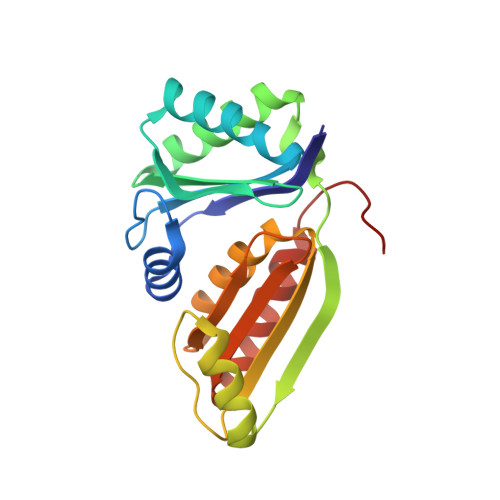
5V76 | pdb_00005v76

Structure of Haliangium ochraceum BMC-T HO-3341


Experimental Data Snapshot

  • Method: X-RAY DIFFRACTION
  • Resolution: 1.55 Å
  • R-Value Free: 
    0.171 (Depositor), 0.173 (DCC) 
  • R-Value Work: 
    0.157 (Depositor), 0.159 (DCC) 
  • R-Value Observed: 
    0.158 (Depositor) 

Starting Model: experimental
View more details

wwPDB Validation 3D Report Full Report

Validation slider image for 5V76

This is version 1.2 of the entry. See complete history

Literature

Assembly principles and structure of a 6.5-MDa bacterial microcompartment shell.

Sutter, M.Greber, B.Aussignargues, C.Kerfeld, C.A.

(2017) Science 356: 1293-1297

  • DOI: https://doi.org/10.1126/science.aan3289
  • Primary Citation Related Structures: 
    5V74, 5V75, 5V76

  • PubMed Abstract: 

    Many bacteria contain primitive organelles composed entirely of protein. These bacterial microcompartments share a common architecture of an enzymatic core encapsulated in a selectively permeable protein shell; prominent examples include the carboxysome for CO 2 fixation and catabolic microcompartments found in many pathogenic microbes. The shell sequesters enzymatic reactions from the cytosol, analogous to the lipid-based membrane of eukaryotic organelles. Despite available structural information for single building blocks, the principles of shell assembly have remained elusive. We present the crystal structure of an intact shell from Haliangium ochraceum , revealing the basic principles of bacterial microcompartment shell construction. Given the conservation among shell proteins of all bacterial microcompartments, these principles apply to functionally diverse organelles and can inform the design and engineering of shells with new functionalities.


  • Organizational Affiliation
    • Michigan State University-U.S. Department of Energy (MSU-DOE) Plant Research Laboratory, Michigan State University, East Lansing, MI 48824, USA.

Macromolecule Content 

  • Total Structure Weight: 43.84 kDa 
  • Atom Count: 3,504 
  • Modeled Residue Count: 412 
  • Deposited Residue Count: 412 
  • Unique protein chains: 1

Macromolecules

Find similar proteins by:|  3D Structure
Entity ID: 1
MoleculeChains  Sequence LengthOrganismDetailsImage
Microcompartments protein
A, B
206Haliangium ochraceum DSM 14365Mutation(s): 0 
Gene Names: Hoch_3341
UniProt
Find proteins for D0LV02 (Haliangium ochraceum (strain DSM 14365 / JCM 11303 / SMP-2))
Explore D0LV02 
Go to UniProtKB:  D0LV02
Entity Groups
Sequence Clusters30% Identity50% Identity70% Identity90% Identity95% Identity100% Identity
UniProt GroupD0LV02
Sequence Annotations
Expand
Reference Sequence

Small Molecules

Ligands 1 Unique
IDChains Name / Formula / InChI Key2D Diagram3D Interactions
GOL

Query on GOL


Download:Ideal Coordinates CCD File
C [auth A]GLYCEROL
C3 H8 O3
PEDCQBHIVMGVHV-UHFFFAOYSA-N

Experimental Data & Validation

Experimental Data

  • Method: X-RAY DIFFRACTION
  • Resolution: 1.55 Å
  • R-Value Free:  0.171 (Depositor), 0.173 (DCC) 
  • R-Value Work:  0.157 (Depositor), 0.159 (DCC) 
  • R-Value Observed: 0.158 (Depositor) 
Space Group: P 21 3
Unit Cell:
Length ( Å )Angle ( ˚ )
a = 110.571α = 90
b = 110.571β = 90
c = 110.571γ = 90
Software Package:
Software NamePurpose
PHENIXrefinement
XDSdata reduction
SCALAdata scaling
PHASERphasing

Structure Validation

View Full Validation Report


Entry History 

Deposition Data

Revision History  (Full details and data files)

  • Version 1.0: 2017-06-21
    Type: Initial release
  • Version 1.1: 2017-07-05
    Changes: Database references
  • Version 1.2: 2023-10-04
    Changes: Data collection, Database references, Refinement description