5UQD | pdb_00005uqd

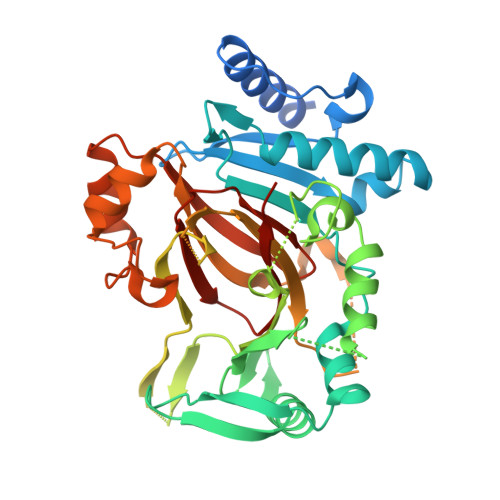
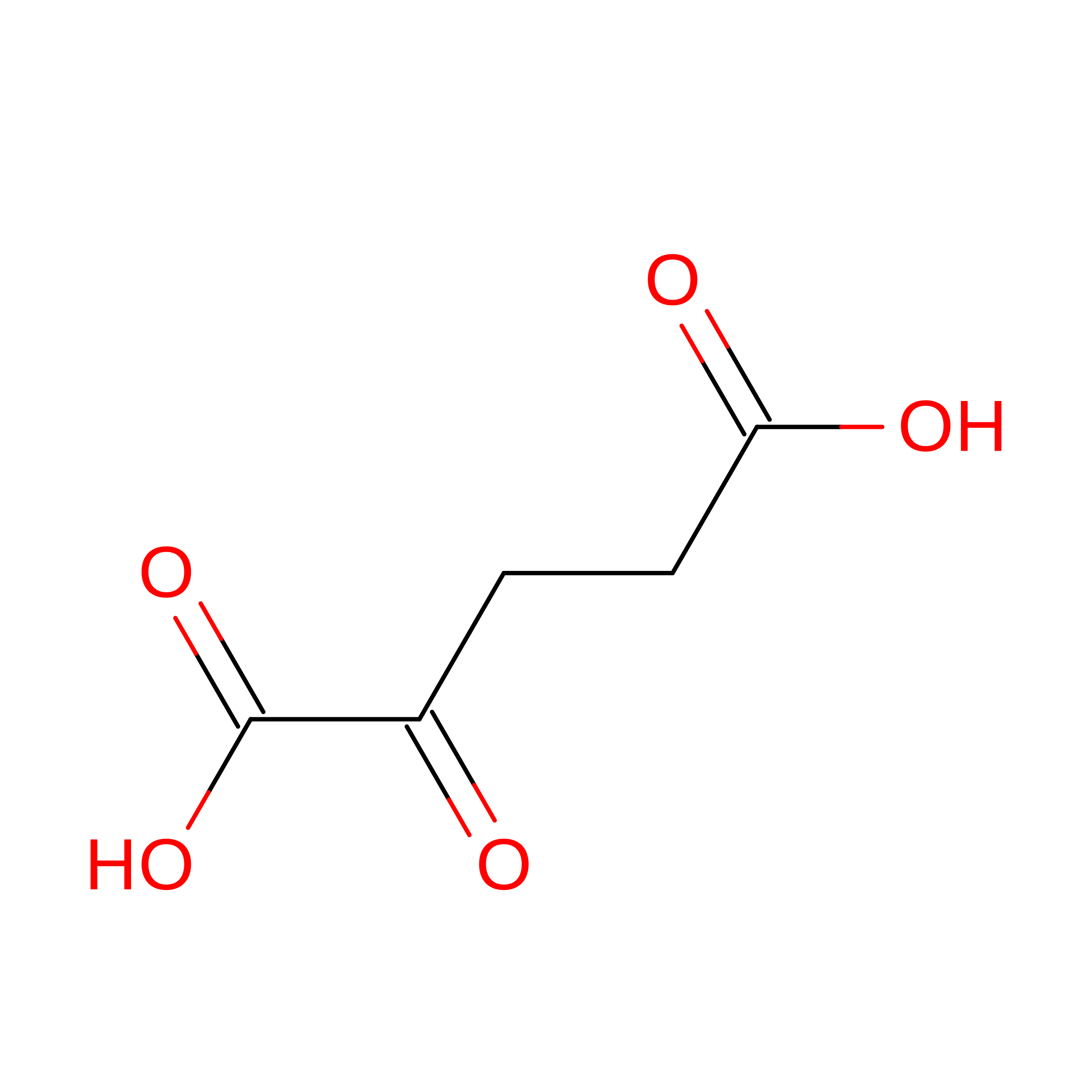
DPY-21 in complex with Fe(II) and alpha-Ketoglutarate


Experimental Data Snapshot

  • Method: X-RAY DIFFRACTION
  • Resolution: 1.80 Å
  • R-Value Free: 
    0.193 (Depositor), 0.194 (DCC) 
  • R-Value Work: 
    0.163 (Depositor), 0.165 (DCC) 
  • R-Value Observed: 
    0.165 (Depositor) 

wwPDB Validation 3D Report Full Report

Validation slider image for 5UQD

This is version 1.7 of the entry. See complete history

Literature

Dynamic Control of X Chromosome Conformation and Repression by a Histone H4K20 Demethylase.

Brejc, K.Bian, Q.Uzawa, S.Wheeler, B.S.Anderson, E.C.King, D.S.Kranzusch, P.J.Preston, C.G.Meyer, B.J.

(2017) Cell 171: 85-102.e23

  • DOI: https://doi.org/10.1016/j.cell.2017.07.041
  • Primary Citation Related Structures: 
    5UQD

  • PubMed Abstract: 

    Chromatin modification and higher-order chromosome structure play key roles in gene regulation, but their functional interplay in controlling gene expression is elusive. We have discovered the machinery and mechanism underlying the dynamic enrichment of histone modification H4K20me1 on hermaphrodite X chromosomes during C. elegans dosage compensation and demonstrated H4K20me1's pivotal role in regulating higher-order chromosome structure and X-chromosome-wide gene expression. The structure and the activity of the dosage compensation complex (DCC) subunit DPY-21 define a Jumonji demethylase subfamily that converts H4K20me2 to H4K20me1 in worms and mammals. Selective inactivation of demethylase activity eliminates H4K20me1 enrichment in somatic cells, elevates X-linked gene expression, reduces X chromosome compaction, and disrupts X chromosome conformation by diminishing the formation of topologically associating domains (TADs). Unexpectedly, DPY-21 also associates with autosomes of germ cells in a DCC-independent manner to enrich H4K20me1 and trigger chromosome compaction. Our findings demonstrate the direct link between chromatin modification and higher-order chromosome structure in long-range regulation of gene expression.


  • Organizational Affiliation
    • Howard Hughes Medical Institute and Department of Molecular and Cell Biology, University of California, Berkeley, Berkeley, CA 94720-3204, USA.

Macromolecule Content 

  • Total Structure Weight: 51.07 kDa 
  • Atom Count: 2,985 
  • Modeled Residue Count: 324 
  • Deposited Residue Count: 442 
  • Unique protein chains: 1

Macromolecules

Find similar proteins by:|  3D Structure
Entity ID: 1
MoleculeChains  Sequence LengthOrganismDetailsImage
DumPY: shorter than wild-type442Caenorhabditis elegansMutation(s): 0 
Gene Names: dpy-21CELE_Y59A8B.1Y59A8B.1
EC: 1.14.11
UniProt
Find proteins for Q9GRZ3 (Caenorhabditis elegans)
Explore Q9GRZ3 
Go to UniProtKB:  Q9GRZ3
Entity Groups
Sequence Clusters30% Identity50% Identity70% Identity90% Identity95% Identity100% Identity
UniProt GroupQ9GRZ3
Sequence Annotations
Expand
Reference Sequence

Experimental Data & Validation

Experimental Data

  • Method: X-RAY DIFFRACTION
  • Resolution: 1.80 Å
  • R-Value Free:  0.193 (Depositor), 0.194 (DCC) 
  • R-Value Work:  0.163 (Depositor), 0.165 (DCC) 
  • R-Value Observed: 0.165 (Depositor) 
Space Group: C 2 2 21
Unit Cell:
Length ( Å )Angle ( ˚ )
a = 87.625α = 90
b = 97.883β = 90
c = 98.838γ = 90
Software Package:
Software NamePurpose
PHENIXrefinement
XDSdata reduction
Aimlessdata scaling
PHENIXphasing

Structure Validation

View Full Validation Report


Entry History 

& Funding Information

Deposition Data


Funding OrganizationLocationGrant Number
National Institutes of Health/National Institute of General Medical Sciences (NIH/NIGMS)United StatesGM030702
National Institutes of Health/National Institute of General Medical Sciences (NIH/NIGMS)United StatesGM100647

Revision History  (Full details and data files)

  • Version 1.0: 2017-09-13
    Type: Initial release
  • Version 1.1: 2017-09-27
    Changes: Author supporting evidence
  • Version 1.2: 2017-10-04
    Changes: Database references
  • Version 1.3: 2017-11-01
    Changes: Author supporting evidence
  • Version 1.4: 2020-01-01
    Changes: Author supporting evidence
  • Version 1.5: 2020-02-26
    Changes: Data collection
  • Version 1.6: 2021-03-17
    Changes: Structure summary
  • Version 1.7: 2024-03-06
    Changes: Data collection, Database references