Download Mendeley
Global analysis of protein folding using massively parallel design, synthesis, and testing.
Rocklin, G.J., Chidyausiku, T.M., Goreshnik, I., Ford, A., Houliston, S., Lemak, A., Carter, L., Ravichandran, R., Mulligan, V.K., Chevalier, A., Arrowsmith, C.H., Baker, D.(2017) Science 357: 168-175
- PubMed: 28706065 Search on PubMedSearch on PubMed Central
- DOI: https://doi.org/10.1126/science.aan0693
- Primary Citation Related Structures:
5UOI, 5UP1, 5UP5, 5UYO - PubMed Abstract:
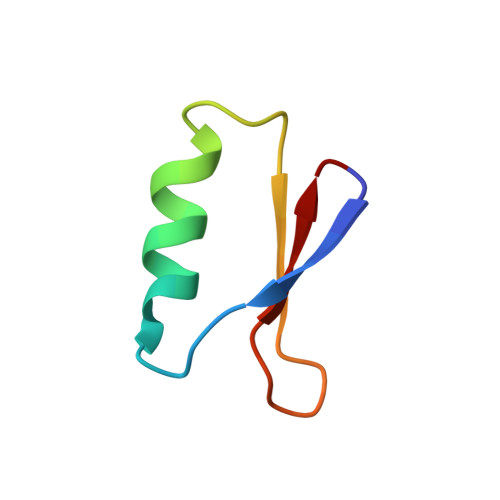
Proteins fold into unique native structures stabilized by thousands of weak interactions that collectively overcome the entropic cost of folding. Although these forces are "encoded" in the thousands of known protein structures, "decoding" them is challenging because of the complexity of natural proteins that have evolved for function, not stability. We combined computational protein design, next-generation gene synthesis, and a high-throughput protease susceptibility assay to measure folding and stability for more than 15,000 de novo designed miniproteins, 1000 natural proteins, 10,000 point mutants, and 30,000 negative control sequences. This analysis identified more than 2500 stable designed proteins in four basic folds-a number sufficient to enable us to systematically examine how sequence determines folding and stability in uncharted protein space. Iteration between design and experiment increased the design success rate from 6% to 47%, produced stable proteins unlike those found in nature for topologies where design was initially unsuccessful, and revealed subtle contributions to stability as designs became increasingly optimized. Our approach achieves the long-standing goal of a tight feedback cycle between computation and experiment and has the potential to transform computational protein design into a data-driven science.
- Department of Biochemistry and Institute for Protein Design, University of Washington, Seattle, WA 98195, USA.
Organizational Affiliation: