5U32 | pdb_00005u32

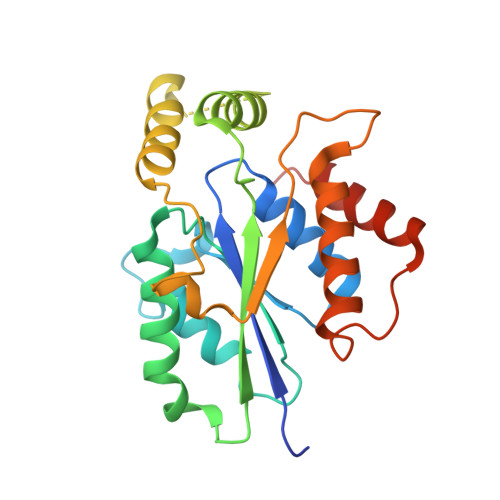
Crystal Structure of Fungal RNA Kinase


Experimental Data Snapshot

  • Method: X-RAY DIFFRACTION
  • Resolution: 2.19 Å
  • R-Value Free: 
    0.246 (Depositor), 0.245 (DCC) 
  • R-Value Work: 
    0.188 (Depositor), 0.189 (DCC) 
  • R-Value Observed: 
    0.193 (Depositor) 

Starting Model: experimental
View more details

wwPDB Validation 3D Report Full Report

Validation slider image for 5U32

Ligand Structure Quality Assessment 


This is version 1.6 of the entry. See complete history

Re-refinement Note

A newer entry is available that reflects an alternative modeling of the original data: 6TZM

Literature

Structural basis for the GTP specificity of the RNA kinase domain of fungal tRNA ligase.

Remus, B.S.Goldgur, Y.Shuman, S.

(2017) Nucleic Acids Res 45: 12945-12953

  • DOI: https://doi.org/10.1093/nar/gkx1159
  • Primary Citation Related Structures: 
    5U32

  • PubMed Abstract: 

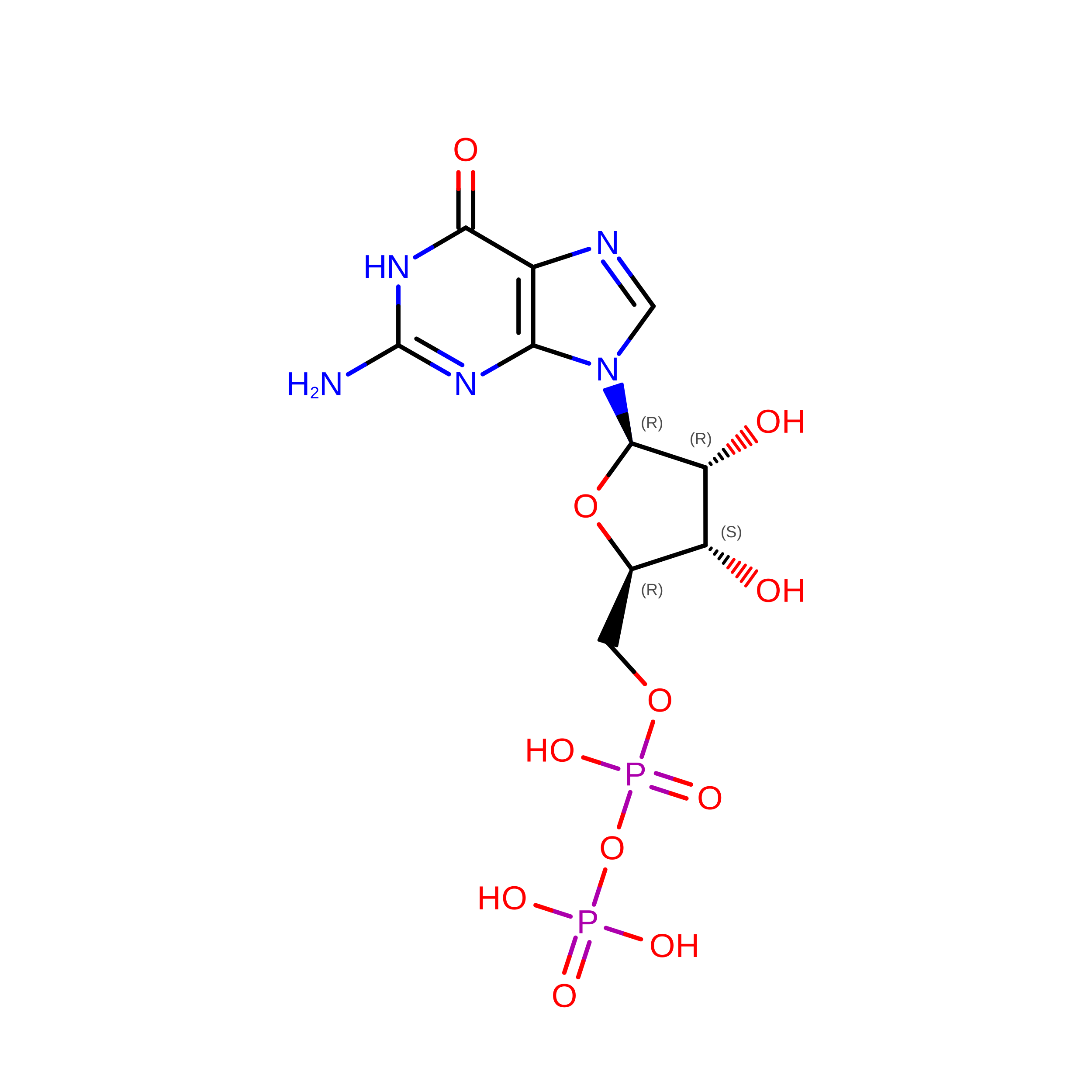
    Fungal tRNA ligase (Trl1) is an essential enzyme that repairs RNA breaks with 2',3'-cyclic-PO4 and 5'-OH ends inflicted during tRNA splicing and non-canonical mRNA splicing in the fungal unfolded protein response. Trl1 is composed of C-terminal cyclic phosphodiesterase and central polynucleotide kinase domains that heal the broken ends to generate the 3'-OH,2'-PO4 and 5'-PO4 termini required for sealing by an N-terminal ligase domain. Trl1 enzymes are found in all human fungal pathogens and are promising targets for antifungal drug discovery because their domain compositions and biochemical mechanisms are unique compared to the mammalian RtcB-type tRNA splicing enzyme. A distinctive feature of Trl1 is its preferential use of GTP as phosphate donor for the RNA kinase reaction. Here we report the 2.2 Å crystal structure of the kinase domain of Trl1 from the fungal pathogen Candida albicans with GDP and Mg2+ in the active site. The P-loop phosphotransferase fold of the kinase is embellished by a unique 'G-loop' element that accounts for guanine nucleotide specificity. Mutations of amino acids that contact the guanine nucleobase efface kinase activity in vitro and Trl1 function in vivo. Our findings fortify the case for the Trl1 kinase as an antifungal target.


  • Organizational Affiliation
    • Molecular Biology Program, Sloan-Kettering Institute, New York, NY 10065, USA.

Macromolecule Content 

  • Total Structure Weight: 27.75 kDa 
  • Atom Count: 1,879 
  • Modeled Residue Count: 213 
  • Deposited Residue Count: 236 
  • Unique protein chains: 1

Macromolecules

Find similar proteins by:|  3D Structure
Entity ID: 1
MoleculeChains  Sequence LengthOrganismDetailsImage
tRNA ligase236Candida albicans SC5314Mutation(s): 0 
Gene Names: LIG1RLG1TRL1CAALFM_C702060WACaJ7.0238CaO19.13864CaO19.6511
EC: 6.5.1.3
UniProt
Find proteins for P43075 (Candida albicans (strain SC5314 / ATCC MYA-2876))
Explore P43075 
Go to UniProtKB:  P43075
Entity Groups
Sequence Clusters30% Identity50% Identity70% Identity90% Identity95% Identity100% Identity
UniProt GroupP43075
Sequence Annotations
Expand
Reference Sequence

Small Molecules

Experimental Data & Validation

Experimental Data

  • Method: X-RAY DIFFRACTION
  • Resolution: 2.19 Å
  • R-Value Free:  0.246 (Depositor), 0.245 (DCC) 
  • R-Value Work:  0.188 (Depositor), 0.189 (DCC) 
  • R-Value Observed: 0.193 (Depositor) 
Space Group: P 21 21 21
Unit Cell:
Length ( Å )Angle ( ˚ )
a = 49.944α = 90
b = 56.304β = 90
c = 82.393γ = 90
Software Package:
Software NamePurpose
PHENIXrefinement
HKL-2000data reduction
HKL-2000data scaling
SHELXCDphasing

Structure Validation

View Full Validation Report


Ligand Structure Quality Assessment 


Entry History 

& Funding Information

Deposition Data


Funding OrganizationLocationGrant Number
National Institutes of Health/National Institute of General Medical Sciences (NIH/NIGMS)United StatesGM42498

Revision History  (Full details and data files)

  • Version 1.0: 2017-11-15
    Type: Initial release
  • Version 1.1: 2017-11-22
    Changes: Database references
  • Version 1.2: 2017-12-13
    Changes: Database references
  • Version 1.3: 2017-12-27
    Changes: Database references
  • Version 1.4: 2020-01-01
    Changes: Author supporting evidence
  • Version 1.5: 2024-03-06
    Changes: Data collection, Database references, Derived calculations
  • Version 1.6: 2024-04-03
    Changes: Refinement description