Download Mendeley
Characterization of Class III Peroxidases from Switchgrass.
Moural, T.W., Lewis, K.M., Barnaba, C., Zhu, F., Palmer, N.A., Sarath, G., Scully, E.D., Jones, J.P., Sattler, S.E., Kang, C.(2017) Plant Physiol 173: 417-433
- PubMed: 27879392 Search on PubMedSearch on PubMed Central
- DOI: https://doi.org/10.1104/pp.16.01426
- Primary Citation Related Structures:
5TWT - PubMed Abstract:
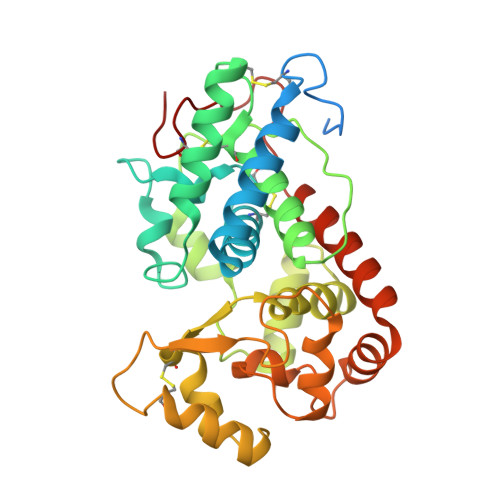
Class III peroxidases (CIIIPRX) catalyze the oxidation of monolignols, generate radicals, and ultimately lead to the formation of lignin. In general, CIIIPRX genes encode a large number of isozymes with ranges of in vitro substrate specificities. In order to elucidate the mode of substrate specificity of these enzymes, we characterized one of the CIIIPRXs (PviPRX9) from switchgrass (Panicum virgatum), a strategic plant for second-generation biofuels. The crystal structure, kinetic experiments, molecular docking, as well as expression patterns of PviPRX9 across multiple tissues and treatments, along with its levels of coexpression with the majority of genes in the monolignol biosynthesis pathway, revealed the function of PviPRX9 in lignification. Significantly, our study suggested that PviPRX9 has the ability to oxidize a broad range of phenylpropanoids with rather similar efficiencies, which reflects its role in the fortification of cell walls during normal growth and root development and in response to insect feeding. Based on the observed interactions of phenylpropanoids in the active site and analysis of kinetics, a catalytic mechanism involving two water molecules and residues histidine-42, arginine-38, and serine-71 was proposed. In addition, proline-138 and gluntamine-140 at the 137 P-X-P-X 140 motif, leucine-66, proline-67, and asparagine-176 may account for the broad substrate specificity of PviPRX9. Taken together, these observations shed new light on the function and catalysis of PviPRX9 and potentially benefit efforts to improve biomass conservation properties in bioenergy and forage crops.
- Department of Chemistry (T.W.M., K.M.L., C.B., J.P.J., C.K.) and Department of Entomology (F.Z.), Washington State University, Pullman, Washington 99164.
Organizational Affiliation: