5OCL | pdb_00005ocl

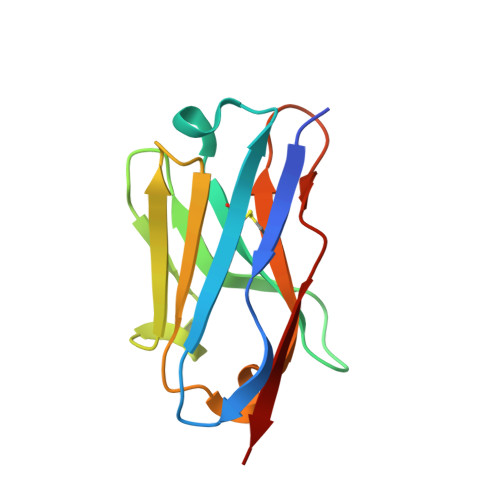
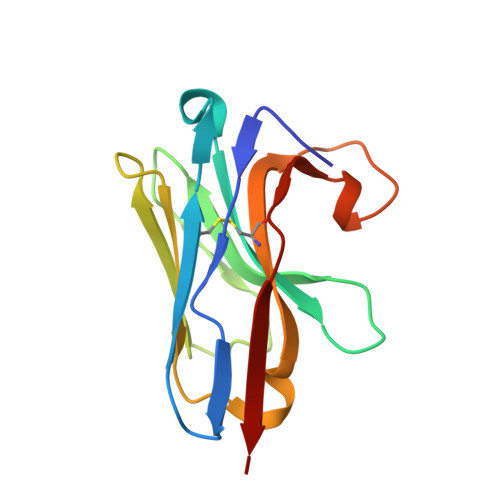
Nanobody-anti-VGLUT nanobody complex


Experimental Data Snapshot

  • Method: X-RAY DIFFRACTION
  • Resolution: 2.20 Å
  • R-Value Free: 
    0.208 (Depositor), 0.211 (DCC) 
  • R-Value Work: 
    0.188 (Depositor), 0.192 (DCC) 
  • R-Value Observed: 
    0.189 (Depositor) 

Starting Model: experimental
View more details

wwPDB Validation 3D Report Full Report

Validation slider image for 5OCL

This is version 1.4 of the entry. See complete history

Literature

Generation and Characterization of Anti-VGLUT Nanobodies Acting as Inhibitors of Transport.

Schenck, S.Kunz, L.Sahlender, D.Pardon, E.Geertsma, E.R.Savtchouk, I.Suzuki, T.Neldner, Y.Stefanic, S.Steyaert, J.Volterra, A.Dutzler, R.

(2017) Biochemistry 56: 3962-3971

  • DOI: https://doi.org/10.1021/acs.biochem.7b00436
  • Primary Citation Related Structures: 
    5OCL

  • PubMed Abstract: 

    The uptake of glutamate by synaptic vesicles is mediated by vesicular glutamate transporters (VGLUTs). The central role of these transporters in excitatory neurotransmission underpins their importance as pharmacological targets. Although several compounds inhibit VGLUTs, highly specific inhibitors were so far unavailable, thus limiting applications to in vitro experiments. Besides their potential in pharmacology, specific inhibitors would also be beneficial for the elucidation of transport mechanisms. To overcome this shortage, we generated nanobodies (Nbs) by immunization of a llama with purified rat VGLUT1 and subsequent selection of binders from a phage display library. All identified Nbs recognize cytosolic epitopes, and two of the binders greatly reduced the rate of uptake of glutamate by reconstituted liposomes and subcellular fractions enriched with synaptic vesicles. These Nbs can be expressed as functional green fluorescent protein fusion proteins in the cytosol of HEK cells for intracellular applications as immunocytochemical and biochemical agents. The selected binders thus provide valuable tools for cell biology and neuroscience.


  • Organizational Affiliation
    • Department of Biochemistry, University of Zurich , Winterthurerstrasse 190, 8057 Zurich, Switzerland.

Macromolecule Content 

  • Total Structure Weight: 106.65 kDa 
  • Atom Count: 7,852 
  • Modeled Residue Count: 959 
  • Deposited Residue Count: 980 
  • Unique protein chains: 2

Macromolecules

Find similar proteins by:|  3D Structure
Entity ID: 1
MoleculeChains  Sequence LengthOrganismDetailsImage
anti-llama nanobody
A, C, F, H
118Vicugna pacosMutation(s): 0 
Find similar proteins by:|  3D Structure
Entity ID: 2
MoleculeChains  Sequence LengthOrganismDetailsImage
anti-vglut nanobody
B, D, E, G
127Lama glamaMutation(s): 0 

Experimental Data & Validation

Experimental Data

  • Method: X-RAY DIFFRACTION
  • Resolution: 2.20 Å
  • R-Value Free:  0.208 (Depositor), 0.211 (DCC) 
  • R-Value Work:  0.188 (Depositor), 0.192 (DCC) 
  • R-Value Observed: 0.189 (Depositor) 
Space Group: P 4 21 2
Unit Cell:
Length ( Å )Angle ( ˚ )
a = 126.295α = 90
b = 126.295β = 90
c = 240.27γ = 90
Software Package:
Software NamePurpose
PHENIXrefinement
XDSdata reduction
XSCALEdata scaling
PHASERphasing

Structure Validation

View Full Validation Report


Entry History 

& Funding Information

Deposition Data


Funding OrganizationLocationGrant Number
SNSFSwitzerlandNCCR TRANSCURE

Revision History  (Full details and data files)

  • Version 1.0: 2017-07-26
    Type: Initial release
  • Version 1.1: 2017-08-02
    Changes: Database references
  • Version 1.2: 2017-08-09
    Changes: Database references
  • Version 1.3: 2024-01-17
    Changes: Data collection, Database references, Refinement description
  • Version 1.4: 2024-10-23
    Changes: Structure summary