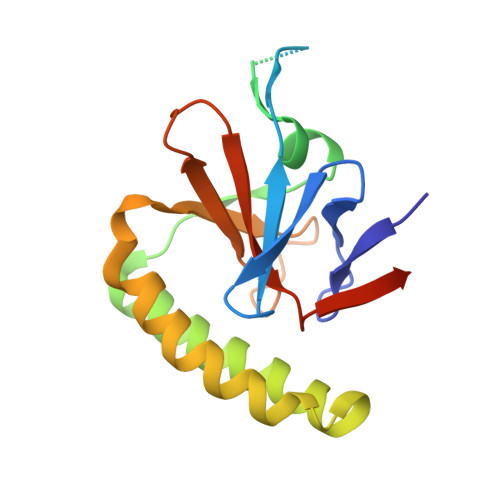
5O9K | pdb_00005o9k

Crystal structure of Murine Histmaine-Releasing Factor (HRF/TCTP)


Experimental Data Snapshot

  • Method: X-RAY DIFFRACTION
  • Resolution: 4.01 Å
  • R-Value Free: 
    0.342 (Depositor), 0.345 (DCC) 
  • R-Value Work: 
    0.300 (Depositor), 0.302 (DCC) 
  • R-Value Observed: 
    0.302 (Depositor) 

Starting Model: experimental
View more details

wwPDB Validation 3D Report Full Report

Validation slider image for 5O9K

This is version 1.2 of the entry. See complete history

Literature

Crystal structures of murine and human Histamine-Releasing Factor (HRF/TCTP) and a model for HRF dimerisation in mast cell activation.

Dore, K.A.Kashiwakura, J.I.McDonnell, J.M.Gould, H.J.Kawakami, T.Sutton, B.J.Davies, A.M.

(2017) Mol Immunol 93: 216-222

  • DOI: https://doi.org/10.1016/j.molimm.2017.11.022
  • Primary Citation Related Structures: 
    5O9K, 5O9L, 5O9M

  • PubMed Abstract: 

    In allergic disease, mast cell activation is conventionally triggered by allergen-mediated cross-linking of receptor-bound IgE on the cell surface. In addition to its diverse range of intracellular roles in apoptosis, cell proliferation and cancer, Histamine-Releasing Factor (HRF) also activates mast cells and basophils. A subset of IgE antibodies bind HRF through their Fab regions, and two IgE binding sites on HRF have been mapped. HRF can form dimers, and a disulphide-linked dimer is critical for activity. The current model for the activity of HRF in mast cell activation involves cross-linking of receptor-bound IgE by dimeric HRF, mediated by HRF/Fab interactions. HRF crystal and solution structures have provided little insight into either the formation of disulphide-linked HRF dimers or the ability of HRF to activate mast cells. We report the first crystal structure of murine HRF (mHRF) to 4.0Å resolution, revealing a conserved fold. We also solved the structure of human HRF (hHRF) in two new crystal forms, one at the highest resolution (1.4Å) yet reported. The high resolution hHRF structure reveals a disulphide-linked dimer, in which the two molecules are closely associated, and provides a model for the role of both human and murine HRF in mast cell activation.


  • Organizational Affiliation
    • King's College London, Randall Centre for Cell and Molecular Biophysics, New Hunt's House, London, SE1 1UL, United Kingdom; Medical Research Council & Asthma UK Centre in Allergic Mechanisms of Asthma, London, United Kingdom.

Macromolecule Content 

  • Total Structure Weight: 41.2 kDa 
  • Atom Count: 2,165 
  • Modeled Residue Count: 286 
  • Deposited Residue Count: 360 
  • Unique protein chains: 1

Macromolecules

Find similar proteins by:|  3D Structure
Entity ID: 1
MoleculeChains  Sequence LengthOrganismDetailsImage
Translationally-controlled tumor protein
A, B
180Mus musculusMutation(s): 0 
Gene Names: Tpt1Trt
UniProt
Find proteins for P63028 (Mus musculus)
Explore P63028 
Go to UniProtKB:  P63028
Entity Groups
Sequence Clusters30% Identity50% Identity70% Identity90% Identity95% Identity100% Identity
UniProt GroupP63028
Sequence Annotations
Expand
Reference Sequence

Small Molecules

Ligands 1 Unique
IDChains Name / Formula / InChI Key2D Diagram3D Interactions
GOL

Query on GOL


Download:Ideal Coordinates CCD File
C [auth B]GLYCEROL
C3 H8 O3
PEDCQBHIVMGVHV-UHFFFAOYSA-N

Experimental Data & Validation

Experimental Data

  • Method: X-RAY DIFFRACTION
  • Resolution: 4.01 Å
  • R-Value Free:  0.342 (Depositor), 0.345 (DCC) 
  • R-Value Work:  0.300 (Depositor), 0.302 (DCC) 
  • R-Value Observed: 0.302 (Depositor) 
Space Group: P 21 21 2
Unit Cell:
Length ( Å )Angle ( ˚ )
a = 69.53α = 90
b = 99.85β = 90
c = 57.47γ = 90
Software Package:
Software NamePurpose
PHENIXrefinement
DIALSdata reduction
Aimlessdata scaling
PHASERphasing

Structure Validation

View Full Validation Report


Entry History 

& Funding Information

Deposition Data


Funding OrganizationLocationGrant Number
Medical Research Council (United Kingdom)United KingdomG1100090

Revision History  (Full details and data files)

  • Version 1.0: 2017-12-20
    Type: Initial release
  • Version 1.1: 2024-01-17
    Changes: Data collection, Database references, Refinement description
  • Version 1.2: 2026-02-11
    Changes: Data collection, Structure summary