5NIY | pdb_00005niy

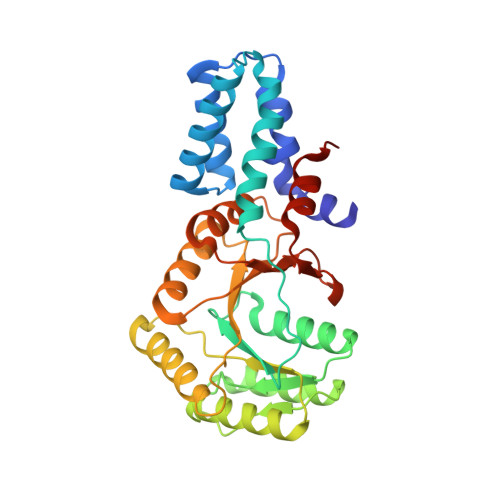
Signal recognition particle-docking protein FtsY


Experimental Data Snapshot

  • Method: X-RAY DIFFRACTION
  • Resolution: 1.70 Å
  • R-Value Free: 
    0.195 (Depositor), 0.197 (DCC) 
  • R-Value Work: 
    0.167 (Depositor), 0.170 (DCC) 
  • R-Value Observed: 
    0.168 (Depositor) 

Starting Model: experimental
View more details

wwPDB Validation 3D Report Full Report

Validation slider image for 5NIY

Ligand Structure Quality Assessment 


This is version 1.2 of the entry. See complete history

Literature

The Escherichia coli SRP Receptor Forms a Homodimer at the Membrane.

Kempf, G.Stjepanovic, G.Sloan, J.Hendricks, A.Lapouge, K.Sinning, I.

(2018) Structure 26: 1440-1450.e5

  • DOI: https://doi.org/10.1016/j.str.2018.07.008
  • Primary Citation Related Structures: 
    5NIY

  • PubMed Abstract: 

    The Escherichia coli signal recognition particle (SRP) receptor, FtsY, plays a fundamental role in co-translational targeting of membrane proteins via the SRP pathway. Efficient targeting relies on membrane interaction of FtsY and heterodimerization with the SRP protein Ffh, which is driven by detachment of α helix (αN1) in FtsY. Here we show that apart from the heterodimer, FtsY forms a nucleotide-dependent homodimer on the membrane, and upon αN1 removal also in solution. Homodimerization triggers reciprocal stimulation of GTP hydrolysis and occurs in vivo. Biochemical characterization together with integrative modeling suggests that the homodimer employs the same interface as the heterodimer. Structure determination of FtsY NG+1 with GMPPNP shows that a dimerization-induced conformational switch of the γ-phosphate is conserved in Escherichia coli, filling an important gap in SRP GTPase activation. Our findings add to the current understanding of SRP GTPases and may challenge previous studies that did not consider homodimerization of FtsY.


  • Organizational Affiliation
    • Heidelberg University Biochemistry Centre, Heidelberg 69120, Germany.

Macromolecule Content 

  • Total Structure Weight: 34.53 kDa 
  • Atom Count: 2,650 
  • Modeled Residue Count: 300 
  • Deposited Residue Count: 309 
  • Unique protein chains: 1

Macromolecules

Find similar proteins by:|  3D Structure
Entity ID: 1
MoleculeChains  Sequence LengthOrganismDetailsImage
Signal recognition particle-docking protein FtsY309Escherichia coliMutation(s): 0 
Gene Names: BK350_09725BK355_12030BK400_00245
EC: 3.6.5.4
UniProt
Find proteins for P10121 (Escherichia coli (strain K12))
Explore P10121 
Go to UniProtKB:  P10121
Entity Groups
Sequence Clusters30% Identity50% Identity70% Identity90% Identity95% Identity100% Identity
UniProt GroupP10121
Sequence Annotations
Expand
Reference Sequence

Small Molecules

Ligands 1 Unique
IDChains Name / Formula / InChI Key2D Diagram3D Interactions
GNP

Query on GNP


Download:Ideal Coordinates CCD File
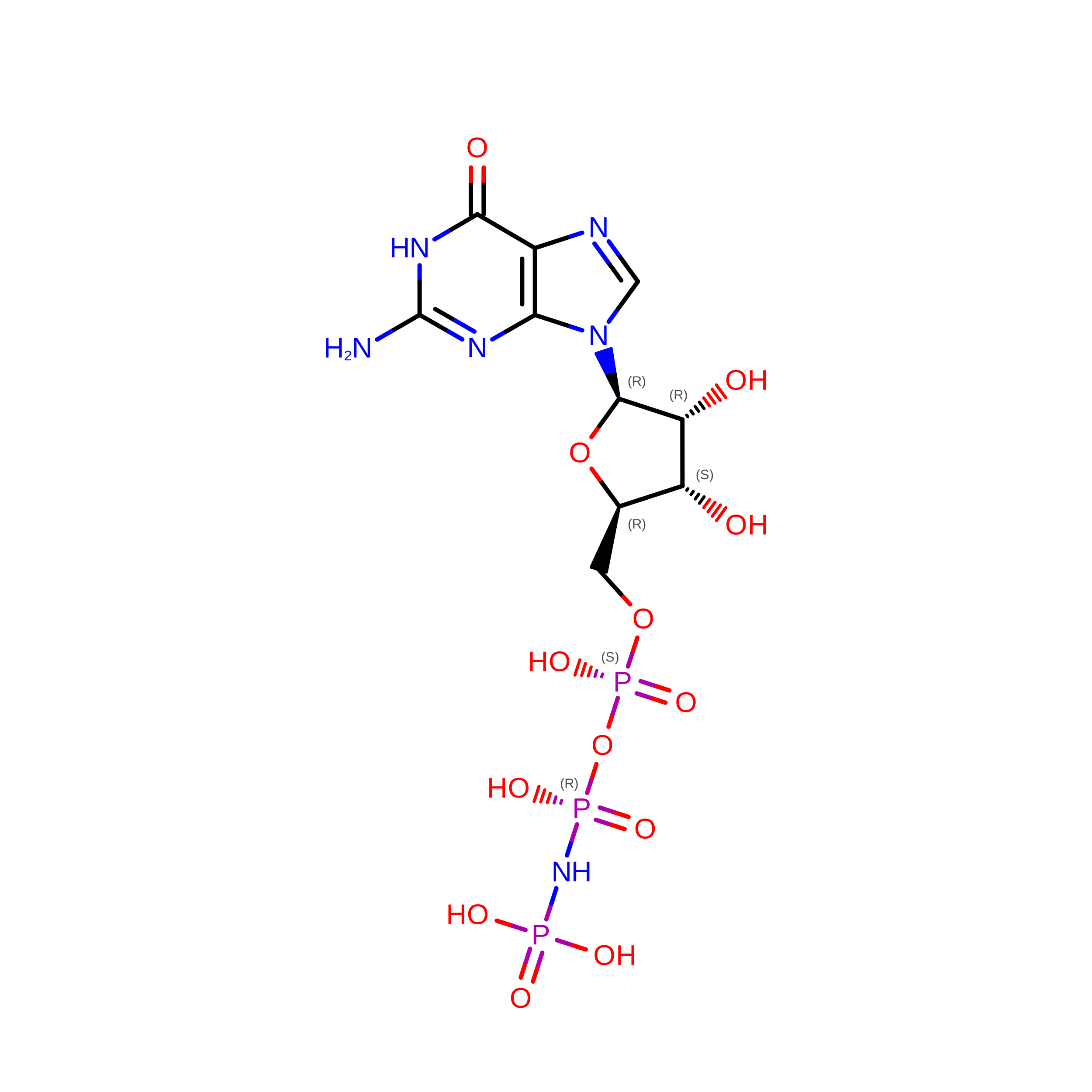
B [auth A]PHOSPHOAMINOPHOSPHONIC ACID-GUANYLATE ESTER
C10 H17 N6 O13 P3
UQABYHGXWYXDTK-UUOKFMHZSA-N

Experimental Data & Validation

Experimental Data

  • Method: X-RAY DIFFRACTION
  • Resolution: 1.70 Å
  • R-Value Free:  0.195 (Depositor), 0.197 (DCC) 
  • R-Value Work:  0.167 (Depositor), 0.170 (DCC) 
  • R-Value Observed: 0.168 (Depositor) 
Space Group: P 1 21 1
Unit Cell:
Length ( Å )Angle ( ˚ )
a = 32.73α = 90
b = 80.64β = 95.23
c = 59.307γ = 90
Software Package:
Software NamePurpose
PHENIXrefinement
XDSdata reduction
Aimlessdata scaling
PHASERphasing

Structure Validation

View Full Validation Report


Ligand Structure Quality Assessment 


Entry History 

& Funding Information

Deposition Data


Funding OrganizationLocationGrant Number
German Research FoundationGermanySFB TRR83
German Research FoundationGermanyLeibniz Programm
German Research FoundationGermanyBZH/Cluster of Excellence:CellNetworks

Revision History  (Full details and data files)

  • Version 1.0: 2018-10-10
    Type: Initial release
  • Version 1.1: 2018-11-14
    Changes: Data collection, Database references, Structure summary
  • Version 1.2: 2024-01-17
    Changes: Data collection, Database references, Refinement description