5NGN | pdb_00005ngn

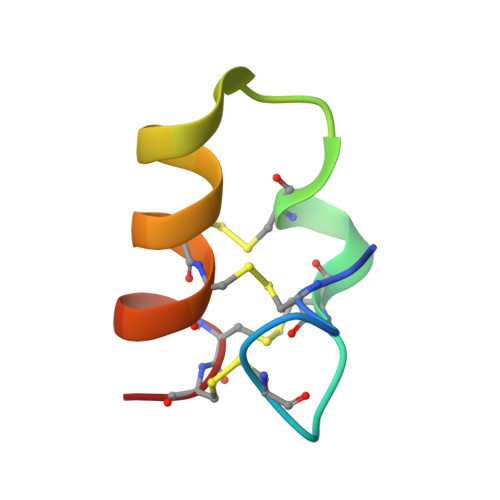
Lybatide 2, a cystine-rich peptide from Lycium barbarum

  • Classification: PLANT PROTEIN
  • Organism(s): Lycium barbarum
  • Mutation(s): No 

  • Deposited: 2017-03-18 Released: 2017-07-26 
  • Deposition Author(s): Lei, J., Tan, W.L., Sakai, N., Hilgenfeld, R.
  • Funding Organization(s): German Federal Ministry of Education and Research, National Research Foundation in Singapore, NTU iFood Research Grant, NTU

Experimental Data Snapshot

  • Method: X-RAY DIFFRACTION
  • Resolution: 1.48 Å
  • R-Value Free: 
    0.137 (Depositor), 0.136 (DCC) 
  • R-Value Work: 
    0.108 (Depositor), 0.108 (DCC) 
  • R-Value Observed: 
    0.109 (Depositor) 

wwPDB Validation 3D Report Full Report

Validation slider image for 5NGN

This is version 1.2 of the entry. See complete history

Literature

Lybatides from Lycium barbarum Contain An Unusual Cystine-stapled Helical Peptide Scaffold.

Tan, W.L.Wong, K.H.Lei, J.Sakai, N.Tan, H.W.Hilgenfeld, R.Tam, J.P.

(2017) Sci Rep 7: 5194-5194

  • DOI: https://doi.org/10.1038/s41598-017-05037-1
  • Primary Citation Related Structures: 
    5NGN

  • PubMed Abstract: 

    Cysteine-rich peptides (CRPs) of 2-6 kDa are generally thermally and proteolytically stable because of their multiple cross-bracing disulfide bonds. Here, we report the discovery and characterization of two novel cystine-stapled CRPs, designated lybatide 1 and 2 (lyba1 and lyba2), from the cortex of Lycium barbarum root. Lybatides, 32 to 33 amino acids in length, are hyperstable and display a novel disulfide connectivity with a cysteine motif of C-C-C-C-CC-CC which contains two pairs of adjacent cysteines (-CC-CC). X-ray structure analysis revealed the presence of a single cystine-stabilized (α + π)-helix in lyba2, a rare feature of CRPs. Together, our results suggest that lybatides, one of the smallest four-disulfide-constrained plant CRPs, is a new family of CRPs. Additionally, this study provides new insights into the molecular diversity of plant cysteine-rich peptides and the unusual lybatide scaffold could be developed as a useful template for peptide engineering and therapeutic development.


  • Organizational Affiliation
    • School of Biological Sciences, Nanyang Technological University, Singapore, Singapore.

Macromolecule Content 

  • Total Structure Weight: 11.33 kDa 
  • Atom Count: 917 
  • Modeled Residue Count: 98 
  • Deposited Residue Count: 99 
  • Unique protein chains: 1

Macromolecules

Find similar proteins by:|  3D Structure
Entity ID: 1
MoleculeChains  Sequence LengthOrganismDetailsImage
lybatide 2
A, B, C
33Lycium barbarumMutation(s): 0 
UniProt
Find proteins for A0A2D0TC93 (Lycium barbarum)
Explore A0A2D0TC93 
Go to UniProtKB:  A0A2D0TC93
Entity Groups
Sequence Clusters30% Identity50% Identity70% Identity90% Identity95% Identity100% Identity
UniProt GroupA0A2D0TC93
Sequence Annotations
Expand
Reference Sequence

Experimental Data & Validation

Experimental Data

  • Method: X-RAY DIFFRACTION
  • Resolution: 1.48 Å
  • R-Value Free:  0.137 (Depositor), 0.136 (DCC) 
  • R-Value Work:  0.108 (Depositor), 0.108 (DCC) 
  • R-Value Observed: 0.109 (Depositor) 
Space Group: P 1 21 1
Unit Cell:
Length ( Å )Angle ( ˚ )
a = 19.318α = 90
b = 54.655β = 100.6
c = 42.4γ = 90
Software Package:
Software NamePurpose
REFMACrefinement
XDSdata reduction
XDSdata scaling
SHELXDEphasing

Structure Validation

View Full Validation Report


Entry History 

& Funding Information

Deposition Data


Funding OrganizationLocationGrant Number
German Federal Ministry of Education and ResearchGermanyBMBF- 01DP12027
National Research Foundation in SingaporeSingaporeNRF-CRP8-2011-05
NTU iFood Research GrantSingaporeM4081467.080
NTUSingaporeSGP-PROG-008

Revision History  (Full details and data files)

  • Version 1.0: 2017-07-26
    Type: Initial release
  • Version 1.1: 2018-04-11
    Changes: Data collection
  • Version 1.2: 2024-10-16
    Changes: Data collection, Database references, Structure summary