5NE3 | pdb_00005ne3

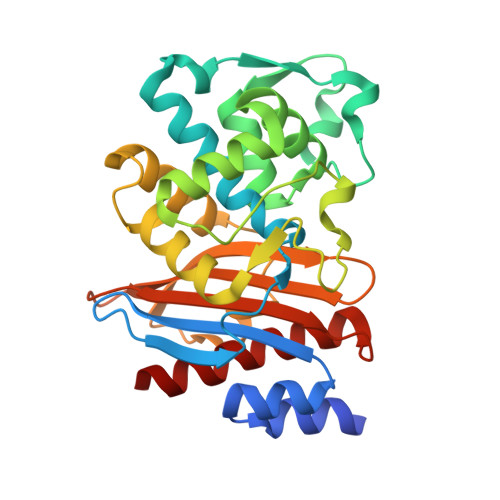
L2 class A serine-beta-lactamase complexed with avibactam


Experimental Data Snapshot

  • Method: X-RAY DIFFRACTION
  • Resolution: 1.35 Å
  • R-Value Free: 
    0.178 (Depositor), 0.180 (DCC) 
  • R-Value Work: 
    0.162 (Depositor), 0.164 (DCC) 
  • R-Value Observed: 
    0.163 (Depositor) 

Starting Model: experimental
View more details

wwPDB Validation 3D Report Full Report

Validation slider image for 5NE3

Ligand Structure Quality Assessment 


This is version 2.3 of the entry. See complete history

Literature

Structural/mechanistic insights into the efficacy of nonclassical beta-lactamase inhibitors against extensively drug resistant Stenotrophomonas maltophilia clinical isolates.

Calvopina, K.Hinchliffe, P.Brem, J.Heesom, K.J.Johnson, S.Cain, R.Lohans, C.T.Fishwick, C.W.G.Schofield, C.J.Spencer, J.Avison, M.B.

(2017) Mol Microbiol 106: 492-504

  • DOI: https://doi.org/10.1111/mmi.13831
  • Primary Citation Related Structures: 
    5NE1, 5NE2, 5NE3

  • PubMed Abstract: 

    Clavulanic acid and avibactam are clinically deployed serine β-lactamase inhibitors, important as a defence against antibacterial resistance. Bicyclic boronates are recently discovered inhibitors of serine and some metallo β-lactamases. Here, we show that avibactam and a bicyclic boronate inhibit L2 (serine β-lactamase) but not L1 (metallo β-lactamase) from the extensively drug resistant human pathogen Stenotrophomonas maltophilia. X-ray crystallography revealed that both inhibitors bind L2 by covalent attachment to the nucleophilic serine. Both inhibitors reverse ceftazidime resistance in S. maltophilia because, unlike clavulanic acid, they do not induce L1 production. Ceftazidime/inhibitor resistant mutants hyperproduce L1, but retain aztreonam/inhibitor susceptibility because aztreonam is not an L1 substrate. Importantly, avibactam, but not the bicyclic boronate is deactivated by L1 at a low rate; the utility of avibactam might be compromised by mutations that increase this deactivation rate. These data rationalize the observed clinical efficacy of ceftazidime/avibactam plus aztreonam as combination therapy for S. maltophilia infections and confirm that aztreonam-like β-lactams plus nonclassical β-lactamase inhibitors, particularly avibactam-like and bicyclic boronate compounds, have potential for treating infections caused by this most intractable of drug resistant pathogens.


  • Organizational Affiliation
    • School of Cellular & Molecular Medicine, University of Bristol, Bristol, UK.

Macromolecule Content 

  • Total Structure Weight: 59.17 kDa 
  • Atom Count: 4,714 
  • Modeled Residue Count: 538 
  • Deposited Residue Count: 556 
  • Unique protein chains: 1

Macromolecules

Find similar proteins by:|  3D Structure
Entity ID: 1
MoleculeChains  Sequence LengthOrganismDetailsImage
Beta-lactamase
A, B
278Stenotrophomonas maltophilia K279aMutation(s): 0 
Gene Names: Smlt3722
EC: 3.5.2.6
UniProt
Find proteins for B2FRP5 (Stenotrophomonas maltophilia (strain K279a))
Explore B2FRP5 
Go to UniProtKB:  B2FRP5
Entity Groups
Sequence Clusters30% Identity50% Identity70% Identity90% Identity95% Identity100% Identity
UniProt GroupB2FRP5
Sequence Annotations
Expand
Reference Sequence

Small Molecules

Ligands 1 Unique
IDChains Name / Formula / InChI Key2D Diagram3D Interactions
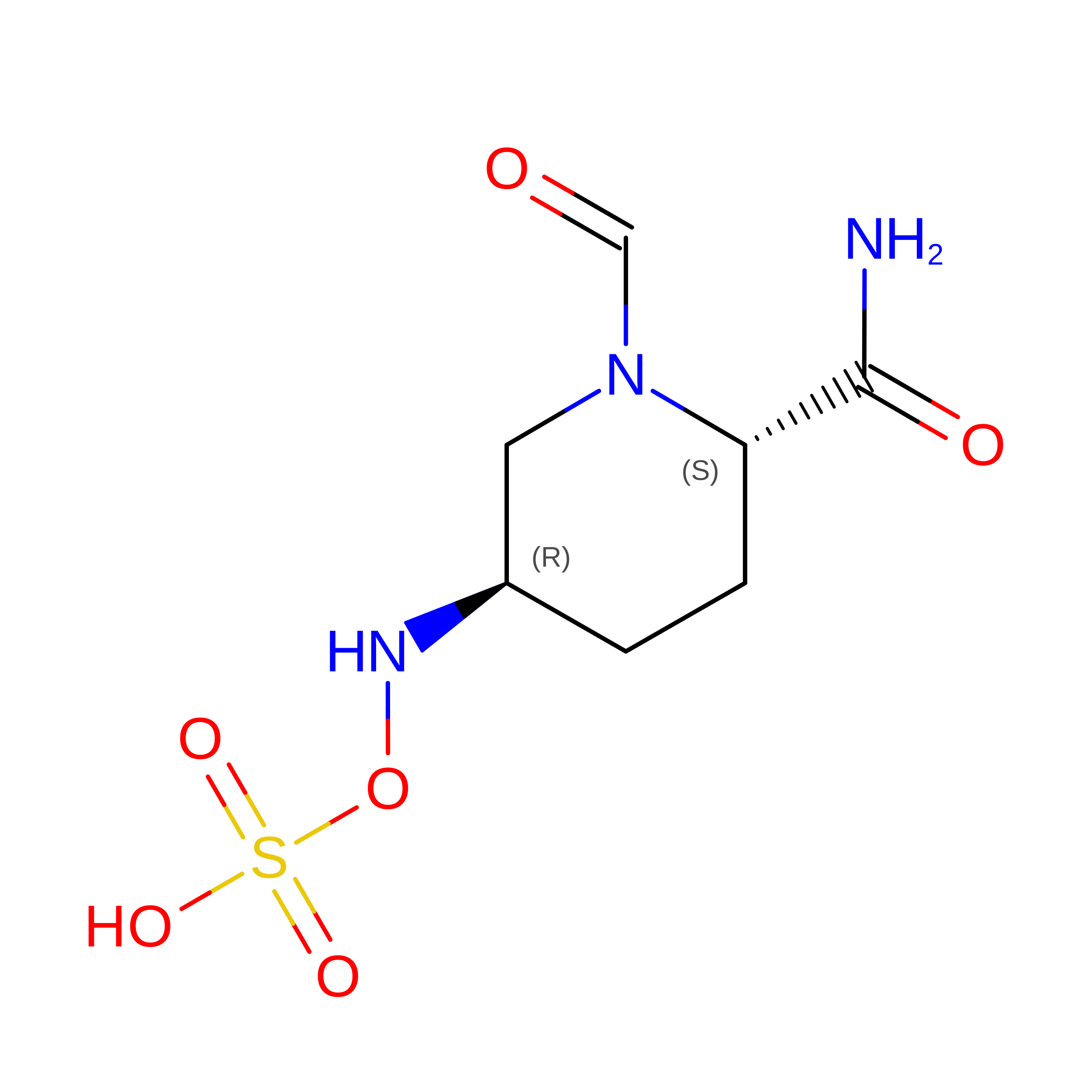
NXL

Query on NXL


Download:Ideal Coordinates CCD File
C [auth A],
D [auth B]
(2S,5R)-1-formyl-5-[(sulfooxy)amino]piperidine-2-carboxamide
C7 H13 N3 O6 S
WJDGWXPPFHLLNL-RITPCOANSA-N

Experimental Data & Validation

Experimental Data

  • Method: X-RAY DIFFRACTION
  • Resolution: 1.35 Å
  • R-Value Free:  0.178 (Depositor), 0.180 (DCC) 
  • R-Value Work:  0.162 (Depositor), 0.164 (DCC) 
  • R-Value Observed: 0.163 (Depositor) 
Space Group: P 21 21 21
Unit Cell:
Length ( Å )Angle ( ˚ )
a = 69.492α = 90
b = 84.305β = 90
c = 93.668γ = 90
Software Package:
Software NamePurpose
PHENIXrefinement
DIALSdata reduction
Aimlessdata scaling
PHASERphasing

Structure Validation

View Full Validation Report


Ligand Structure Quality Assessment 


Entry History 

Deposition Data

Revision History  (Full details and data files)

  • Version 1.0: 2017-09-13
    Type: Initial release
  • Version 2.0: 2017-09-20
    Changes: Advisory, Atomic model, Database references
  • Version 2.1: 2017-11-01
    Changes: Database references
  • Version 2.2: 2024-01-17
    Changes: Data collection, Database references, Refinement description, Structure summary
  • Version 2.3: 2024-11-13
    Changes: Structure summary