5NBW | pdb_00005nbw

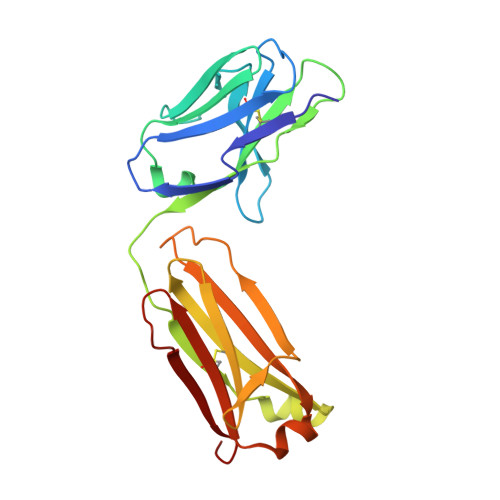
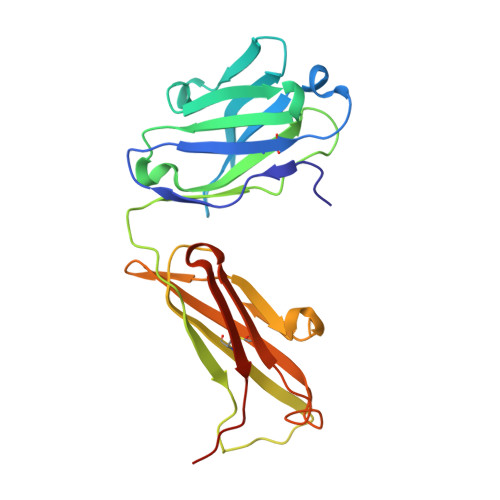
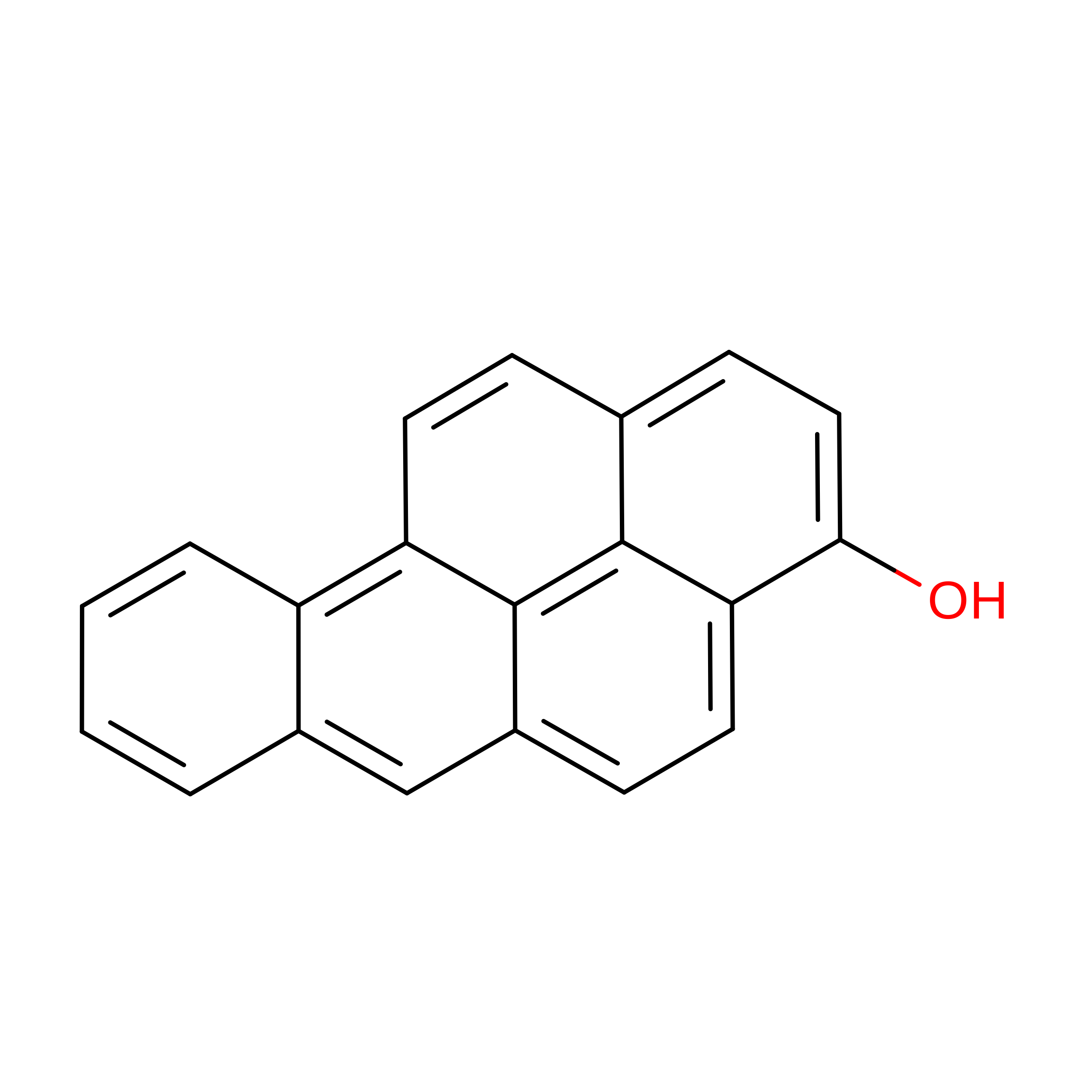
Crystal structure of the Fab fragment 22F12 in complex with 3-hydroxybenzo[a]pyrene


Experimental Data Snapshot

  • Method: X-RAY DIFFRACTION
  • Resolution: 2.40 Å
  • R-Value Free: 
    0.228 (Depositor), 0.230 (DCC) 
  • R-Value Work: 
    0.180 (Depositor), 0.185 (DCC) 
  • R-Value Observed: 
    0.183 (Depositor) 

Starting Model: experimental
View more details

wwPDB Validation 3D Report Full Report

Validation slider image for 5NBW

Ligand Structure Quality Assessment 


This is version 1.3 of the entry. See complete history

Literature

Tight Molecular Recognition of Benzo[a]pyrene by a High-Affinity Antibody.

Eichinger, A.Neumaier, I.Pschenitza, M.Niessner, R.Knopp, D.Skerra, A.

(2017) Angew Chem Int Ed Engl 56: 10592-10597

  • DOI: https://doi.org/10.1002/anie.201703893
  • Primary Citation Related Structures: 
    5NBW

  • PubMed Abstract: 

    Benzo[a]pyrene, which is produced during the incomplete combustion of organic material, is an abundant noxious pollutant because of its carcinogenic metabolic degradation products. The high-affinity (K D ≈3 nm) monoclonal antibody 22F12 allows facile bioanalytical quantification of benzo[a]pyrene even in complex matrices. We report the functional and X-ray crystallographic analysis of 22F12 in complex with 3-hydroxybenzo[a]pyrene after cloning of the V-genes and production as a recombinant Fab fragment. The polycyclic aromatic hydrocarbon is bound in a deep pocket between the light and heavy chains, surrounded mainly by aromatic and aliphatic amino acid side chains. Interestingly, the hapten-antibody interface is less densely packed than expected and reveals polar, H-bond-like interactions with the polycyclic aromatic π-electron system, which may allow the antibody to maintain a large, predominantly hydrophobic binding site in an aqueous environment while providing sufficient complementarity to its ligand.


  • Organizational Affiliation
    • Munich Center for Integrated Protein Science, CIPS-M, und Lehrstuhl für Biologische Chemie, Technische Universität München, 85354, Freising, Weihenstephan, Germany.

Macromolecule Content 

  • Total Structure Weight: 96.61 kDa 
  • Atom Count: 6,920 
  • Modeled Residue Count: 860 
  • Deposited Residue Count: 872 
  • Unique protein chains: 2

Macromolecules

Find similar proteins by:|  3D Structure
Entity ID: 1
MoleculeChains  Sequence LengthOrganismDetailsImage
Fab 22F12 (L,H)A [auth L],
C [auth A]
214Mus musculusMutation(s): 0 
Find similar proteins by:|  3D Structure
Entity ID: 2
MoleculeChains  Sequence LengthOrganismDetailsImage
Fab 22F12 (A,B)B [auth H],
D [auth B]
222Mus musculusMutation(s): 0 

Experimental Data & Validation

Experimental Data

  • Method: X-RAY DIFFRACTION
  • Resolution: 2.40 Å
  • R-Value Free:  0.228 (Depositor), 0.230 (DCC) 
  • R-Value Work:  0.180 (Depositor), 0.185 (DCC) 
  • R-Value Observed: 0.183 (Depositor) 
Space Group: P 21 21 21
Unit Cell:
Length ( Å )Angle ( ˚ )
a = 58.15α = 90
b = 81β = 90
c = 186.16γ = 90
Software Package:
Software NamePurpose
REFMACrefinement
MOSFLMdata reduction
SCALAdata scaling
PHASERphasing

Structure Validation

View Full Validation Report


Ligand Structure Quality Assessment 


Entry History 

Deposition Data

Revision History  (Full details and data files)

  • Version 1.0: 2017-06-28
    Type: Initial release
  • Version 1.1: 2017-08-30
    Changes: Database references
  • Version 1.2: 2024-01-17
    Changes: Data collection, Database references, Refinement description
  • Version 1.3: 2024-10-23
    Changes: Structure summary